










Tega targets Molycop 100-basis-point margin expansion
Key highlights
- Tega intends to raise Molycop’s Q2 EBITDA margin of 14% by 100 basis points in the coming year.
- Tega’s US$2 crore cost-optimisation programme has a two-to-2.5-year delivery period and excludes cross-selling.
- A 500-tonne grinding-media trial could scale to 20,000 to 30,000 tonnes if it converts.
- Tega maintained 5% Molycop volume-growth guidance while Grasberg and Cobre Panamá continue ramping up.
powered by IRIS
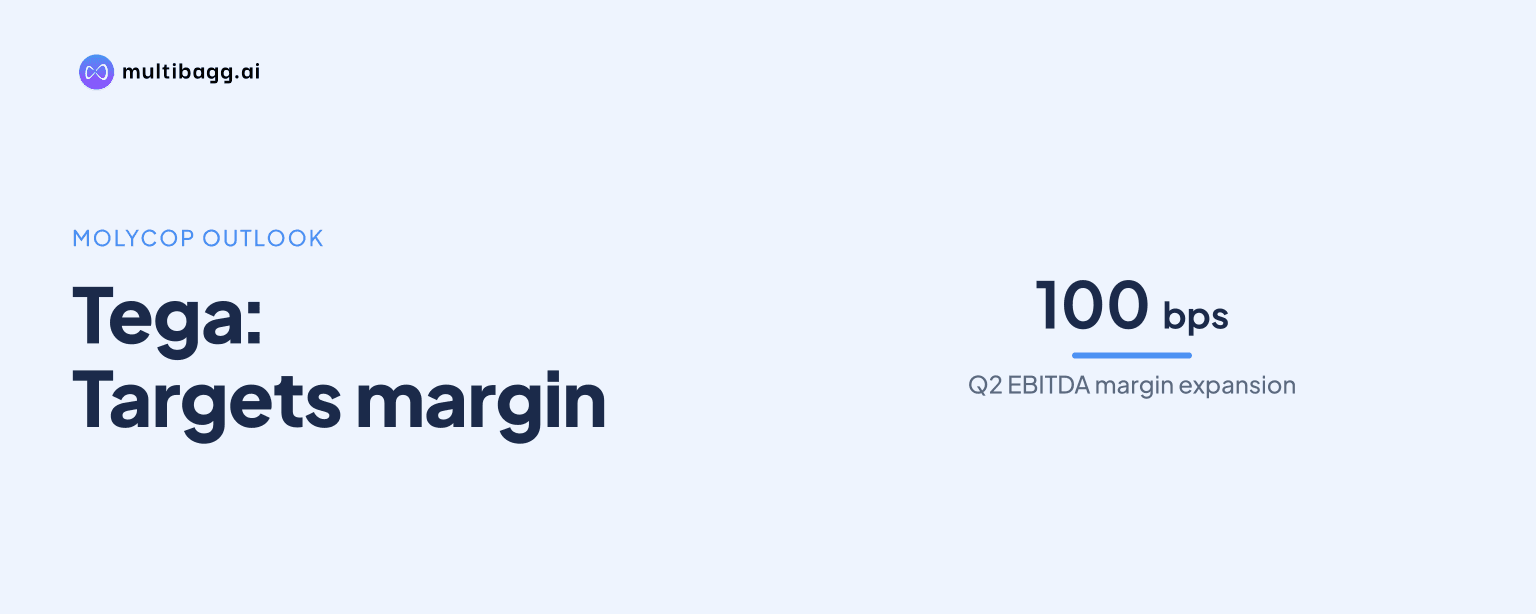
Tega Industries intends to lift Molycop’s 14% EBITDA margin reported in Q2 by 100 basis points in the coming year, using a global capability centre, lower-cost headquarters, lower selling, general and administrative expenses, and improved operating yield. Management said cross-selling is additional to its US$2 crore cost-optimisation programme.
Know Tega Industries inside out
Results, valuation, peers and who's buying, in one view.
How will Tega expand Molycop’s margin?
Tega intends to increase Molycop’s Q2 EBITDA, or earnings before interest, tax, depreciation and amortisation, margin of 14% by 100 basis points in the coming year. Management identified four levers: establishing a global capability centre, or GCC; relocating headquarters to a lower-cost base; reducing selling, general and administrative, or SG&A, expenses; and actively tracking operating efficiencies to improve yield.
The GCC, headquarters relocation and SG&A measures are intended to lower the fixed-cost burden, while yield initiatives address operating execution. Management did not provide individual savings estimates, implementation milestones or a quarterly timetable for the four actions. Its stated margin objective therefore gives a direction and scale for improvement, but not a disclosed breakdown of how much each measure will contribute.
The 100-basis-point objective is more specific than management’s earlier near-term view that Molycop’s percentage margin would be relatively flat as volumes increase. Management said it monitors Molycop profitability chiefly through EBITDA per tonne because steel-price fluctuations can affect margin as a percentage of sales. Molycop averaged about US$155 per tonne in the prior year, providing the unit-economics measure management uses alongside the 14% Q2 percentage margin.
Is Tega’s US$2 crore cost programme separate from cross-selling?
Yes, Tega said its US$2 crore target is a cost-optimisation programme to be delivered over two to 2.5 years, while cross-selling is a separate top-up opportunity. Management made that distinction when asked whether the potential value of combined mill-liner and grinding-media sales was included in the cost target. It did not quantify the revenue or margin contribution expected from cross-selling.
Tega has secured a 500-tonne grinding-media trial order with an existing mill-lining customer. Management said that, if the trial progresses to a scaled commercial order, the opportunity could be between 20,000 and 30,000 tonnes. It also cited further initiatives in multiple geographies, but did not identify customers, give a conversion date or state a value for the pipeline.
Only four months had passed since the transaction when management discussed the trial order. That timing helps explain why Tega did not attach an immediate financial contribution to cross-selling. The disclosed US$2 crore target relates to cost optimisation over two to 2.5 years, whereas the 500-tonne trial is evidence of a separate commercial opportunity that still requires conversion to larger volumes.
Got a follow-up? Ask IRIS
What does Molycop’s volume outlook mean for the margin plan?
Tega is maintaining Molycop volume-growth guidance of 5%, even as Grasberg and Cobre Panamá continue to ramp up. Management said neither mine was fully back and did not revise its 5% assumption upward. The margin-expansion plan is therefore not presented as relying on a higher volume-growth forecast from these two mines.
Management said rising volumes should increase total EBITDA, but initially expected percentage margins to be relatively flat versus the prior year. The subsequent 100-basis-point objective depends on cost and yield measures improving the result despite steel-price movements and changes in sales mix. This distinction is important because Molycop’s prior-year US$155-per-tonne average is management’s preferred operating indicator, rather than percentage margin alone.
Mine ramp-up also affects the timing of acquisition-related contingent payments. Management said Cobre Panamá did not yet have mining permits, so contingent payments had not been triggered. It also said Grasberg had not returned to full volume and EBITDA margins, and management did not expect any payment related to that mine until FY 2028.
What other operations could affect Tega’s margin trajectory?
Tega said its consolidated margin, currently about 14%, should trend upward, while describing 17% to 18% as management’s longer-term vision rather than a dated target. Management said it did not expect the combined business to return to Tega’s former standalone margin range of 22% to 24%. It also said operating leverage should lift the 22% margin guidance previously discussed for Tega’s growth journey, without issuing a specific revised target.
Equipment execution remains a nearer-term variable because management reduced equipment-business growth guidance to 15% from 25%. It attributed the cut to customer orders moving to later quarters and to pending approvals needed before products can be shipped. Although management described the order book as healthy and expected Q3 and Q4 execution to improve, the 15% guidance shows that backlog has not yet converted fully into reported revenue.
Tega said H1 was the final period for one-time acquisition-related expenses after an expense of Rs 67 crore in the quarter under discussion. Management had previously indicated US$60 lakh to US$70 lakh of such costs, specifically related to stamp duty on land in Australia, and said no further one-time expenses were expected. Separately, Chile remained on track for a January startup and commercial production in March 2027.
The Chile plant is intended to sustain Tega’s capacity requirements for the next four to five years, rather than add incremental FY 2028 revenue. Management said its anticipated 15% compound annual growth rate, or CAGR, already subsumes the plant’s contribution. That makes the project an operational-capacity measure rather than a separately guided source of FY 2028 sales.
Conclusion
Tega’s disclosed Molycop margin plan rests on four cost and operating actions intended to add 100 basis points to the 14% Q2 EBITDA margin in the coming year. The US$2 crore cost-optimisation target has a two-to-2.5-year delivery period and is distinct from cross-selling, where the first 500-tonne trial could potentially expand to 20,000 to 30,000 tonnes.
The next indicators are whether the four initiatives translate into the intended margin increase, whether the 500-tonne trial converts into a larger order, and whether Molycop maintains its 5% growth guidance as Grasberg and Cobre Panamá ramp up. Investors can also monitor Q3 and Q4 equipment execution under the reduced 15% growth outlook and Chile’s planned January startup before commercial production in March 2027.