










Tejas Cargo lifts new verticals to 11.5% of H1 revenue share
Key highlights
- Tejas Cargo said newer logistics verticals contributed 11.5% of H1 FY27 revenue, versus about 5.5% in FY26.
- Tejas Cargo secured Rs 146.11 crore of new orders during H1 FY27.
- Tejas Cargo reported H1 FY27 total income of Rs 347 crore, up 13.4% from Rs 306 crore.
- Tejas Cargo’s owned fleet reached 1,381 vehicles as of September 30, 2026, including 20 EVs added in H1 FY27.
powered by IRIS
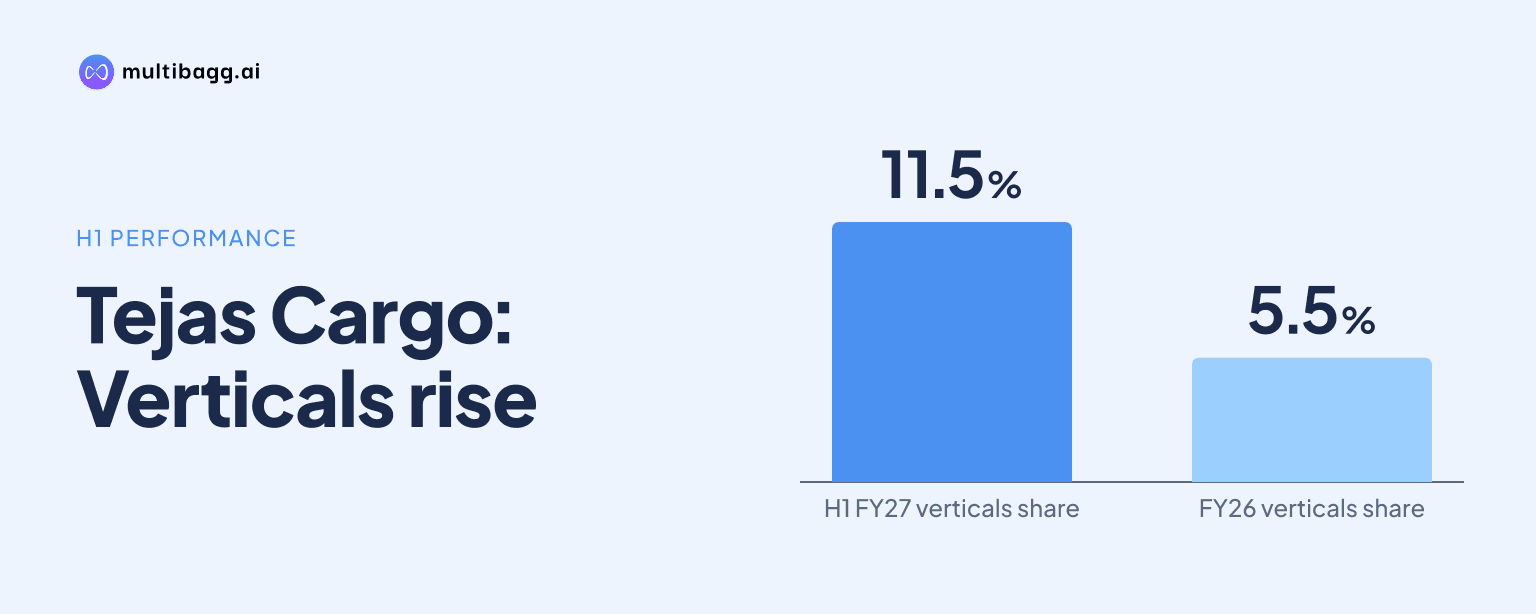
Tejas Cargo India Limited said its coal, fly-ash, car-carrier and freight-forwarding verticals contributed 11.5% of revenue in H1 FY27, compared with about 5.5% in FY26, as it added mining and electric-vehicle logistics work and secured Rs 146.11 crore of new orders during the six-month period.
Know Tejas Cargo India inside out
Results, valuation, peers and who's buying, in one view.
How much has Tejas Cargo diversified its revenue mix?
Tejas Cargo said its strategic focus areas contributed 11.5% of H1 FY27 revenue, roughly double their about 5.5% contribution in FY26. The cited areas are coal transportation, fly ash transportation, car-carrier operations and freight forwarding, which sit alongside the company’s conventional full-truckload, or FTL, transport business.
The change followed additions across mining, fly ash, coal and electric-vehicle, or EV, deployment during H1 FY27. Management described these as early contributions from newer verticals rather than providing revenue separately for each business, so the transcript does not establish which of the four cited areas made the largest contribution to the 11.5% share.
Tejas Cargo’s expansion is supported by more customer relationships, including Hindalco Industries, Dalmia Cement Bharat, Chhattisgarh Mineral Development Corporation, or CMDC, and Jindal Stainless. It also said it strengthened its engagement with Tata Motors Passenger Vehicle, while its top-10 customer contribution fell to 49% in H1 FY27 from 77% in the presentation comparison cited by an analyst.
Management said the top-10 share was also affected by route-level changes and customers splitting work orders among subsidiaries. On a group basis, it put the comparable customer concentration at about 68% to 69%, indicating that part of the apparent reduction reflects the way orders were allocated within customer groups rather than solely entirely new customer additions.
Which new contracts are driving Tejas Cargo’s transition?
Tejas Cargo secured Rs 146.11 crore of new orders in H1 FY27, including contracts in mining, coal, fly ash and EV deployment. The largest disclosed long-duration assignments were an eight-year Rs 38 crore EV contract with Dalmia Cement Bharat and a five-year Rs 27 crore EV contract with Jindal Stainless, each requiring deployment of 10 EVs in Odisha.
The company entered mining through a five-year Rs 28 crore CMDC work order for bauxite mining and excavation at Jamirapath, Chhattisgarh. Transporting mined bauxite is separately billable and is therefore outside the stated mining work-order value, but management said the eventual transportation revenue depends on CMDC’s successful auctions of the mined minerals.
As of H1 FY27, Tejas Cargo said it had mined more than 23,500 tonnes against an annual target of more than 65,000 tonnes under the CMDC project. Only 4,000 tonnes had been transported, at an indicated freight rate of about Rs 82 per tonne over roughly 120 kilometres, and management said a further six months would be needed to assess the extra transport opportunity.
Other awards included a two-month Rs 5 crore multimodal coal-transport contract from Hindalco, a six-month Rs 16 crore fly-ash contract from Chhattisgarh State Power Generating Company, a six-month Rs 9 crore renewal with Rail Vikas Nigam, and a two-month Rs 12.50 crore contract from Shivalaya Construction. Management said most orders apart from the three long-term contracts were expected to be executed within six to eight months.
What do Tejas Cargo’s H1 FY27 financial results show?
Tejas Cargo reported total income of Rs 347 crore in H1 FY27, up 13.4% from Rs 306 crore in the corresponding period. Earnings before interest, tax, depreciation and amortisation, or EBITDA, including other income, rose 13.7% to Rs 54.30 crore from Rs 47.80 crore, while the EBITDA margin edged up to 15.7% from 15.6%.
Profit before tax increased to Rs 18.50 crore from Rs 16.80 crore, and profit after tax rose 9.6% to Rs 13.80 crore from Rs 12.60 crore. Management attributed the income and EBITDA increase to a larger operating scale and said it was focused on fleet productivity, operating costs and ensuring that growth in newer verticals translated into sustainable margins.
Net cash generated from operating activities was Rs 22.80 crore during H1 FY27. Total borrowings stood at Rs 256.90 crore as of September 30, 2026, with debt to equity at 1.24 times; management said its internal target is that this ratio should not exceed that level while the company expands fleet capacity and evaluates leasing options.
Management told investors that the debtor cycle had increased to 84 days from 72 days as new segments were added. It nevertheless expected net cash from operating activities of about Rs 50 crore to Rs 53 crore for FY27, while noting that slower collections could affect the pace of cash conversion.
Got a follow-up? Ask IRIS
How is Tejas Cargo funding specialised fleet expansion?
Tejas Cargo’s owned fleet reached 1,381 vehicles on September 30, 2026, after it added 43 vehicles in H1 FY27. The additions comprised 20 EVs, 10 car carriers, 10 32-foot single-axle trailers and three tippers, linking fleet investment directly to specialised customer contracts and operating opportunities.
The 20 EVs include 10 each for Dalmia Cement Bharat and Jindal Stainless. Management expects the projects to have a payback period of about 4.4 to five years, based on its project reports and the long-term contract structures; it funded 10 EVs from business profits and financed the other 10 through Axis and Kotak.
Tejas Cargo said it plans to use an approximately 50:50 mix of self-funding and financing for future EV additions. It is discussing lease arrangements with Vertelo and Driven, but management said the leasing cost it examined was about 3 percentage points higher than its roughly 8% weighted average cost of debt for term loans.
Fleet utilisation improved to 83% in H1 FY27 from 82% in FY26. Management’s internal FY27 target is 85%, against a benchmark it has set of 87% to 88%; the unutilised portion includes maintenance time, travel to loading stations and waiting for the next placement.
Can technology and short-cycle contracts support the next phase?
Tejas Cargo said its new enterprise resource planning, or ERP, platform is being tested at full scale and is expected to be fully operational by April 2027. The system is intended to combine transportation and freight forwarding operations, supported by GPS, geofencing, advanced driver-assistance systems, driver monitoring, AI-enabled rear cameras and digital locking.
Management said the ERP deployment is complete except for the finance module. It expects integrated ERP, fleet monitoring and control-tower tools to improve visibility over vehicle deployment, route execution, maintenance and cargo security, while also supporting the utilisation objective of 85% for FY27.
In fly ash and coal, the contract model may require regular rebidding because management said tenders typically run for three, six or at most nine months. It cited an April estimate of about 2 lakh tonnes of fly ash awaiting transport at Chhattisgarh State Power Generating Company, which management said could still reach 2.10 lakh tonnes by FY27-end despite tendering and removals.
For mining-plus-transport projects, management illustrated economics of about Rs 63 per tonne of revenue against Rs 53 to Rs 55 per tonne of cost for overburden removal, with the cost including capital expenditure amortised over seven years. It stressed that economics differ by project and whether the scope involves only topsoil removal or extraction of minerals as well.
Conclusion
Tejas Cargo’s 11.5% revenue contribution from selected newer verticals in H1 FY27 shows a measurable shift beyond conventional FTL transport. The transition is being built through Rs 146.11 crore of new orders, specialised fleet additions and contracts spanning EVs, mining, coal and fly ash, while H1 income increased 13.4% to Rs 347 crore.
The next evidence point is execution: management expects most shorter contracts to be completed within six to eight months, while the Rs 28 crore CMDC assignment needs more operating history to clarify its separately billable transport potential. Investors can also watch for the planned full ERP launch by April 2027, FY27 fleet utilisation against the 85% target, and management’s stated operating-cash-flow expectation of Rs 50 crore to Rs 53 crore.