








Tieramet expects China ingot exports to fall sharply in Q3

Find your next multibaggerBe a Pro Investor
Research stocks and track your picks on the go. Download the app.
Key highlights
- Tieramet expects China copper-ingot export volumes to fall sharply in the third quarter after a second-quarter opportunity.
- China commodity export margins reached 3% to 3.5%, compared with Tieramet's historical commodity margin of about 2%.
- Tieramet plans to raise value-added product mix from about 60% toward 70% over three to five years.
- Tieramet has earmarked Rs 40 crore over this year and next year for scrap-processing and by-product infrastructure.
powered by IRIS
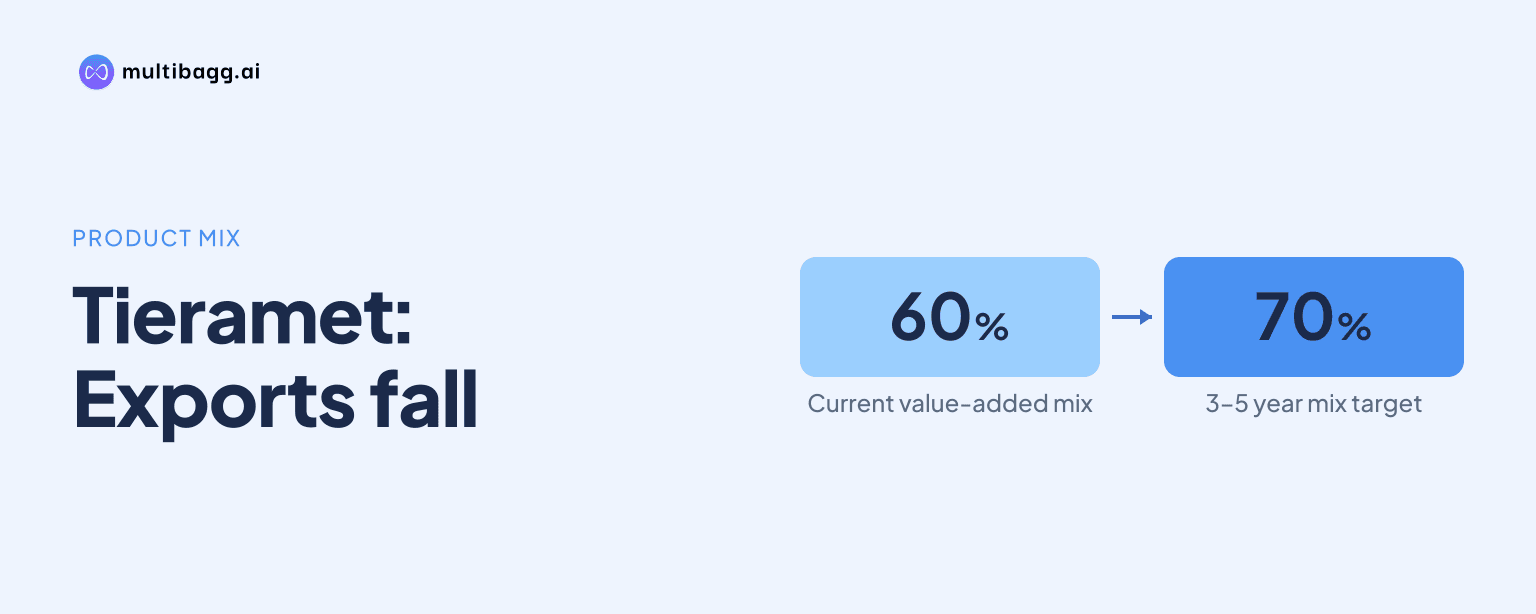
Tieramet expects China copper-ingot export volumes to fall sharply in the third quarter after a second-quarter shortage lifted commodity export margins to 3% to 3.5%, versus a normal 2%. Management expects the change to raise the value-added mix, which it plans to move from about 60% toward 70% over three to five years.
Know Bhagyanagar India inside out
Results, valuation, peers and who's buying, in one view.
Why does Tieramet expect China ingot exports to fall in the third quarter?
Tieramet expects China ingot exports to decline because the second-quarter shipments reflected a temporary market opportunity rather than a permanent change in its product strategy. Management said a major copper shortage in China enabled higher ingot exports and value addition of 3% to 3.5% on those commodity sales, compared with the business's usual commodity margin of about 2%.
The China opportunity followed a first quarter in which value-added products represented 63% of the mix. Management said commodity volume rose in the second quarter because the export economics were favourable, but its expectation of a sharp third-quarter fall in China exports means the value-added percentage should rise dramatically. It also said the mix can change quarter to quarter with market conditions.
What changed in Tieramet's second-quarter profitability?
Tieramet said its earnings before interest, tax, depreciation and amortisation, or EBITDA, margin rose to 5.08% from 4%, with market buoyancy and higher copper prices contributing. Management said copper prices increased by about 50%, which lifted EBITDA per kg from around Rs 34 to around Rs 72 because scrap purchases and product economics are assessed as percentages linked to the London Metal Exchange, or LME.
The higher China commodity return also contributed to the second-quarter outcome, but management did not describe the 3% to 3.5% export margin as a recurring level. It said value-added products carry margins of 4% to 10%, averaging roughly 7% to 7.5%, while product size, customer requirements and service levels influence the return across nearly 15 products.
How will Tieramet raise value-added products toward 70%?
Tieramet plans to increase value-added products from about 60% of its business toward 70% over the next three to five years. Management said an earlier five-year projection placed value-added products at 69% and commodities at 31%, indicating that the intended mix shift still retains a substantial commodity operation.
Tieramet will continue making ingots because certain imported copper forms cannot be converted into value-added products and must be sold as commodities. Management also said commodity participation helps it remain competitive across the copper chain, even though 75% of the organisation is focused on value-added products. The second-quarter China trade illustrates that the company will pursue commodity volume when margins rise above the normal 2% level.
Got a follow-up? Ask IRIS
Which Tieramet products are expected to drive the mix change?
Tieramet said transformers and motors, along with bus bars, should provide the major growth within value-added products, while automotive and switchgear is the slowest-growing of its three categories. Transformers and motors accounted for around 11% of the mix discussed on the call, and management said this segment generally ranges from 10% to 15%.
Bus bars serve building-related demand, trade, panel builders and artificial-intelligence applications, so management said it cannot provide a precise end-market split for that category. Tieramet has earmarked Rs 40 crore of capital expenditure over this year and next year to process more types of scrap and improve recovery from by-products, especially plastic. It is also evaluating two or three additional copper products.
What could influence Tieramet's mix and margin delivery?
Tieramet's mix remains linked to copper-market conditions because its scrap purchases are LME-based and its profitability is managed as a percentage rather than only as Rs per kg. Management said global markets outside the United States were in backwardation, while the United States held substantial copper inventory that could be released. It did not make a firm copper-price forecast, although it said it did not foresee a freefall.
Scrap availability is another factor in the expansion plan, but management said it does not expect a major supply-chain disruption over the next one to one-and-a-half years. It expects scrap availability to increase and said the principal task is securing enough market share of supply. Management cited Tieramet's vertically integrated operations and supply-chain relationships when explaining that view.
Conclusion
Tieramet's second-quarter China ingot exports were an opportunistic response to a copper shortage that improved commodity margins from about 2% to 3% to 3.5%. Management's expectation of a sharp third-quarter export decline indicates a return to a higher value-added mix, where the stated average margin of roughly 7% to 7.5% exceeds the historical commodity level.
The next development to watch is progress from about 60% value-added products toward management's 69% to 70% objective over three to five years, alongside its 4.5% to 5% EBITDA-margin aim. Management has earmarked Rs 40 crore for infrastructure over this year and next year and is evaluating two or three additional copper products with targeted margins of 5% to 10%.

