








Tieramet cuts volume outlook to 10%, FY29 capacity benefit

Find your next multibaggerBe a Pro Investor
Research stocks and track your picks on the go. Download the app.
Key highlights
- Tieramet cut expected annual volume growth to 10% from 12%-15% after reporting 7% year-on-year volume growth in Q2 FY26.
- Tieramet expects capacity to increase from 35,000 metric tonnes to 45,000 metric tonnes in Q4 FY28.
- Tieramet said the additional 10,000 metric tonnes of capacity will contribute from FY29.
- Tieramet expects EBITDA margin to remain between 4.5% and 5% despite lower copper prices.
powered by IRIS
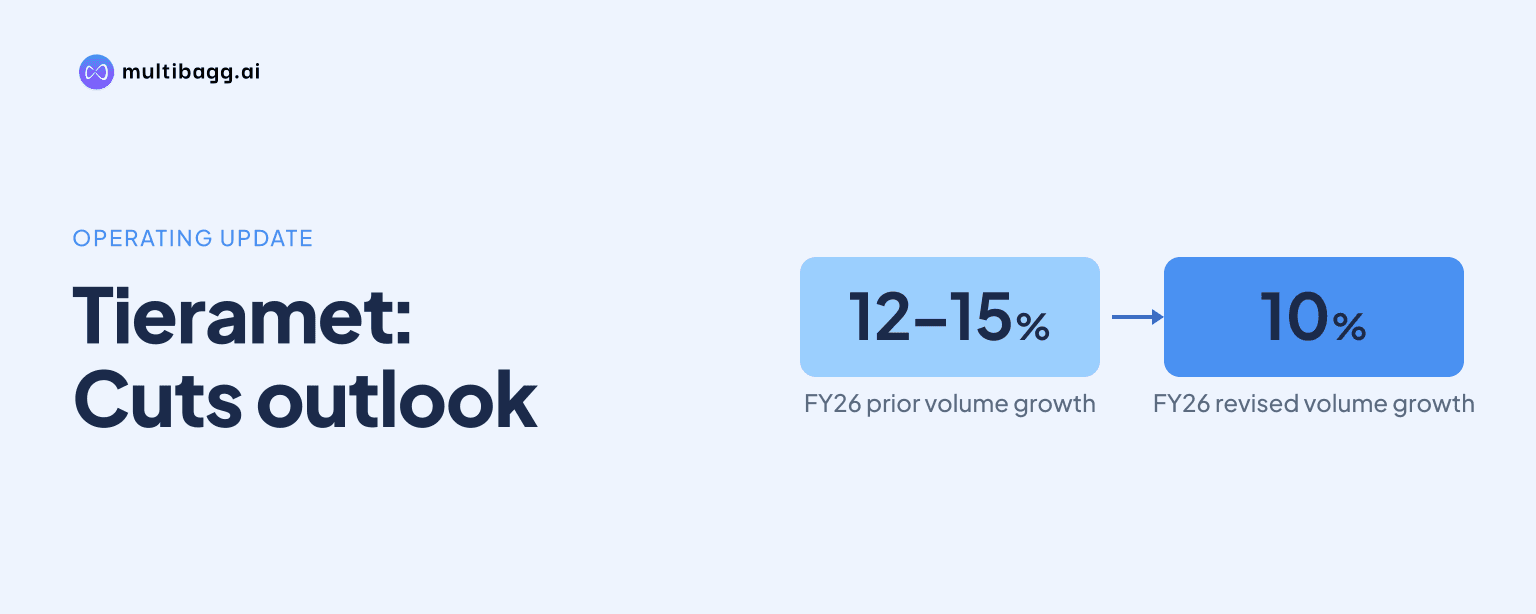
Tieramet has reduced its annual volume-growth expectation to 10% from 12%-15% after falling copper prices cooled market activity, while management expects capacity to reach 45,000 metric tonnes in Q4 FY28 and the additional capacity to contribute from FY29. The revision follows 7% year-on-year volume growth in Q2 FY26.
Know Bhagyanagar India inside out
Results, valuation, peers and who's buying, in one view.
Why did Tieramet reduce its volume-growth outlook to 10%?
Tieramet reduced its expected year-on-year volume growth to 10% from the earlier 12%-15% range because management said falling copper prices can create a freeze in the market. Devendra Surana said rising copper prices generally bring buoyancy, while price declines make customers more hesitant, leading management to lower its volume-growth expectation for the next few years.
The new 10% assumption follows 7% year-on-year volume growth in Q2 FY26. Management described Q2 FY26 as one of its highest-volume quarters in 2026, meaning the reported 7% growth came against a high comparison base. The revised outlook is above the Q2 FY26 growth rate but below the prior 12%-15% projection, reflecting the changed copper-price and demand backdrop.
Management linked the volume revision specifically to market activity rather than to a disclosed change in operating capacity. It said copper prices had fallen sharply, and that lower prices reduce buying momentum. Tieramet did not provide a quarterly volume target, but stated that it now expects 10% year-on-year volume growth going forward.
When will Tieramet's 45,000-tonne capacity be available?
Tieramet expects its capacity to increase from 35,000 metric tonnes to 45,000 metric tonnes in the last quarter of FY28, and management said the additional capacity will aid output only from FY29. It reiterated that no capacity increase is planned in the current year, with the 10,000-metric-tonne addition remaining part of its FY27-FY28 expansion plan.
Management confirmed the FY29 contribution timing when an analyst asked whether completion in Q4 FY28 meant the capacity would help from FY29. The company agreed. Before that commissioning, management said its focus in the current year is on value-added products and the plastic-recycling part of the business rather than a further increase in installed copper-processing capacity.
The capacity timetable is also connected to utilisation. In response to an analyst's question on closing utilisation of about 85%, management agreed and said 10% annual volume growth would bring the business close to that position. Tieramet did not disclose current utilisation, so the 85% figure was an analyst estimate accepted by management rather than a reported utilisation result.
How does Tieramet plan to reach its FY30 revenue target?
Tieramet said its stated FY30 revenue target of Rs 5,000 crore assumes 10% annual volume growth, with the balance of growth coming from price increases. An analyst described the target as nearly five times FY26 revenue, while management clarified that the volume component now uses the reduced 10% assumption rather than the earlier 12%-15% range.
Bus bars are one product category cited in the discussion of future demand, including possible demand linked to artificial intelligence, or AI, data centres. Management said it cannot always determine whether bus bars supplied to customers are eventually deployed in AI data centres, because customers and contractors may use them in multiple applications. Its estimate was that AI-data-centre-related bus-bar volumes in India and overseas could be increasing by about 20%-25% annually.
Tieramet cited one export customer that had already purchased Rs 24 crore of bus bars and was expected to take about 100 tonnes a month from the current month through March. Management said all of those bus bars were for export, but did not identify the final application. Therefore, the 20%-25% AI-data-centre growth figure was management's assessment, not separately reported AI-related revenue.
Got a follow-up? Ask IRIS
What do lower copper prices mean for Tieramet's revenue and margin?
Tieramet said lower copper prices will reduce reported revenue and make Rs 1,000 crore of turnover difficult to achieve in the next quarter. Management nevertheless said it expects better growth in Q4 if the market normalises, even if copper prices do not return to their earlier peak. The company said it was confident of taking advantage of a Q4 recovery.
Tieramet said 85% of its copper-price exposure continues to be hedged on the Multi Commodity Exchange, or MCX. Management explained that the hedge practice remains unchanged despite the price correction. However, it said the rupee value of revenue declines when copper prices decline, even where the company maintains its established hedge coverage.
Management expects earnings before interest, tax, depreciation and amortisation, or EBITDA, margin to remain between 4.5% and 5%. It said purchases and sales are both priced as a percentage of the London Metal Exchange, or LME, benchmark, so LME movements affect both sides of the transaction. Management added that a copper-price fall of about Rs 250 to Rs 300 per kilogram could reduce EBITDA per tonne by about Rs 10 in the next quarter.
What are Tieramet's operating priorities before FY28?
Tieramet said its operating emphasis in the current year is on value-added products and plastic recycling, while the 35,000-to-45,000-metric-tonne capacity expansion is targeted for the last quarter of FY28. This means product mix and execution in the existing footprint will be the disclosed operating priorities before the additional 10,000 metric tonnes begins contributing in FY29.
On raw-material availability, management said it does not expect a major supply disruption over the next one to one-and-a-half years. It said scrap availability rises over time and that the main question is whether Tieramet can secure sufficient market share. Management also cited its vertically integrated copper operations and supply-chain relationships as reasons it expects to manage procurement.
That view on supply remains management's assessment rather than a quantified supply commitment. Tieramet did not disclose contracted scrap volumes, procurement prices or a separate sourcing target. The relevant near-term disclosed period is the next one to one-and-a-half years, during which management said it sees no major hiccup in supply availability.
Conclusion
Tieramet has reset the volume element of its growth plan to 10% annually from 12%-15%, following 7% year-on-year volume growth in Q2 FY26 and management's view that falling copper prices have dampened market activity. Its FY30 revenue target of Rs 5,000 crore still combines volume growth with price increases, while management expects EBITDA margin to remain between 4.5% and 5%.
The next stated capacity milestone is Q4 FY28, when Tieramet expects installed capacity to rise to 45,000 metric tonnes from 35,000 metric tonnes, with benefits beginning in FY29. Before then, management's stated targets to watch are 10% annual volume growth, the analyst-discussed utilisation level of about 85%, and a return towards 5% EBITDA margin in Q4.

