










Timex Plans 12 Million Baddi Capacity as Movement Supply Tightens
Key highlights
- Timex plans Baddi infrastructure for 12 million annual single-shift watches by May 2027, versus 6 million units currently.
- Timex plans to lift Baddi operating capacity to 8 million units next year before progressing toward 12 million units.
- Baddi is operating at almost 100% utilisation and Timex expects 6 million units of production in the current year.
- Timex said Indian production provides an effective 10% to 12% material-cost benefit against imported watches.
powered by IRIS
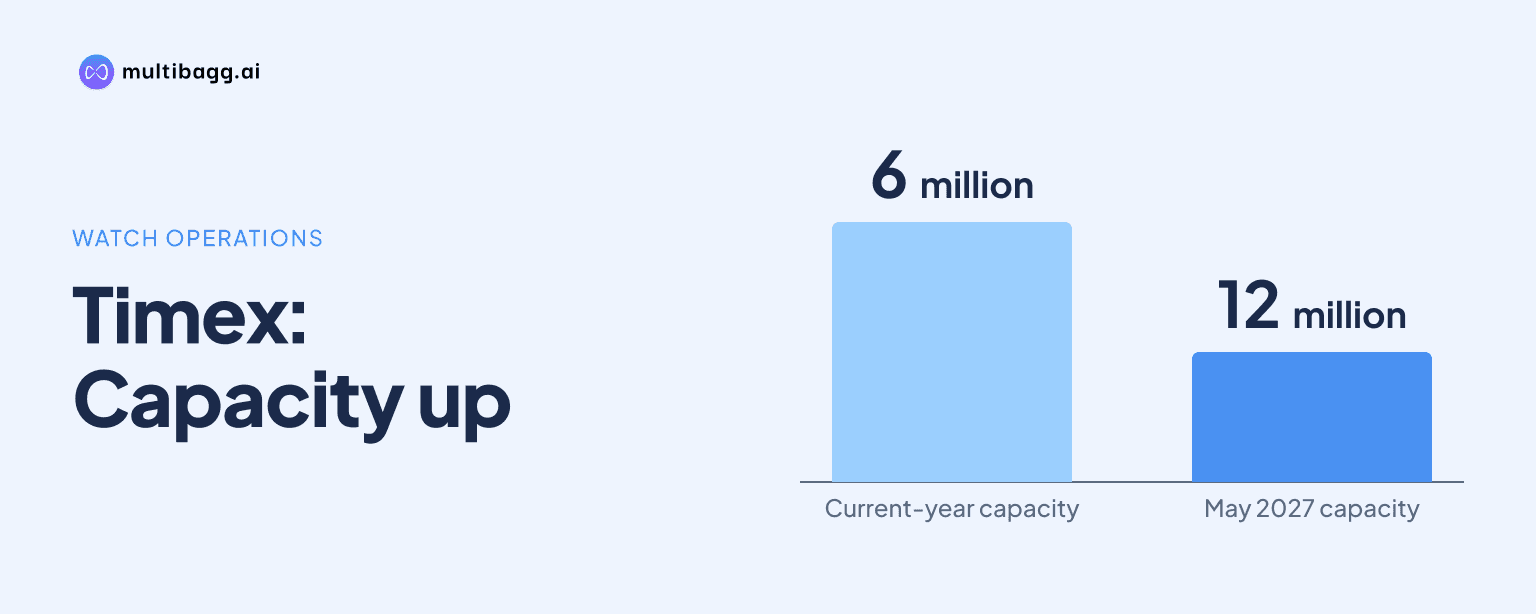
Timex Group India Limited plans to prepare its Baddi factory for 12 million watches of annual single-shift capacity by May 2027, double the current 6 million units, after utilisation reached almost 100%. Timex will initially lift operating capacity to 8 million units next year while it explores a movement-manufacturing partnership to address supply shortages.
Know Timex Group India inside out
Results, valuation, peers and who's buying, in one view.
Why is Timex expanding the Baddi factory?
Timex is expanding Baddi because its current annual single-shift capacity of 6 million watches is almost fully utilised, and management expects the plant to produce 6 million units in the current year. Management said it had raised capacity to 6 million units about six to seven months before the November 4, 2026 earnings call, but further capacity was needed for its future plans.
The expansion follows a quarter in which Timex sold about 2.4 million to 2.5 million watches across the company. The Timex brand accounted for more than half of sales and approximately 64% to 65% of volume, according to management, making factory capacity particularly relevant to the company’s core watch portfolio.
Timex is also using Baddi to support local production across a broader range of products. Management said it was already assembling Marlin and Timex Q watches at the plant, while high-volume Guess models are planned for assembly in India from the April quarter of next year.
How will Timex phase the Baddi capacity increase?
Timex will build physical infrastructure for 12 million annual units by May 2027 but plans to operate at 8 million units next year before adding further assembly lines as demand requires. Management said this approach should maintain utilisation above 90% rather than create unused installed production capacity immediately.
The distinction between infrastructure and installed lines is central to Timex’s plan. Management said constructing the building and related civil infrastructure takes about six months, whereas installing an assembly line takes about 45 days, allowing the company to time line additions to production requirements.
Timex currently operates a double shift when production exceeds 5 lakh watches in a period, although management framed the expansion target in terms of single-shift capacity. The phased plan therefore gives the company a route beyond the present 6 million-unit threshold without committing to all 12 million units of equipment at once.
Why is Timex exploring a movement-manufacturing partnership?
Timex is exploring a movement partnership because management said the global watch industry faces a shortage of movements, the mechanisms that power watches. It said three large Japanese manufacturers produce most movements and have not expanded capacity even as global watch demand shifted from a decline of 3% to 4% to growth of 3% to 4%.
Management said Timex’s global scale provides some protection because the group sells in 100 countries and negotiates movement purchases for worldwide volumes. However, it also said movement prices have risen, while India’s watch-market growth remains more unit-driven than value-driven, increasing the importance of reliable component supply.
The potential partnership remains at an early stage. Management said it was considering an arrangement with a new company involved in movement manufacturing to build Timex movements, but did not identify a partner, capital commitment, production location or launch date.
Got a follow-up? Ask IRIS
What does local assembly mean for Timex’s product range?
Local assembly gives Timex an effective 10% to 12% material-cost benefit compared with imported watches, management said, despite import duties of about 22% because certain components must still be sourced internationally. The company described that benefit as a material-cost advantage rather than a direct equivalent increase in operating margin.
The Baddi plant supports both volume products and higher-priced franchise lines. Management said products priced above Rs 10,000 now account for 14% of the Timex brand’s business, after the company introduced franchises including Q, Marlin, Waterbury, Ironman and Weekender that had not previously been sold in India.
Timex said it is widening its range without leaving its established price bands. Management positioned TMX below Rs 2,000 and the Timex brand mainly between Rs 2,000 and Rs 10,000, while stating that the Rs 2,000 to Rs 5,000 segment is growing somewhat faster than the Rs 5,000 to Rs 10,000 segment.
What operating issues could affect the expansion?
Timex identified movement availability, commodity costs and foreign exchange as operating risks, rather than a specific construction risk to Baddi. Management said the US dollar had moved from Rs 85 to Rs 97 over the preceding one to one-and-a-half years and remained around Rs 95 to Rs 96, while gold had risen 100%, silver 2.5 times and copper three times.
The company introduced selective price increases across all brands from April 2026. Management said increases ranged from 5% to 15%, with an average of about 8% to 8.5%, and were applied only to selected stock-keeping units where internal pricing analysis indicated room for increases.
Inventory is also part of Timex’s preparation for demand. Gross inventory stood at about Rs 358 crore on September 30, including approximately Rs 100 crore of work-in-progress and components and about Rs 40 crore to Rs 45 crore of consignment inventory; management said stock was intended to support a larger third quarter and Valentine-related sell-in.
Conclusion
Timex’s Baddi programme is a staged response to near-full utilisation, a broader local-assembly agenda and a constrained movement market. The company is preparing for 12 million annual single-shift units, but its disclosed operating target is 8 million units next year, limiting the amount of capacity installed ahead of demand.
The next milestones are the planned May 2027 completion of physical infrastructure, the pace of additional assembly-line installations and the April-quarter plan to assemble high-volume Guess models in India. Timex has not disclosed a partner or timetable for movement manufacturing, leaving progress on that early-stage initiative unresolved.