










Timex builds Rs 358 crore inventory for Q3 and Valentine
Key highlights
- Timex held Rs 358 crore of gross inventory on September 30, 2026.
- About Rs 100 crore of Timex inventory was factory WIP and components.
- Timex e-commerce revenue rose 75% year on year to Rs 190 crore in Q2.
- Timex plans to double Baddi single-shift capacity from 60 lakh to 1.20 crore watches by about May next year.
powered by IRIS
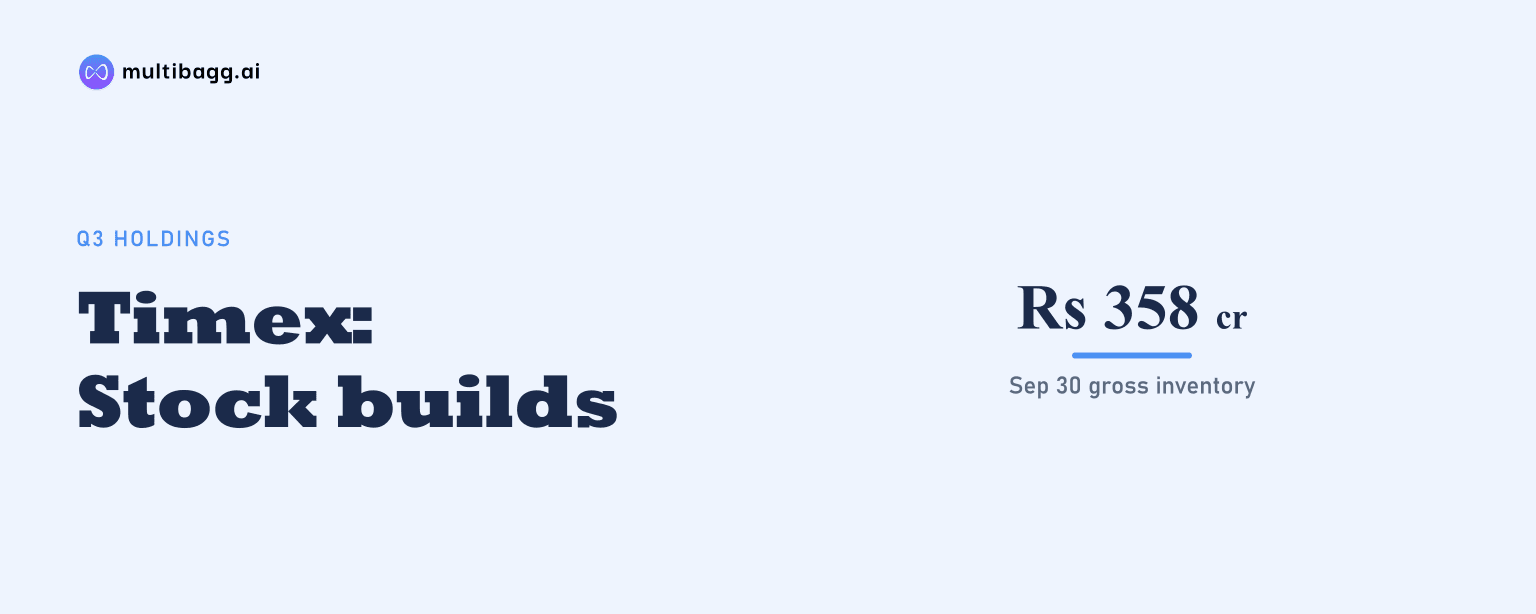
Timex Group India Limited held Rs 358 crore of gross inventory on September 30, 2026, chiefly in core watch styles, to support a larger Q3 and prevent supply gaps before Valentine demand. Management said roughly Rs 100 crore was factory work-in-progress and components, while the inventory is scheduled to taper by calendar year-end.
Know Timex Group India inside out
Results, valuation, peers and who's buying, in one view.
Why did Timex build Rs 358 crore of inventory?
Timex said the Rs 358 crore inventory was a deliberate availability investment, not a stockpile of slow-moving goods. Managing Director Deepak Chhabra said Timex deploys free cash in inventory so its sales teams do not lose orders during demand peaks, with purchases concentrated in top-selling core styles that remain saleable for longer if sales fall below expectations.
The timing reflects Timex’s partner-led sales cycle, under which sell-in generally occurs 30 to 45 days before consumer demand. Q2 revenue reached Rs 359 crore, up 47% year on year, while management said Diwali and urban-wedding demand are major seasonal events. Timex expects Q3 to remain smaller than Q2, but said it has prepared for a bigger Q3 than in recent years.
The stock is also intended to protect sales beyond Q3. Management said year-end and early-calendar-year manufacturing and operating disruptions had caused lost Valentine opportunities in the past two years. Valentine sell-in largely occurs in late December or the first half of January, while the rural-wedding season is expected to start in February this time rather than in late March.
What does Timex’s September inventory contain?
Timex said about Rs 100 crore of its Rs 358 crore gross inventory at September 30 consisted of factory work-in-progress, or WIP, and components. Another roughly Rs 40 crore to Rs 45 crore was inventory in sale-or-return consignment accounts, leaving the balance as finished goods, based on management’s broad breakdown.
The breakdown means the Rs 358 crore total was not composed solely of sale-ready watches. WIP and components support production at Timex’s Baddi facility, while consignment stock sits in a separate sale-or-return arrangement. Management did not disclose the requested split between imported licensed-brand products and watches made at Baddi.
Timex described Q2 as its normal seasonal inventory peak. Management said a review of the last three or four years would show Q2 inventory at the highest level, after which it typically tapers stock at the calendar year-end because of business phasing and rebuilds it around February. The September position was therefore presented as a recurring pattern rather than a permanent inventory level.
Can Timex replenish stock from its Baddi factory?
Timex said Baddi was operating at almost 100% utilisation, and it ran double shifts for a couple of months because quarterly requirements exceeded 5 lakh watches, the level management said it could make in a single shift. The facility’s annual single-shift capacity was increased to 60 lakh watches about six or seven months earlier, and Timex expects to produce that volume this year.
Management has finalised a plan to construct another building of similar size at Baddi by about May next year. The project is intended to double single-shift annual capacity from 60 lakh to 1.20 crore watches. Timex did not provide a completion date beyond its estimate of about May next year, but linked the expansion to future production requirements.
Timex estimated it sold about 24 lakh to 25 lakh watches in Q2. The Timex brand accounted for more than half of sales and about 64% to 65% of volume, management said, because its average selling price is lower than that of the licensed portfolio. Timex also plans to begin assembling higher-volume GUESS top sellers in India in the April quarter next year.
Got a follow-up? Ask IRIS
How does inventory support Timex’s channel and seasonal strategy?
Timex’s inventory build supports a channel mix in which e-commerce moves ahead of the festive season and offline sales follow later. E-commerce revenue rose 75% year on year to Rs 190 crore in Q2 from Rs 108 crore, while trade revenue increased 34% to Rs 85 crore from Rs 64 crore. Management said Q3 is generally heavier for offline activity than Q2.
Timex is also increasing the number of outlets that can sell its portfolio. It added four exclusive retail stores in Q2, taking the count to 44, all under a franchise-owned and franchise-operated model. Management plans about 40 new stores next year, followed by about 80 to 100 in 2028 and another 70 to 80 in 2029 across Just Watches and Timex World.
The inventory decision also carries input-cost exposure. Timex said product margin declined about 1.1 percentage points year on year in Q2, citing movement costs, foreign exchange and prices of copper, gold and silver. It raised prices on selected stock-keeping units from April by 5% to 15%, with an average increase of about 8% to 8.5%, rather than increasing prices across every product.
What could change the planned inventory rundown?
Timex said its inventory should taper at the calendar year-end, but the pace will depend on Q3 sell-in and preparations for Valentine and rural-wedding demand. Management said Diwali was delayed by about two weeks, which should provide some Q3 benefit versus last year, although Timex’s partner-led model means the company sells products before the consumer event.
Supply availability is another factor. Management said global watch-movement supply remains constrained because movements are largely made by three large Japanese companies that have not increased capacity while demand has risen. Timex said its global purchasing scale helps it secure supply, while it is also considering a partnership with a movement manufacturer, though that plan remains at an early stage.
Conclusion
Timex’s Rs 358 crore September inventory was presented as a planned buffer for Q3, Valentine demand and the earlier rural-wedding cycle rather than as evidence of unsold goods. Its composition supports that account: roughly Rs 100 crore was factory WIP and components, and about Rs 40 crore to Rs 45 crore was consignment stock. The 75% rise in e-commerce revenue to Rs 190 crore also shows why management prioritised availability before peak consumer selling periods.
The next point to watch is whether inventory declines by calendar year-end as management says it normally does, while still supporting Q3 and January sell-in. Timex also plans to expand Baddi’s single-shift capacity from 60 lakh to 1.20 crore watches by about May next year and to begin assembling selected GUESS top sellers in India in the April quarter next year.