










Timex says EBITDA margin can approach 20% in a year or so
Key highlights
- Timex said full-year EBITDA margin can approach 20% in a year or so, versus 17.5% in the first half and 14.5% in FY26.
- Product gross margin declined by about 1.1 percentage points year on year because of movement, foreign-exchange and metal costs.
- Timex said corporate and regional fixed costs are rising about 6% to 8% while business is growing at about 35%.
- Baddi capacity is planned to rise from six million watches to eight million next year, with infrastructure for 12 million by May next year.
powered by IRIS
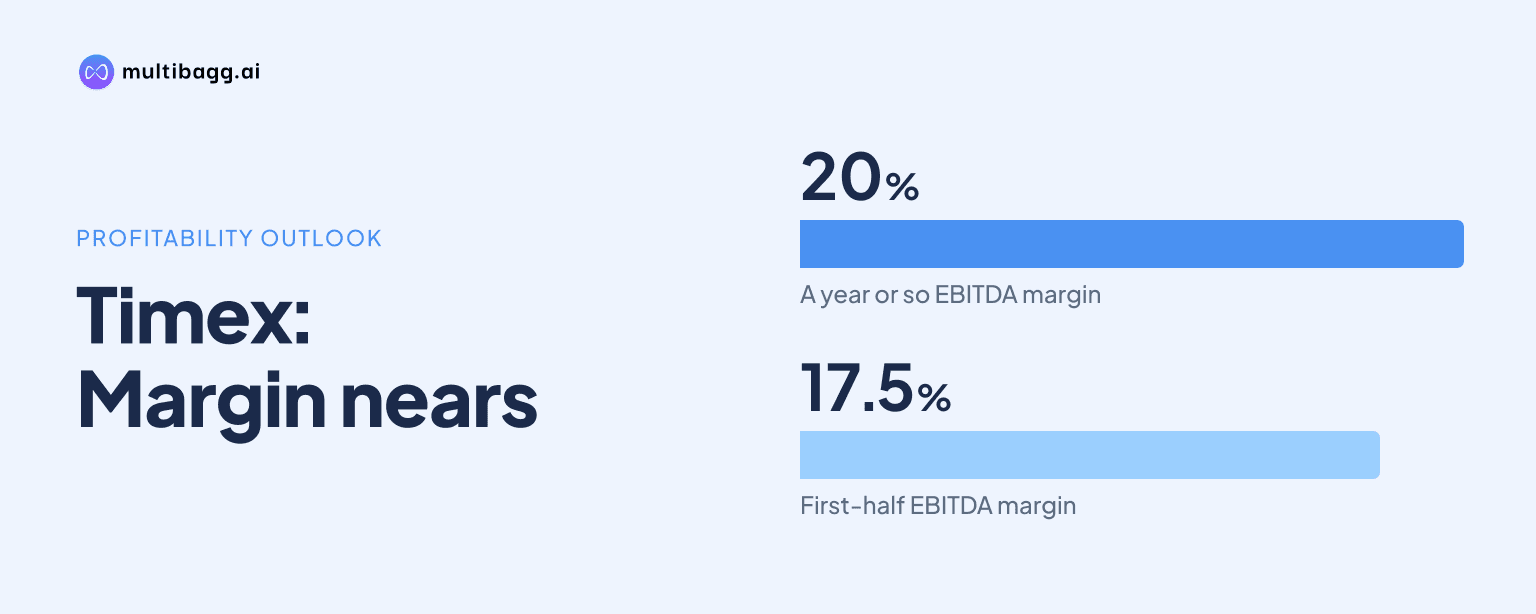
Timex Group India Limited said its full-year EBITDA, or earnings before interest, tax, depreciation and amortisation, margin can approach 20% in a year or so, compared with 17.5% in the first half and 14.5% in financial year 2026 (FY26). Timex expects fixed-cost leverage from sales growth to support expansion while maintaining brand and distribution investment.
Know Timex Group India inside out
Results, valuation, peers and who's buying, in one view.
Can Timex reach a 20% EBITDA margin in a year or so?
Yes, management said Timex can potentially reach an EBITDA margin of about 20% on a full-year basis in a year or so. It clarified that the view did not apply to the current year and was not a quarterly-margin target, because margins vary by quarter. Timex reported a 17.5% EBITDA margin in the first half, compared with 14.5% in FY26.
Management described 20% as a level consistent with its growth strategy rather than a commitment to maximise the margin percentage. It said revenue growth and absolute EBITDA remain the priority, and moving beyond about 20% could compromise top-line growth. Timex does not provide revenue guidance.
What caused Timex's recent product-margin pressure?
Timex said product gross margin declined by about 1.1 percentage points year on year in the quarter because of higher movement, commodity and foreign-exchange costs. Movements account for about 30% of a watch's cost and come from Japan, while the company also imports raw material from China. Management cited a US dollar peak of about Rs 97 and higher copper, gold and silver prices.
Timex took selective price increases from April across all brands to offset part of the pressure. Price increases ranged from 5% to 15% on selected stock-keeping units, or SKUs, with an average increase of about 8% to 8.5%. Management said it compared prices with competing products rather than raising prices across every SKU.
For the third quarter (Q3), management said gold, silver and copper prices had eased, while the dollar remained at about Rs 95 to Rs 96. It expected the negative purchase-price variance, or PPV, to be lower than in the second quarter (Q2), but did not give a specific margin forecast.
How will fixed-cost leverage support Timex's margin plan?
Timex said leverage of fixed costs outside manufacturing is the principal route to a margin near 20%. Management said people costs in corporate and regional offices, customer-facing teams and other functions were rising by about 6% to 8% year on year, while business was growing at about 35%. The difference is expected to increase EBITDA as revenue grows.
Manufacturing absorption is an additional contributor. Timex said its Baddi factory was operating at almost 100% of its six-million-watch annual capacity on a single shift, and ran double shifts for a couple of months when output requirements exceeded 500,000 watches. Management said factory overhead absorption improves with higher output, but corporate and regional fixed costs offer the larger leverage.
Got a follow-up? Ask IRIS
Will marketing investment continue while Timex expands margins?
Yes, Timex said it intends to preserve marketing investment while using scale to improve EBITDA. The company spends about 8% to 8.5% of overall revenue on marketing, while the Timex brand receives about 10% to 11% of its revenue. Management said the percentage spent on Timex is expected to remain in that range even as the rupee amount increases with sales.
A higher mix of own brands does not automatically produce a substantially higher EBITDA margin, according to management. Own brands, including Timex, Helix, TMX, spare parts and technology business, accounted for about 60% of sales, up from about 55% a year earlier. Timex said its EBITDA margins are broadly similar across own brands, licensed brands and original equipment manufacturer, or OEM, operations because it spends more on advertising and promotion for its own brands.
Local production can still lower product costs. Management said imported watches face duties of about 22%, while making products in India creates an effective benefit of about 10% to 12% of material cost after imported components. Timex is assembling Marlin and Timex Q at Baddi and plans to assemble high-volume GUESS products in India from the first quarter of next year.
What sales growth supports Timex's margin outlook?
Timex's fixed-cost leverage depends on sustained growth in volume and value. The company said quarterly revenue grew 47%, while first-half revenue growth was about 40% to 41%, split broadly equally between volume and value. Value growth reflected higher average selling prices, or ASPs, from a larger GUESS mix and Timex sales at higher price points.
E-commerce sales were Rs 190 crore in the quarter, compared with Rs 108 crore a year earlier, a 75% increase. Trade sales rose 34% to Rs 85 crore from Rs 64 crore. Management said e-commerce represented about 40% to 42% of Timex business, compared with the 18% to 19% it cited for many watch brands.
Timex is adding premium products without withdrawing from its core price range. Products above Rs 10,000, including Waterbury, Marlin and Q franchises, now contribute 14% of Timex business. The company continues to address the Rs 2,000 to Rs 10,000 segment, while TMX serves entry-level watches priced below Rs 2,000.
Conclusion
Timex's route from a 17.5% first-half EBITDA margin towards about 20% is based on growth-led operating leverage rather than broad cuts to marketing or a move away from lower-priced watches. The outlook depends on sales growth continuing to outpace corporate and regional fixed costs, while price actions and easing commodity costs limit pressure from foreign exchange, movements and metals.
The next disclosed milestones are Baddi infrastructure capable of supporting 12 million watches annually in a single shift by May next year and a planned increase in installed capacity from six million to eight million watches next year. Management also plans about 40 franchise-owned, franchise-operated stores next year, followed by about 80 to 100 stores in 2028, within its ambition to open more than 200 stores over three years.