










Timex Group India cash flow falls as working capital rises in first half
Key highlights
- Timex Group India’s operating cash flow was Rs 38.96 crore in the six months ended September 30, 2026, versus Rs 63.96 crore a year earlier.
- Inventory increased by Rs 171.09 crore to Rs 368.02 crore between March 31 and September 30, 2026.
- Trade receivables increased by Rs 62.08 crore to Rs 120.55 crore in the six-month period.
- Profit before tax rose to Rs 97.12 crore from Rs 60.56 crore, while revenue from operations reached Rs 576.91 crore.
powered by IRIS
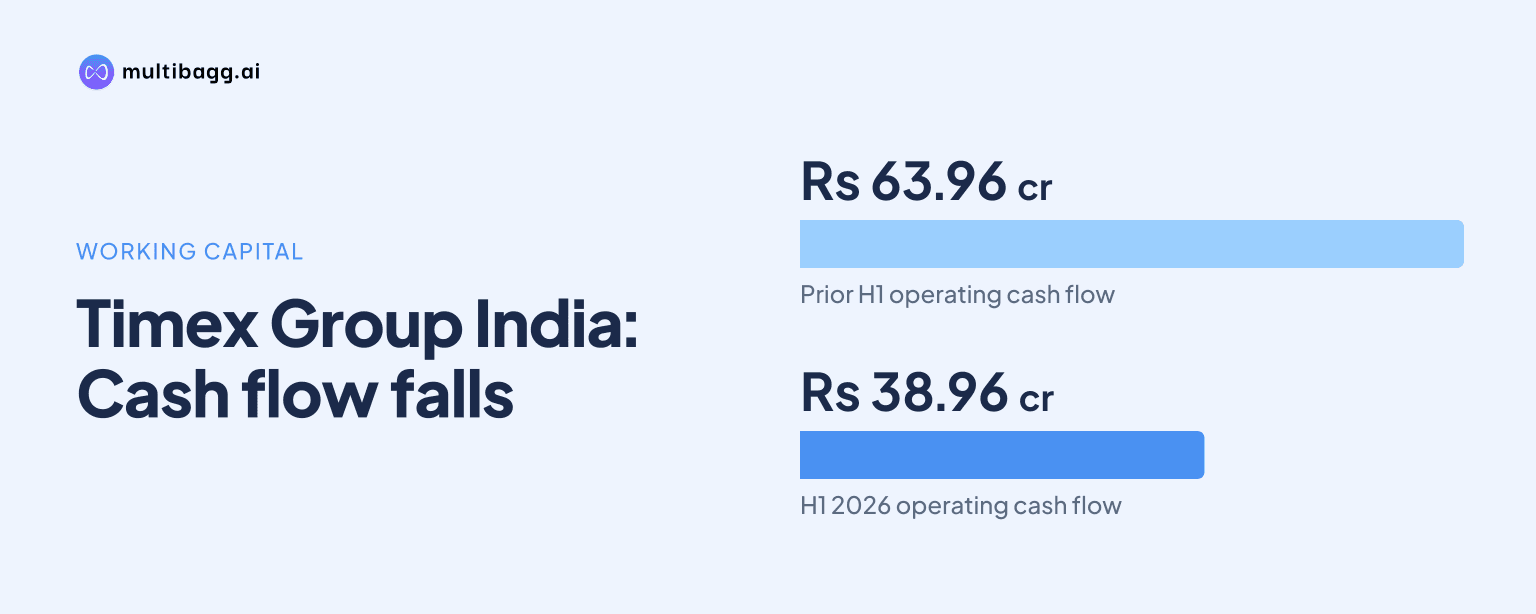
Timex Group India Limited generated Rs 38.96 crore of operating cash in the six months ended September 30, 2026, down from Rs 63.96 crore a year earlier, as a Rs 171.09 crore inventory build and a Rs 62.08 crore increase in trade receivables absorbed cash. Timex Group India’s profit before tax nevertheless rose to Rs 97.12 crore from Rs 60.56 crore.
Know Timex Group India inside out
Results, valuation, peers and who's buying, in one view.
Why did Timex Group India’s operating cash flow decline?
Timex Group India’s operating cash flow declined because larger investments in inventory, trade receivables and other current assets more than offset the increase in profit and cash generated through trade payables. Net cash generated from operating activities was Rs 38.96 crore for the six months ended September 30, 2026, compared with Rs 63.96 crore in the corresponding 2025 period, a reduction of Rs 25.00 crore.
Cash generated from operations before tax payments fell to Rs 39.35 crore from Rs 66.13 crore, even though pre-tax profit increased by Rs 36.56 crore year on year. Income taxes paid were Rs 0.39 crore, versus Rs 2.17 crore a year earlier, so the lower tax outflow partly moderated the decline between cash generated from operations and net operating cash.
The operating cash-flow statement records Rs 171.09 crore used by the increase in inventories and Rs 62.08 crore used by the increase in trade receivables during the 2026 half year. Other current assets used another Rs 20.23 crore, compared with a Rs 2.79 crore source of cash in the prior-year half, adding to the difference between reported profit and operating cash generation.
How much did Timex Group India’s inventory and receivables increase?
Timex Group India’s inventory rose to Rs 368.02 crore at September 30, 2026 from Rs 196.93 crore at March 31, 2026, while trade receivables rose to Rs 120.55 crore from Rs 58.16 crore. These balance-sheet increases match the cash-flow statement’s Rs 171.09 crore inventory outflow and Rs 62.08 crore receivables outflow for the six-month period.
The inventory balance was nearly twice the March 31 level by September 30, while receivables also more than doubled. Total current assets increased to Rs 585.05 crore from Rs 313.85 crore over the same period, with inventory accounting for the largest part of that Rs 271.20 crore rise.
Other current assets increased to Rs 44.81 crore from Rs 24.58 crore, an increase reflected as a Rs 20.23 crore cash use in the operating cash-flow statement. Cash and cash equivalents also increased to Rs 51.56 crore from Rs 33.95 crore, but that closing cash movement reflects operating, investing and financing flows rather than working-capital movement alone.
Timex Group India disclosed no separate segment breakdown for the inventory or receivables balances. The company said it operates as a single segment under Indian Accounting Standard 108, covering watch manufacturing and trading, related after-sales services, and information-technology support services provided to group companies.
Got a follow-up? Ask IRIS
Did higher profit offset Timex Group India’s working-capital cash use?
Higher profit did not offset Timex Group India’s working-capital cash use in the first half because the Rs 36.56 crore year-on-year increase in profit before tax was smaller than the additional cash absorbed by inventories and receivables. Pre-tax profit reached Rs 97.12 crore in the six months ended September 30, 2026, while the combined cash outflow from those two asset categories was Rs 233.17 crore.
Revenue from operations increased to Rs 576.91 crore from Rs 412.61 crore, and profit after tax rose to Rs 72.13 crore from Rs 44.90 crore. The higher revenue and profit were accompanied by a larger trade-payables cash inflow of Rs 179.32 crore, compared with Rs 28.57 crore in the prior-year half, providing a partial offset to the asset build.
Current trade payables to creditors other than micro and small enterprises were Rs 263.27 crore at September 30, 2026, compared with Rs 97.32 crore at March 31, 2026. Dues to micro and small enterprises were Rs 36.31 crore, up from Rs 23.47 crore, while the cash-flow statement also recorded Rs 11.76 crore from higher other current financial liabilities.
The balance sheet shows current liabilities of Rs 391.64 crore at September 30, 2026, up from Rs 172.93 crore at March 31, 2026. That increase occurred alongside the rise in current assets, and the cash-flow statement identifies the individual operating-asset and operating-liability movements rather than assigning a reason for the changes.
What else affected Timex Group India’s cash balance?
Timex Group India’s cash and cash equivalents increased by Rs 17.61 crore during the 2026 half year because operating cash generation exceeded the combined investing and financing cash outflows. Cash and cash equivalents ended September 30, 2026 at Rs 51.56 crore, compared with Rs 33.95 crore at the start of the period.
Investing activities used Rs 2.91 crore, substantially less than the Rs 44.13 crore used in the prior-year half. The previous period included a Rs 43.00 crore outflow for movement in current investments, whereas the 2026 half showed no such movement; payments for property, plant and equipment, capital work-in-progress and intangible assets were Rs 3.22 crore, compared with Rs 1.37 crore.
Financing activities used Rs 18.44 crore, against Rs 10.75 crore a year earlier. The 2026 figure included Rs 16.39 crore of preference-share dividend payments and Rs 1.82 crore of withholding tax on that dividend, partly offset by Rs 1.54 crore of net proceeds from short-term borrowings.
The preference-share dividends were approved by members on August 20, 2026 and paid on August 24, 2026. The approved amounts included Rs 14.00 crore for 5% cumulative redeemable non-convertible preference shares, Rs 4.21 crore for 10.75% cumulative redeemable non-convertible preference shares, and Rs 0.23 lakh for 0.09% non-cumulative redeemable non-convertible preference shares.
Conclusion
Timex Group India reported higher first-half revenue, profit before tax and profit after tax for the six months ended September 30, 2026, but its operating cash flow fell to Rs 38.96 crore. The principal disclosed difference was working capital: inventory and receivables absorbed Rs 233.17 crore of cash, while higher trade payables provided a Rs 179.32 crore offset.
The next disclosed matter to watch is the finalisation of state rules and related aspects of India’s new Labour Codes. Timex Group India said it continues to monitor those developments after recognising a Rs 5.31 crore provision in the year ended March 31, 2026, and will account for changes if required.