










Timex keeps ₹2,000-₹10,000 core while adding premium lines
Key highlights
- Timex said franchises above ₹10,000 contribute 14% of business.
- Timex identifies ₹2,000-₹10,000 as its main India-focused watch segment.
- Guess business rose from about ₹25 crore four years ago to close to ₹200 crore.
- Timex plans to increase production capacity from 60 lakh to 80 lakh watches next year.
powered by IRIS
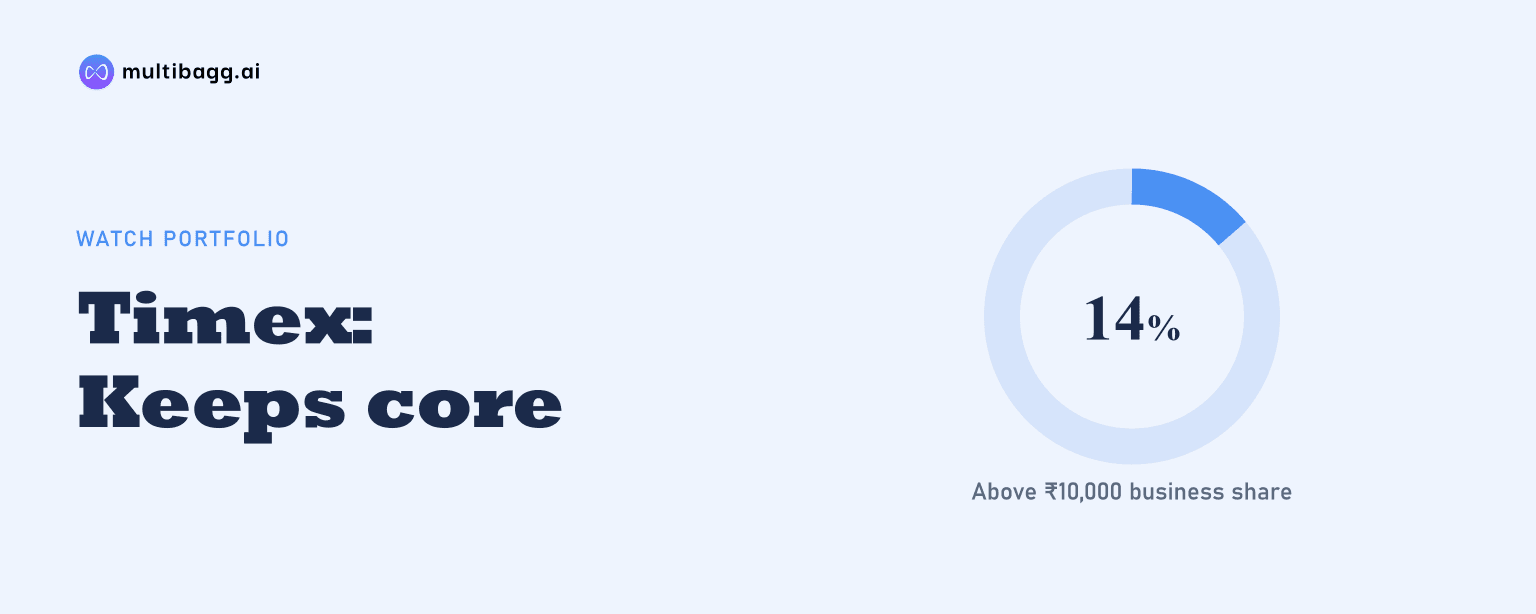
Timex Group India Limited is retaining its ₹2,000-₹10,000 watch range while extending Timex products to ₹30,000, and franchises above ₹10,000 already supplied 14% of business at its November 4, 2026 earnings call. Management said the portfolio is designed to cover the consumption pyramid rather than replace volume-led core demand with premiumisation.
Know Timex Group India inside out
Results, valuation, peers and who's buying, in one view.
Why is Timex keeping ₹2,000-₹10,000 at the centre of its strategy?
Timex is keeping ₹2,000-₹10,000 central because management considers it India’s largest and most durable watch segment. Deepak Chhabra said this range has been relevant for 35 years and should remain relevant over the next 20 years, reflecting the size of the middle-class consumer base and the continuing flow of consumers into that group.
The company’s stated architecture places TMX below ₹2,000, Timex mainly between ₹2,000 and ₹10,000, fashion labels between ₹10,000 and ₹25,000, and luxury brands at higher price points. Management said the distributor-led Timex business has particular opportunity between ₹2,000 and ₹6,000, while the ₹2,000-₹5,000 band is growing faster than the ₹5,000-₹10,000 band.
Management linked the core opportunity to India adding about 43 million people to the middle class over the past four years. It also estimated that watch penetration in India is only 15%-16%, against 70%-80% in some other markets. Those figures were management’s market assessment, not company guidance, but explain why it expects first-time watch purchases to remain relevant alongside repeat purchases.
How is Timex moving into higher price points without leaving its core buyers?
Timex is moving upward through franchise-led products rather than by broadly repricing its existing core range. Management named Q, Marlin, Waterbury, Ironman and Weekender as products that were not previously sold in India and said several carry average selling prices about three times the standard Timex average. Some are priced above ₹14,000-₹15,000, and selected Timex products reach ₹30,000.
These elevated franchises now account for 14% of business, according to management. The company distinguishes this product-mix shift from inflation-related price increases: a higher average selling price comes from offering value-added products to another consumer group, whereas a price increase applies to the same product when input costs rise.
Management said the franchise model allows Timex to create separation within one brand. A Waterbury or Q watch is positioned as an elevated Timex product, while locally designed products continue to serve customers in the ₹2,000-₹10,000 range. The stated objective is to stretch the brand across price tiers rather than vacate lower-priced categories as it adds premium merchandise.
The same approach applies to repeat buyers, management said. It argued that consumers often seek a more premium watch for their next purchase rather than another watch at the same price point. That pattern is intended to let Timex serve entry demand at ₹2,000-₹5,000 while also retaining customers as they move toward products above ₹10,000.
How do other brands extend Timex beyond the core watch range?
Timex uses a portfolio of about 14 brands to address consumers outside its core brand’s main price range. Management identified Guess, Nautica and Benetton as fashion offerings between ₹10,000 and ₹25,000, while Versace and Ferragamo provide luxury exposure. This structure means Timex does not rely on the Timex name alone to compete at every price point.
Guess is management’s principal example of the higher-priced strategy. It said Guess business grew from about ₹25 crore four years ago to close to ₹200 crore, and that it has introduced Guess automatics at about ₹30,000. Management contrasted those models with the brand’s prior average selling price of roughly ₹15,000-₹16,000.
Timex plans to assemble top-selling Guess models in India in the April quarter of next year. Management said local production provides a 10%-12% material-cost benefit versus imports, despite import duties of about 22%, because some components still need to be imported. It also said it was working on adding an entry-level Swiss brand and may share further details in three to four months.
Management said Timex and licensed brands deliver broadly similar earnings before interest, tax, depreciation and amortisation, or EBITDA, margins, generally within one to 1.5 percentage points. Timex product gross margins are higher, management said, but this is offset by higher advertising and promotion spending on the company’s own brand.
Got a follow-up? Ask IRIS
What supports Timex’s broader price coverage in distribution and production?
Timex supports its portfolio through about 6,000 points of sale across online and offline channels, alongside local manufacturing. Management said e-commerce and quick commerce generate about 40%-42% of its business, compared with an 18%-19% contribution for many watch brands in its comparison. It attributed this difference to channel development without reducing offline growth.
The company sold about 24 lakh to 25 lakh watches in the quarter discussed on the call. Timex represented more than half of business and about 64%-65% of volume because its average selling price is below that of the licensed portfolio. This mix shows that the core brand remains the principal unit-volume driver even as franchises above ₹10,000 expand.
Timex currently has single-shift capacity of 60 lakh watches and is building physical infrastructure that can support 1.2 crore watches. Management’s plan is to increase production capacity to 80 lakh watches next year, then add assembly lines according to demand to reach 1.2 crore over the following two to three years. It said a new assembly line takes about 45 days to install, while civil infrastructure takes roughly six months.
Marketing and exclusive retail are additional elements of the plan. Management expects to invest 10%-11% of Timex revenue in marketing for at least the next few years, versus 8%-8.5% at the company level. All 44 exclusive stores are franchise-owned and franchise-operated, and management intends to use the same model as it works toward 200-250 stores.
How are price increases and margin goals being managed?
Timex took selective price increases of 5%-15%, averaging about 8%-8.5%, effective April 2026 across all brands. Management said it did not raise prices for every stock-keeping unit, or SKU, but selected products where its pricing review showed room relative to competition. The action followed volatility in gold, silver, copper and foreign exchange costs.
Management said price rises helped preserve similar product margins despite cost pressure, while average selling price expansion is being driven by product mix. It cited foreign exchange as a continuing issue, with the dollar around ₹95-₹96 at the time of the call, although it said commodity-price pressure had eased from the second quarter.
For the full first half, management reported an EBITDA margin of about 17.5% and said it could potentially reach about 20% in a year or so. It clarified that this was a full-year potential rather than a target for the current year. Management said revenue growth and absolute EBITDA remain more important than maximising the EBITDA percentage.
The margin case rests mainly on fixed-cost leverage, according to management. It said corporate, regional-office and support costs were rising by about 6%-8% year on year while business was growing at about 35%. Manufacturing absorption can also improve as output rises, but management said it would add capacity in stages rather than install all 1.2 crore units of assembly capacity immediately.
Conclusion
Timex is using a broad portfolio strategy rather than choosing between mass-market volumes and premiumisation. The ₹2,000-₹10,000 core remains its primary market, while premium Timex franchises now contribute 14% of business and fashion and luxury labels extend the offering beyond that range. Distribution through 6,000 points of sale, local production and brand investment are intended to support the wider price architecture.
The next developments to watch are local assembly of leading Guess models in the April quarter next year, possible details on an entry-level Swiss brand within three to four months, and the planned increase in production capacity from 60 lakh to 80 lakh watches next year. Management’s expansion of franchise-operated exclusive stores toward 200-250 locations will also indicate how quickly Timex can deepen direct brand visibility while remaining asset-light.