










Titan Company jewellery margin hits 14.3% on duty benefit
Key highlights
- Titan’s domestic Tanishq, Mia and Zoya portfolio reported a 14.3% EBIT margin in Q2FY27, including a ₹490 crore customs-duty benefit.
- Excluding the duty benefit, Titan’s domestic Tanishq, Mia and Zoya EBIT was ₹1,652 crore and the margin was 11.1%.
- Titan’s domestic Tanishq, Mia and Zoya revenue grew 19.9% to ₹14,935 crore, while buyer growth was flat year on year.
- CaratLane revenue rose about 31% to ₹1,408 crore, but its duty-adjusted EBIT margin was 6.6%.
powered by IRIS
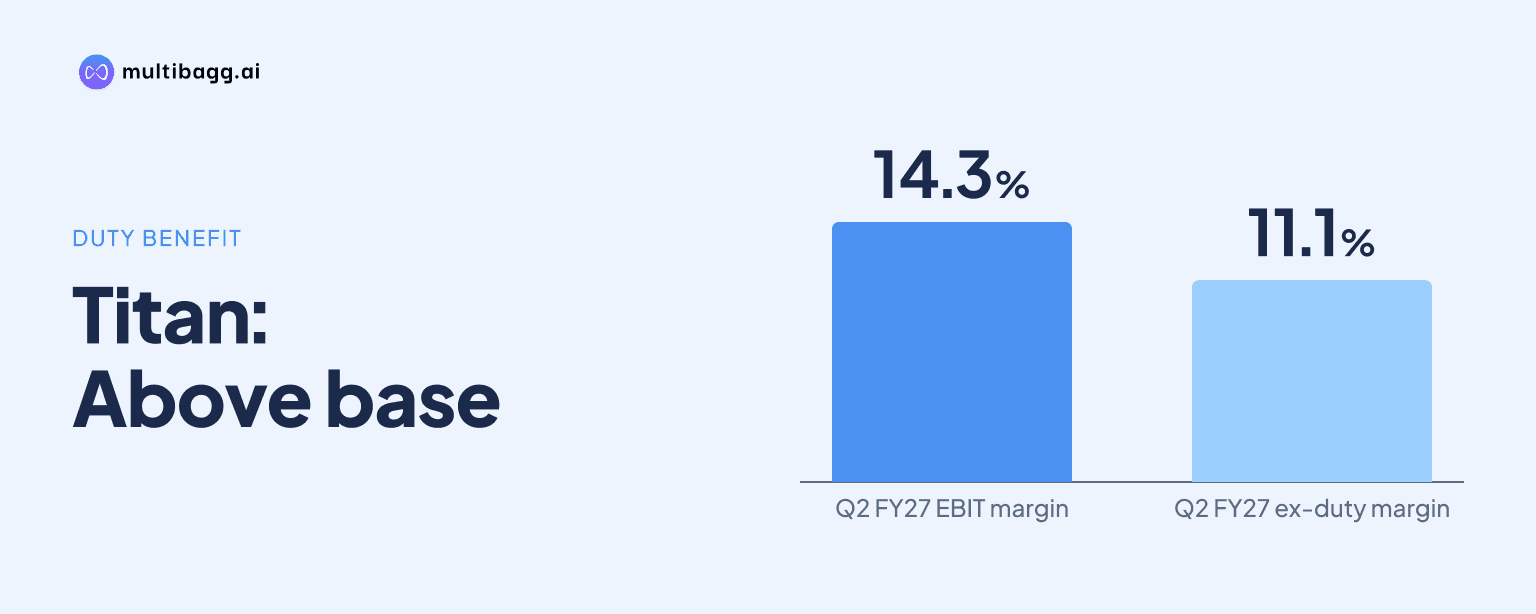
Titan Company reported a 14.3% earnings before interest and tax (EBIT) margin for its domestic Tanishq, Mia and Zoya portfolio in Q2FY27, but a ₹490 crore one-time customs-duty benefit lifted the result; excluding it, Titan’s EBIT was ₹1,652 crore and its margin was 11.1%.
Know Titan Company inside out
Results, valuation, peers and who's buying, in one view.
Why did Titan’s domestic jewellery EBIT margin reach 14.3%?
Titan’s reported 14.3% margin partly reflected a ₹490 crore one-time customs-duty benefit, which lifted quarterly EBIT to ₹2,142 crore. The domestic Tanishq, Mia and Zoya portfolio recorded revenue of ₹14,935 crore in Q2FY27, up 19.9% from ₹12,460 crore in Q2FY26, while reported EBIT increased 55.1% from ₹1,381 crore.
Excluding the duty benefit, Titan said EBIT was ₹1,652 crore, equal to an 11.1% margin and growth of about 20% from the prior year. The ₹490 crore item represented about 64% of the ₹761 crore increase in reported EBIT between the two quarters, based on the disclosed figures. It also accounts for much of the 3.2-percentage-point gap between the reported and normalised margins.
Titan’s wider domestic jewellery business, including CaratLane, reported EBIT of ₹2,281 crore on revenue of ₹16,343 crore in Q2FY27. That produced a 14.0% margin, compared with 11.0% on ₹1,490 crore of EBIT and ₹13,532 crore of revenue a year earlier. Titan disclosed separate duty benefits for the Tanishq, Mia and Zoya portfolio and CaratLane, rather than a normalised margin for the combined domestic business.
How did Titan’s underlying domestic jewellery demand change?
Titan’s domestic Tanishq, Mia and Zoya portfolio grew about 20% year on year, while like-for-like sales growth was about 15% in Q2FY27. Titan said consumer demand remained largely resilient despite a strong Q2FY26 comparison base and a shift in the festive calendar. Across all domestic brands, overall secondary growth was 21% and like-for-like growth was 15%.
Higher average ticket sizes, rather than a larger buyer base, led the portfolio’s growth. Titan said consumers continued to prefer design-led jewellery, lifting ticket sizes, while buyer growth was flat year on year. The ₹14,935 crore revenue increase was therefore achieved without growth in the portfolio’s buyer base.
Studded jewellery was the faster-growing major category, rising about 32% year on year during the Festival of Diamonds campaign. Plain gold jewellery grew about 20%, while coins declined about 7% as investment-led buying in the base quarter tapered. The domestic product mix, including CaratLane, shifted to 35% studded jewellery in Q2FY27 from 32% in Q2FY26, while gold, coins and other products fell to 65% from 68%.
Got a follow-up? Ask IRIS
How did CaratLane and international jewellery perform?
Titan’s CaratLane revenue rose about 31% to ₹1,408 crore in Q2FY27, ahead of the 19.9% growth in the Tanishq, Mia and Zoya domestic portfolio. CaratLane’s studded portfolio grew about 33%, while its gold jewellery portfolio grew about 20%. Titan attributed double-digit buyer growth partly to advertising, promotions and offers during the quarter.
CaratLane’s reported EBIT rose 27% to ₹138 crore, but its reported margin declined to 9.8% from 10.1% in Q2FY26. After adjusting for its ₹46 crore customs-duty benefit, EBIT was ₹92 crore and the margin was 6.6%, with adjusted EBIT declining about 15% year on year. The duty benefit was therefore material to CaratLane’s reported quarterly profit as well.
International jewellery revenue increased to ₹1,152 crore from ₹561 crore, although Titan said the figures are not strictly comparable because Damas was included after its acquisition. Tanishq, Mia and CaratLane international revenue grew 40.6% to ₹788 crore, producing EBIT of ₹43 crore and a 5.5% margin, versus ₹16 crore and 2.8% a year earlier. Damas core contributed ₹364 crore of revenue but posted an EBIT loss of ₹24 crore, equal to a negative 6.5% margin.
What did Titan add to its jewellery retail network?
Titan added 29 net stores across Tanishq, Mia and beYon in Q2FY27, comprising seven Tanishq stores, 18 Mia stores and four beYon stores. At September 2026, Tanishq had 539 domestic stores in 318 towns, while Mia had 317 domestic stores in 125 towns. beYon reached six stores across four towns after its four net additions.
CaratLane added 13 net domestic stores, ending September 2026 with 394 domestic stores in 167 towns and 522,000 square feet of retail area. Tanishq added one international store in Los Angeles, taking its international store count to 32. Titan separately said its international portfolio footprint was 33 stores at September 30, 2026.
Damas had 122 core stores across six Gulf Cooperation Council countries at September 30, 2026, after opening two stores and closing two during the quarter. Its core revenue was ₹364 crore, while Tanishq-converted stores operated with Damas as franchise partner generated ₹110 crore. Titan said consumer demand in the region remained soft amid geopolitical disruptions, requiring retail and promotional initiatives.
Conclusion
Titan’s Q2FY27 domestic jewellery performance combined revenue growth, a higher studded mix and larger ticket sizes with a significant one-time profitability benefit. The Tanishq, Mia and Zoya portfolio’s 14.3% reported EBIT margin was above its 11.1% normalised margin, while CaratLane’s 6.6% duty-adjusted margin showed a different profit trend despite about 31% revenue growth.
What to watch next is whether management’s stated investments in consumer engagement, advertising and promotional offers support buyer growth and margins after the customs-duty benefits. Titan also disclosed ongoing Gulf demand disruption affecting Damas, whose core business recorded a ₹24 crore quarterly EBIT loss, alongside continued network expansion across its jewellery brands.