










Titan Company cuts emerging-business EBIT loss to Rs 6 crore
Key highlights
- Titan's emerging-business EBIT loss narrowed to Rs 6 crore in Q2FY27 from Rs 24 crore in Q2FY26.
- Titan's emerging-business Total Income rose 20.8% to Rs 171 crore in Q2FY27 from Rs 142 crore.
- Taneira ended September 2026 with 76 stores, down one from June 2026, while Irth reached 21 stores after adding two.
- Taneira reported 16% overall Secondary UCP growth and 13% like-to-like growth in Q2FY27.
powered by IRIS
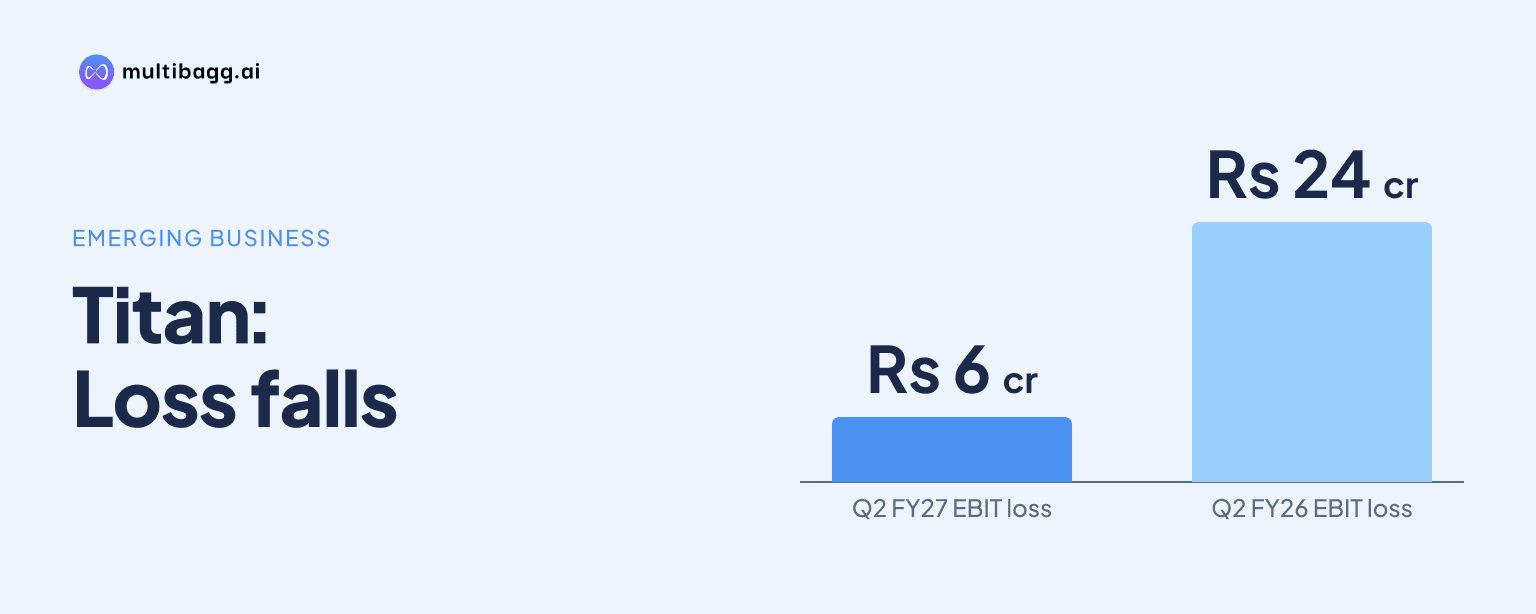
Titan Company cut the combined emerging-business earnings before interest and tax, or EBIT, loss to Rs 6 crore in Q2FY27 from Rs 24 crore in Q2FY26, as total income increased 20.8% to Rs 171 crore and the fragrances business delivered higher profitability.
Know Titan Company inside out
Results, valuation, peers and who's buying, in one view.
How did Titan's emerging-business financial performance change?
Titan reported a Rs 6 crore EBIT loss for its emerging-business portfolio in Q2FY27, compared with a Rs 24 crore loss in Q2FY26. The Rs 18 crore reduction took the EBIT margin, measured as EBIT divided by total income, to negative 3.5% from negative 16.8%. Titan specifically attributed the narrower combined loss to higher profitability in fragrances.
Total income rose by Rs 29 crore year on year to Rs 171 crore in Q2FY27 from Rs 142 crore in Q2FY26. That equals 20.8% growth, while Titan's quarterly narrative described emerging-business revenue growth as approximately 18%. The presentation does not reconcile the difference between its Total Income line and the approximate revenue-growth statement.
The income increase and loss reduction moved at different rates during the quarter: income rose 20.8%, while the EBIT deficit declined by Rs 18 crore. Titan did not disclose revenue, EBIT or margin by Taneira, Irth, Fastrack Bags, Skinn or Fastrack fragrances, so the financial contribution of each category cannot be calculated from the presentation.
Which categories drove Titan's emerging-business growth?
Titan said fragrances were the stated driver of the portfolio's profitability improvement in Q2FY27. Skinn and Fastrack fragrances delivered another quarter of robust growth, supported by strong double-digit volume growth and mid-single-digit average selling price, or ASP, expansion. Titan did not provide fragrance sales, volume, ASP or standalone EBIT figures.
Women's Bags grew in the high-teens, with Titan linking the result to new store openings and higher ASPs across Irth and Fastrack. Irth added two net stores in the quarter, reaching 21 at September 2026 from 19 at June 2026. The presentation does not separate the contribution of Irth from Fastrack Bags or quantify the effect of store openings versus ASP growth.
Taneira grew in the high-single-digits in Q2FY27 while focusing on same-store performance. Titan reported 16% year-on-year overall Secondary UCP growth and 13% like-to-like growth, leaving the like-to-like measure 3 percentage points below the overall measure. The supplied presentation does not define Secondary UCP.
Got a follow-up? Ask IRIS
How did Titan's emerging-business retail network change?
Taneira ended September 2026 with 76 stores, down one from 77 at June 2026. Its retail area declined to 222 thousand square feet from 226 thousand square feet, while its presence remained at 41 towns. This smaller network coincided with high-single-digit quarterly growth and 13% like-to-like growth.
Irth expanded from 19 stores at June 2026 to 21 at September 2026, while retail area increased to 10 thousand square feet from 8 thousand square feet. Its town presence rose to 16 from 12. Titan cited new store openings alongside higher ASPs in explaining high-teens growth in Women's Bags.
Skinn remained at two stores, 0.3 thousand square feet of retail area and two towns between June and September 2026. Its reported fragrance growth and higher profitability therefore came without a change in dedicated Skinn store count. Titan does not state how Skinn and Fastrack fragrances are distributed beyond these dedicated Skinn stores.
Titan notes that net changes in retail area include existing-store refurbishments. Store-count changes and area changes therefore do not have a direct one-to-one relationship, including Taneira's 3-thousand-square-foot area reduction and Irth's 2-thousand-square-foot increase during the quarter.
What actions did Titan disclose across these brands?
Titan introduced Skinn's “Make Every Moment Special” campaign with brand ambassadors Ayushmann Khurrana and Sobhita Dhulipala. The campaign positioned fine fragrance as an everyday ritual rather than an occasion-led indulgence. It accompanied strong double-digit fragrance-volume growth and mid-single-digit ASP expansion across Skinn and Fastrack.
Fastrack Bags introduced its “Carry More, Weigh Less” laptop collection, aimed at students and young professionals. Titan described lightweight designs, contemporary colours and functional features, while reporting high-teens growth for Women's Bags. The presentation does not disclose the collection's launch date, sales contribution or impact on segment profitability.
Taneira ran its “Drapes of Gratitude” campaign around gifting sarees to teachers and mentors, while retaining its focus on same-store performance. The brand had 76 stores across 41 towns at September 2026, compared with 77 stores across the same 41 towns at June 2026. Titan did not disclose whether the 222-thousand-square-foot network includes franchise and company-operated locations.
Conclusion
Titan's Q2FY27 result shows an emerging-business portfolio that remained loss-making but reduced its EBIT deficit by Rs 18 crore year on year. Total income reached Rs 171 crore, fragrances supplied the stated profitability improvement, Women's Bags grew in the high-teens, and Taneira delivered high-single-digit growth despite a one-store reduction.
The next disclosures will indicate whether fragrance profitability and Taneira's same-store focus can sustain the lower loss as Irth expands its network. Titan disclosed 21 Irth stores, 76 Taneira stores and two Skinn stores at September 2026, but gave no break-even target or timing for the combined emerging-business portfolio.