










Titan approves ₹2,500 crore unsecured NCD funding programme
Key highlights
- Titan approved a private-placement NCD programme of up to ₹2,500 crore on 5 November 2026.
- The proposed NCDs are rated, listed, redeemable and unsecured.
- Titan reported Q2FY27 consolidated total income of ₹20,533 crore, up 25% year on year.
- A board committee will finalise NCD terms and allotments before Titan makes further issuance disclosures.
powered by IRIS
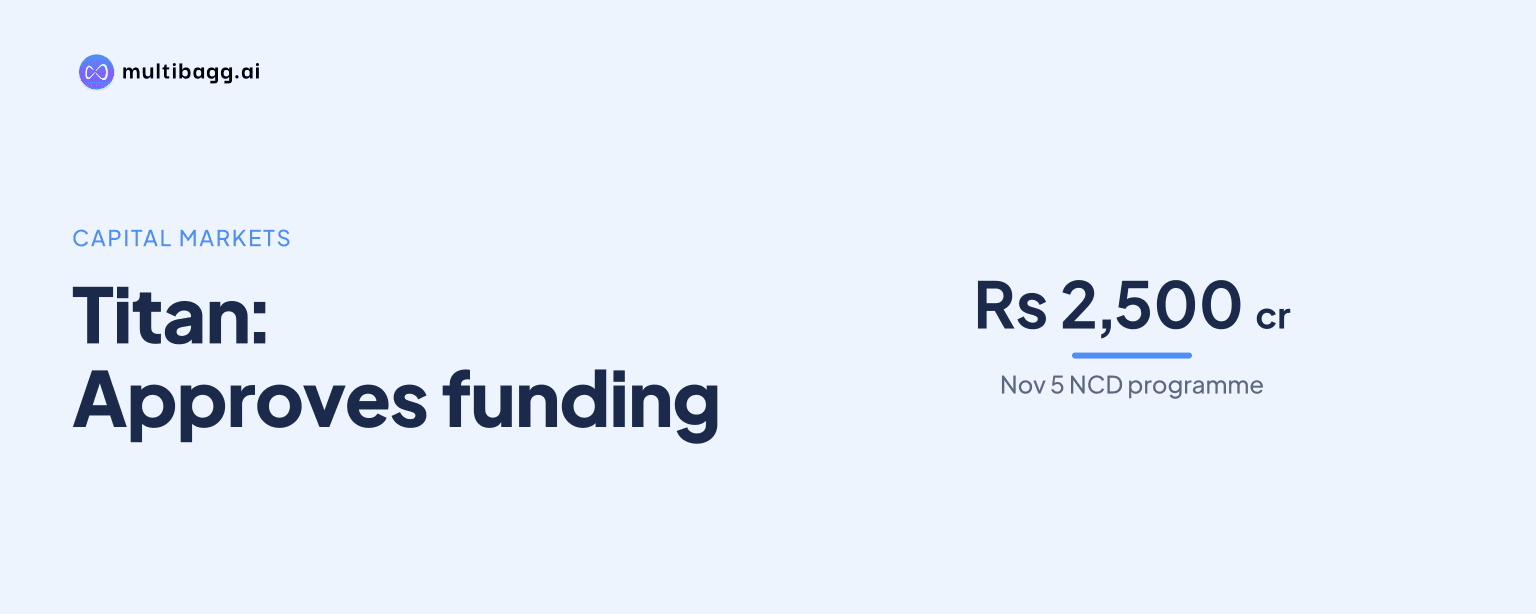
Titan Company Limited approved on 5 November 2026 a private-placement programme of up to ₹2,500 crore of rated, listed, redeemable and unsecured Non-Convertible Debentures. The approval authorises a maximum debt-raising amount, while a board committee will set terms and allotments; Titan disclosed neither an issue date nor an amount already issued.
Know Titan Company inside out
Results, valuation, peers and who's buying, in one view.
What did Titan approve on 5 November 2026?
Titan approved a proposal to raise up to ₹2,500 crore through Non-Convertible Debentures, or NCDs, on a private-placement basis at its board meeting on 5 November 2026. The stated amount is the programme ceiling approved by the board, not confirmation that Titan has issued, allotted or received the full ₹2,500 crore.
The board meeting began at 2:00 p.m. and concluded at 4:15 p.m. on 5 November 2026. Titan said the proposal covered rated, listed, redeemable and unsecured NCDs, but did not disclose the intended use of proceeds, linking the potential funding neither to a business segment nor to a specific capital, acquisition, repayment or working-capital plan.
What are the terms of Titan's proposed NCDs?
Titan's proposed NCDs are rated, listed, redeemable and unsecured instruments to be issued through private placement, subject to the ₹2,500 crore limit. A Non-Convertible Debenture is the full description used in the 5 November 2026 board outcome, while NCD is the abbreviation used for the proposed securities.
The private-placement mechanism distinguishes the planned issuance from a public offer. Titan said the NCDs would be listed, but the disclosure does not identify the exchange on which they would trade, a credit-rating agency, a rating grade, the number of NCDs, or whether the programme would be executed through one issue or multiple tranches.
Titan also disclosed that the NCDs would be redeemable and unsecured. However, the 5 November 2026 announcement gives no redemption date, tenure, repayment structure, coupon rate, issue price, security arrangement or investor list, leaving the commercial terms unresolved at the programme-approval stage.
Who will decide Titan's NCD issue and allotment terms?
A committee of Titan's board will finalise the NCD issuance terms and allotments after the board's 5 November 2026 approval. The delegation covers all actions concerning finalisation of issuance terms and allotment, while the board has fixed the maximum programme amount at ₹2,500 crore.
Titan did not identify the committee members or specify a deadline for an issuance decision. It also did not state a first-tranche amount, meaning the filing does not establish how much, if any, of the ₹2,500 crore authorisation will be used in an initial allotment.
Titan said disclosures required under Regulation 30 of the Securities and Exchange Board of India, or SEBI, Listing Obligations and Disclosure Requirements Regulations, 2015 would be made at the appropriate stage upon issuance and/or allotment. This sequence makes the 5 November decision an authorisation for a funding route rather than a report of completed borrowing.
Got a follow-up? Ask IRIS
How did Titan's latest financial results compare?
Titan reported consolidated total income of ₹20,533 crore for Q2FY27, up 25% from ₹16,407 crore in Q2FY26, alongside the NCD programme approval on 5 November 2026. Total income in the company's presentation excludes bullion and digi-gold sales, as well as a non-operational Ind-AS credit of ₹671 crore.
For Q2FY27, Titan reported profit before tax of ₹2,329 crore, compared with ₹1,522 crore in Q2FY26, while its reported profit before tax margin rose to 11.3% from 9.3%. The company said reported Q2FY27 profit included ₹536 crore of gains from a gold custom-duty increase; excluding that quarterly gain, it reported profit before tax of ₹1,793 crore and an 8.7% margin.
Titan's Jewellery portfolio grew 24% to ₹17,495 crore in Q2FY27, excluding bullion and digi-gold sales, while the Watches portfolio rose 27% to ₹1,881 crore and EyeCare grew 28% to ₹281 crore. The segment figures show Jewellery remained the largest reported portfolio by revenue, while Watches and EyeCare posted higher percentage growth than Jewellery during the quarter.
What other board decisions were announced?
Titan's board approved unaudited standalone and consolidated results for Q2FY27 and H1FY27 ended 30 September 2026. B S R & Co. LLP, the statutory auditors at the time of the results, issued a limited-review report with an unmodified opinion, according to the 5 November 2026 outcome.
The board said Noel N. Tata would retire as Vice Chairman and Director with effect from 12 November 2026 under Tata Group Governance Guidelines. Titan said he had been associated with the company since August 2003 and recorded its appreciation for his contribution over the past 23 years; the announcement did not name a successor for either role.
Titan also approved and recommended the appointment of Price Waterhouse Chartered Accountants LLP as statutory auditor for five years, subject to shareholder approval. The proposed term would run from the conclusion of the 43rd Annual General Meeting in 2027 to the conclusion of the 48th Annual General Meeting thereafter.
Conclusion
Titan's board has created an authorised private-placement route for up to ₹2,500 crore of unsecured NCDs, but has not reported a completed debt issue. The company paired that authorisation with Q2FY27 consolidated total income of ₹20,533 crore and profit after tax of ₹1,722 crore, while providing no stated use of proceeds or initial issue size.
The next disclosed trigger is an issuance or allotment, when Titan said it would make the required Regulation 30 disclosure. That update may clarify the coupon, tenure, rating, issue size, allotment and redemption terms that remain undisclosed; shareholders are also due to consider the proposed five-year auditor appointment at the 43rd Annual General Meeting in 2027.