










Triveni Turbine enters combined-cycle with 50 MW steam order
Key highlights
- Triveni Turbine received a 50 MW steam-turbine order for a combined-cycle conversion behind a pre-existing 150 MW gas-turbine plant.
- Combined-cycle opportunities represent less than 5% of Triveni Turbine’s total enquiry book.
- Triveni Turbine’s enquiry book was about 18 GW at FY26 end and was broadly flat in H1 FY27.
- Domestic order booking in Q2 FY27 was twice the Q1 FY27 level, according to management.
powered by IRIS
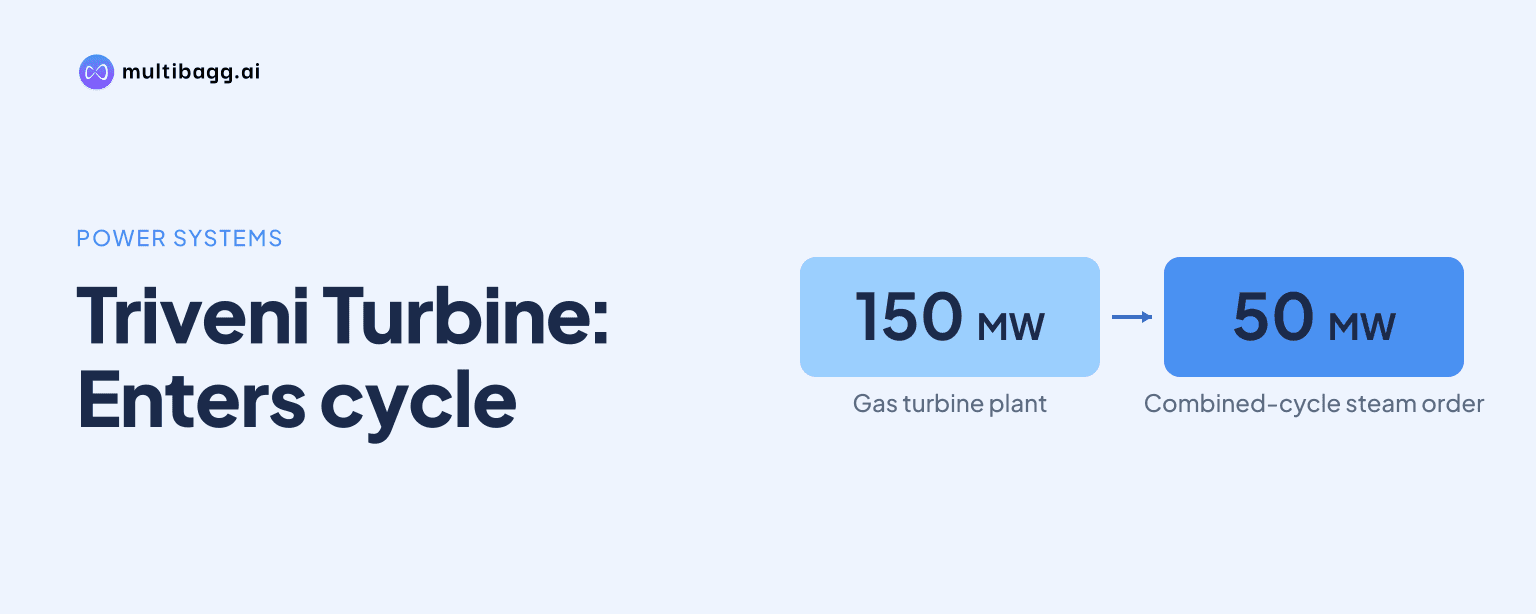
In Q2 FY27, Triveni Turbine received a 50 MW steam-turbine order to add combined-cycle capacity to a pre-existing 150 MW gas-turbine plant, creating an execution reference in a segment that accounts for less than 5% of its enquiry book. Management said the project opens a difficult market but is not a rapid-growth driver.
Know Triveni Turbine inside out
Results, valuation, peers and who's buying, in one view.
What does Triveni Turbine’s 50 MW combined-cycle order include?
Triveni Turbine’s scope is a 50 MW steam turbine added to an existing gas-turbine installation, not the supply of a gas turbine. Management said the project has a 3:1 relationship between the steam-turbine capacity and the gas-turbine capacity, indicating that the steam turbine will sit behind a 150 MW gas-turbine power plant. The company stated that it does not manufacture gas turbines.
Management described the transaction as an add-on to a pre-existing gas turbine in a simple-cycle-to-combined-cycle conversion. In a simple-cycle plant, the gas turbine generates power directly; the added steam turbine uses heat from the gas-turbine process in the combined-cycle arrangement. The 50 MW order was placed directly by the client, whereas Triveni Turbine said it would often quote to engineering, procurement and construction, or EPC, contractors and boiler manufacturers that integrate equipment for other combined-cycle projects.
Has Triveni Turbine confirmed this is a US data-centre order?
No, Triveni Turbine did not confirm on the call that the 50 MW order is in the United States or that it is for a data centre. An analyst asked whether the order was the data-centre opportunity discussed during the preceding two quarters and later asked whether it was from the US market. Management answered by explaining the 50 MW steam-turbine scope and the 150 MW gas-turbine configuration, without identifying the country, customer or end application.
Triveni Turbine did say that US enquiry visibility had risen substantially by H1 FY27, with opportunities split between data-centre combined-cycle operations and other industrial uses. Management also identified novel energy-storage and carbon-capture projects as newer US enquiry areas. These comments establish the US as an expanding source of opportunities, but they do not establish a connection between the announced 50 MW order and any US data-centre project.
How large is combined cycle in Triveni Turbine’s pipeline?
Gas-turbine combined-cycle opportunities represent less than 5% of Triveni Turbine’s total enquiry book. Management said the addressable market is large, but gas-turbine original equipment manufacturers, or OEMs, have historically held a strong position in it. Therefore, more than 95% of the company’s pipeline lies outside the combined-cycle category described in the call.
The total enquiry book was about 18 gigawatts, or GW, at the end of FY26, comprising about 7 GW of domestic enquiries and 11 GW of export enquiries. Triveni Turbine said the aggregate pipeline was broadly flat in H1 FY27, but regional trends differed: US visibility increased substantially, while Central and South American enquiries declined. India, Southeast Asia and Europe were described as broadly flat, making the combined-cycle opportunity a change in the mix rather than an increase in the total enquiry base.
Got a follow-up? Ask IRIS
What does the 50 MW order mean for Triveni Turbine’s market entry?
The 50 MW order gives Triveni Turbine and its clients an execution reference in combined-cycle conversion, but management said it does not expect very rapid growth from the segment. Management called it a tough market to enter and said the order opens doors by building confidence in the company’s ability to execute. That positioning distinguishes a strategic entry from a near-term volume target.
Management said the 50 MW steam-turbine order follows the average pricing used in export markets. It also said export margins are significantly higher than domestic margins, while clarifying that the relevant scope remains the steam turbine rather than the pre-existing 150 MW gas turbine. The comparison concerns the company’s export steam-turbine business and does not provide a separate price or margin benchmark for combined-cycle projects.
How does this order fit Triveni Turbine’s wider booking outlook?
The 50 MW project was disclosed alongside management’s expectation of stronger order finalisation in Q3 FY27. Domestic order booking in Q2 FY27 was twice the Q1 FY27 level, according to management, after order finalisation was delayed in sectors including cement and steel. Management also said international business performed better than the prior year, making domestic bookings appear lower relative to exports.
Triveni Turbine cited thermal-power additions, commodity demand, process cogeneration and boiler-feed-pump drive requirements as supports for domestic demand. For exports, management said deferred dispatches to Middle East customers were expected to occur in Q3 and Q4 FY27 as transportation conditions eased. It also said about 80% of the order book at the beginning of a financial year is typically executed within that year, although larger turbines and complex refurbishment work can extend delivery cycles.
How could execution cycles affect Triveni Turbine’s revenue timing?
Triveni Turbine said the revenue timing of the 50 MW order will depend on its product execution schedule, while larger-capacity turbines generally take longer to manufacture than smaller units. Management did not disclose a delivery date for this order. It said product orders, including higher-megawatt equipment, can have a more prolonged execution cycle than spares and routine service work.
Within the aftermarket, Triveni Turbine said spares usually take three to four months from order to execution and servicing takes about a quarter. Refurbishment can take five to six months or nine to 12 months depending on the work, with current higher-value refurbishment work typically taking about three quarters. This variation explains why order booking may not translate into revenue in the same quarter, even as management expects most beginning-of-year order book to be executed during the financial year.
Conclusion
The 50 MW order establishes Triveni Turbine’s participation in a combined-cycle conversion involving a pre-existing 150 MW gas-turbine plant. Its importance is strategic rather than based on current pipeline scale: management places combined-cycle opportunities at less than 5% of the enquiry book, even as US visibility has increased and the overall pipeline remained broadly flat against the 18 GW reported at FY26 end.
The next disclosures to watch are Q3 FY27 order finalisation, deferred Middle East export dispatches expected in Q3 and Q4 FY27, and whether increased US enquiries produce further orders. Management has not provided a rapid-growth target for combined cycle and has instead said the 50 MW order must demonstrate execution capability in a market where gas-turbine OEMs are established.