










Triveni Turbine sees H2 export mix lift margins after NTPC drag
Key highlights
- Only about 15% of the low-to-negative-margin NTPC order remains to be billed, split between Q3 and Q4 FY27.
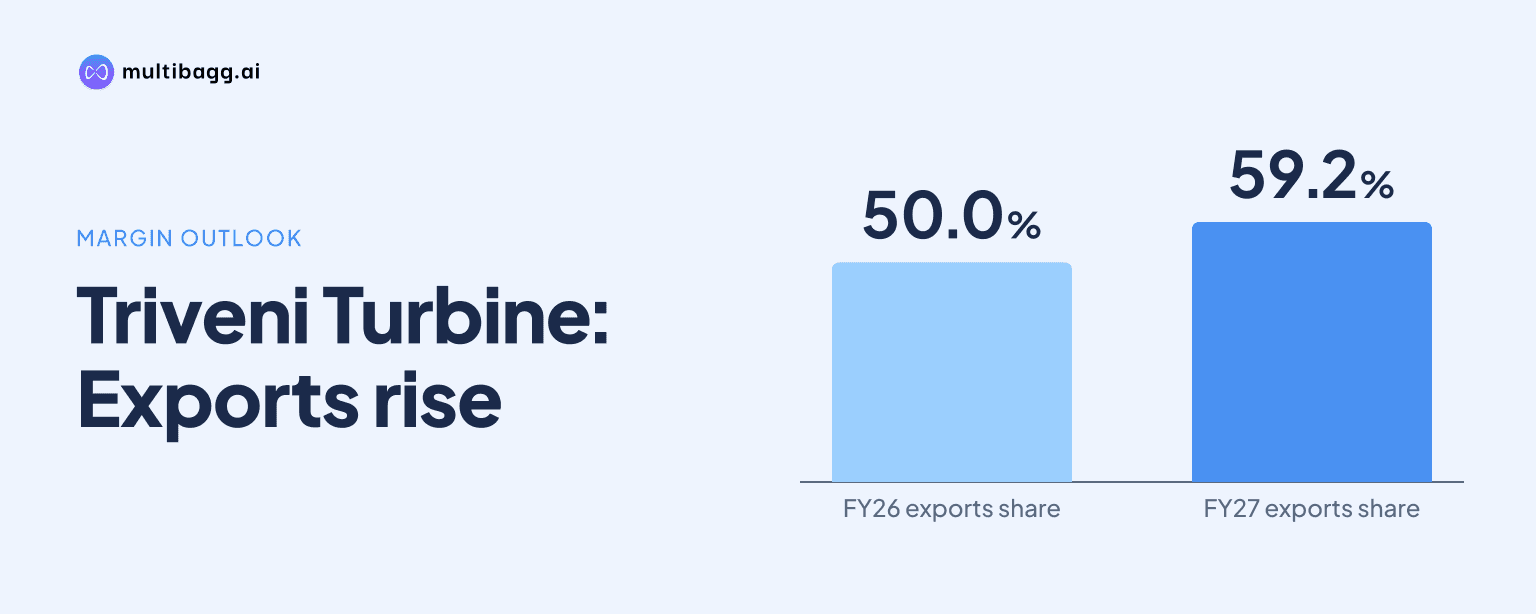
- Exports represented 59.2% of Triveni’s Rs 2,453 crore closing order book, up from 50.0% a year earlier.
- The aftermarket closing order book rose 105.4% year on year to Rs 639 crore and reached 26% of the total book.
- Management said consolidated FY27 EBITDA should be roughly consistent with FY26 despite a healthier H2 mix.
powered by IRIS
Triveni Turbine expects margins to improve in the second half of financial year 2027 (H2 FY27) because only about 15% of its low-to-negative-margin NTPC order remains to be billed and deferred exports are scheduled for the third and fourth quarters (Q3 and Q4). Management nevertheless said consolidated earnings before interest, tax, depreciation and amortisation (EBITDA) for FY27 should be roughly consistent with FY26.
Know Triveni Turbine inside out
Results, valuation, peers and who's buying, in one view.
Why does Triveni expect H2 FY27 margins to improve?
Triveni expects a healthier H2 FY27 margin mix because exports and aftermarket will account for a significantly larger share of billing than in the first half. Management said the remaining NTPC billing, equal to about 15% of that order’s value, will be split equally between Q3 and Q4, while exports deferred by freight-related issues are now expected to be recognised in those two quarters.
Triveni described the NTPC project as a strategic order carrying a low-to-negative margin, with losses already accounted for conservatively. Management said any later claims would only benefit Triveni rather than being necessary to recognise the existing loss. The NTPC project is expected to be commissioned in Q4 FY27, after which its contribution to domestic product billing will diminish.
The recovery is expected to build through the second half rather than arrive evenly in both quarters. Management said the mix would revert significantly in H2 FY27 and more in Q4 than Q3. It also said commodity-cost disruptions seen in the first quarter (Q1) should normalise by Q4, providing greater visibility for financial year 2028 (FY28), although it did not provide a quarterly EBITDA margin target.
How has Triveni’s order book shifted toward exports and aftermarket?
Triveni’s closing order book has shifted materially toward exports and aftermarket, which management identifies as the main drivers of company margins. The closing order book stood at Rs 2,453 crore, up 10.5% year on year, and export orders represented 59.2% of it, compared with 50.0% a year earlier. Export order booking rose 29.3%.
Aftermarket order booking grew 12.3% and represented 29% of incoming orders. More importantly for future execution, the aftermarket closing order book more than doubled, rising 105.4% year on year to Rs 639 crore. Its share of the total closing order book rose to 26% from 14%, following contract wins across thermal, renewable, combined-cycle, utility, geothermal and other value-added service segments.
The mix differs from the domestic business, where management said pricing is significantly lower than in global markets. Domestic order booking was down 16%, although Q2 domestic orders were twice Q1 levels after delayed finalisation in cement and steel. Management said the domestic market itself has grown, principally in metals, but Triveni’s market share has declined in certain segments, including larger 40 megawatt (MW) and 50 MW turbines.
What does management expect for FY27 revenue and EBITDA?
Management expects FY27 revenue growth over FY26 and a recovery in profitability, but it expects consolidated EBITDA to be roughly consistent with FY26. This distinction reflects the NTPC drag, the timing of deferred export dispatches and management’s view that some Q3 and Q4 work could have better margin implications. It did not endorse an analyst suggestion that H2 margins could be 18% to 19%.
Triveni said first-half FY27 revenue had grown roughly 6% to 7%, while it expects some growth for the full financial year because it must execute commitments already made to customers. Management characterised FY27 profitability growth as not significant on a year-on-year basis, despite saying H2 product mix should be significantly healthier. The outlook therefore points to a second-half mix improvement without a disclosed full-year margin percentage.
Management also said new advanced product platforms are expected to have a better cost structure than current platforms and should affect margins positively as they are rolled out in coming quarters. That is a stated plan rather than a quantified forecast. Triveni said it remains focused on increasing installed base, references in higher-MW applications and global-market penetration, even where new-product entry can affect near-term margins.
Got a follow-up? Ask IRIS
When will deferred exports and aftermarket orders become revenue?
Triveni expects most freight-related export deferments to be reflected in Q3 and Q4 FY27, particularly for Middle East customers. Management did not disclose the quantum outstanding, but said H2 export revenue as a percentage of total revenue would be much higher than in the first half. Transportation conditions were said to be easing for the majority of affected deliveries.
Aftermarket revenue conversion depends on the service type. Spares for Triveni’s installed base usually take three to four months from order to execution, while manpower-based servicing generally takes about one quarter. Refurbishment has a longer cycle of about five to six months to nine to 12 months, depending on whether the work is an overhaul, upgrade or another higher-value service.
Management said about 80% of the order book at the beginning of a financial year is typically executed within that year. It added that more complex refurbishment work currently takes around three quarters, and future complex projects could require three to four quarters. This longer conversion profile helps explain why the aftermarket order book can grow faster than reported revenue in a given quarter.
Which markets could support Triveni’s export mix?
Triveni sees a broad export opportunity from electrification, industrial power requirements, combined-cycle projects, energy storage and refurbishment, although management said the enquiry book was broadly flat overall in the first half of FY27. The United States (US) enquiry pipeline increased substantially, supported by data-centre combined-cycle opportunities, industrial demand, novel energy-storage projects and carbon-capture applications.
One Q2 FY27 order was for a 50 MW steam turbine added to an existing gas-turbine configuration, implying a 150 MW gas-turbine power plant on a three-to-one basis. Management said it was a combined-cycle, data-centre application and followed average export pricing. Combined-cycle opportunities account for less than 5% of the entire enquiry book, so management does not expect rapid growth from that market alone.
Triveni also secured long-term gas-turbine refurbishment work through its South African subsidiary, involving parts upgrades, replacement, manufacturing and installation with a European partner. Management said the potential market opportunity would play out over four to five years, but billings depend on assessed overhaul needs. It plans to expand services and parts activity while pursuing multi-year development of a small gas-turbine product for thrust applications.
Conclusion
Triveni’s disclosed order-book mix and execution timing point to a different revenue composition in the second half of FY27: exports accounted for 59.2% of the Rs 2,453 crore closing order book, while aftermarket represented 26%, up from 50.0% and 14% respectively a year earlier. That shift is central to management’s expectation of healthier H2 margins, even as it expects full-year consolidated EBITDA to remain roughly in line with FY26.
The next indicators are Q3 and Q4 export dispatches, NTPC commissioning in Q4 FY27 and the extent to which export and aftermarket execution offsets the project’s legacy drag. Management also expects Q1 commodity-cost effects to normalise by Q4 and said FY28 should offer better visibility, while refurbishment revenue will depend on contracts with delivery cycles ranging from three months to four quarters.