










UDS BSS margin reaches 7.7% as EBITDA rises more than 62%
Key highlights
- UDS BSS revenue increased 11% year on year to Rs 267 crore in Q2 FY27.
- UDS BSS EBITDA rose more than 62% to about Rs 21 crore, lifting margin to 7.7% from 5.3%.
- Denave EBITDA increased 110% to Rs 10 crore in Q2 FY27 and its margin reached 5.6%.
- Athena reported Rs 5.5 crore of EBITDA at a 19% margin and had two revenue-generating agentic AI deployments live.
powered by IRIS
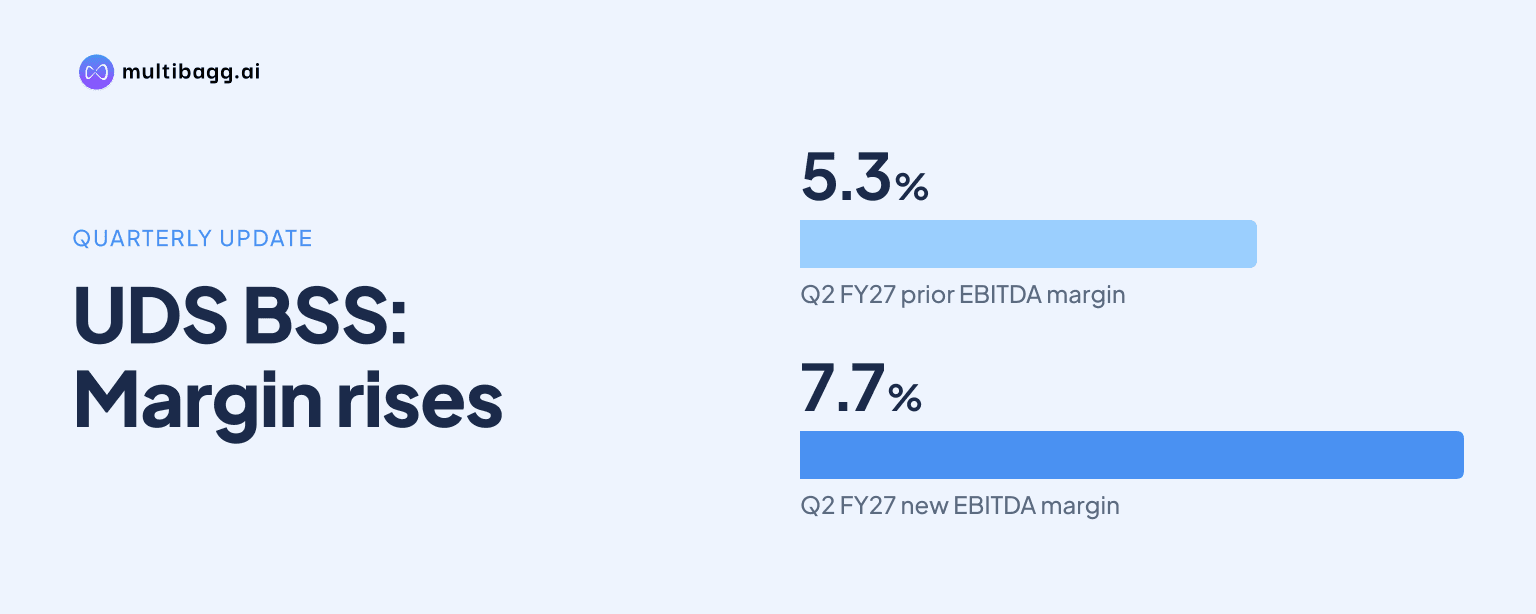
Updater Services Limited (UDS) reported a 7.7% Business Support Services (BSS) earnings before interest, tax, depreciation and amortisation (EBITDA) margin in Q2 FY27, up from 5.3% a year earlier, as segment EBITDA rose more than 62% to about Rs 21 crore. Management attributed the improvement to restructuring, cost control, delivery gains and paid artificial intelligence (AI)-led and outcome-linked services.
Know Updater Services inside out
Results, valuation, peers and who's buying, in one view.
What drove UDS BSS margin expansion in Q2 FY27?
UDS expanded BSS margin because revenue grew while its operating companies improved delivery and reduced their cost to serve. BSS revenue rose 11% year on year to Rs 267 crore in Q2 FY27 from Rs 240 crore in Q2 FY26, while EBITDA increased more than 62% to about Rs 21 crore. The resulting 7.7% margin was 2.4 percentage points above the 5.3% reported a year earlier.
Management said the direct reporting of Denave, Athena and Matrix to senior leadership had, over the previous two quarters, enabled faster decisions, tighter cost control and clearer accountability. Denave also initiated closure of two small step-down subsidiaries, Denave Europe and Denave Korea. Management said the closures would not have a material financial effect but would reduce organisational complexity.
The Q2 result extended a first-half trend. BSS revenue for H1 FY27, or the first half of financial year 2027, increased 9% year on year to Rs 520 crore, while EBITDA grew 36.4% to about Rs 40 crore. The H1 margin reached about 7.6%, compared with 6% in H1 FY26, and management said the gain came alongside revenue growth rather than from cutting activity.
How did Denave contribute to UDS BSS improvement?
Denave contributed through revenue growth, outcome-linked Demand Gen delivery and cost discipline. Its Q2 FY27 revenue increased 17% year on year to Rs 175 crore, while EBITDA rose 110% to Rs 10 crore. EBITDA margin reached 5.6%, compared with 3.2% in Q2 FY26, and profit after tax rose 160% to Rs 8.5 crore.
Management said both Demand Gen and field marketing services drove Denave's growth. Demand Gen had faced margin pressure in Q1 FY27, but management said AI-supported delivery generated higher income on contracts tied to client outcomes in Q2. Field marketing continued to grow and, although management said it carries lower margins than Demand Gen, it creates recurring engagements and cross-selling opportunities for digital and Demand Gen services.
Denave is using its Intellibank platform to combine intent, enterprise technology and engagement data for each target account. The platform maps decision-makers, recommends a next action and produces outreach content including call scripts and personalised emails. Management said AI agents are being scaled across research, qualification and follow-up tasks, allowing staff to focus on conversations intended to convert sales pipelines into revenue.
How is Athena monetising agentic AI services?
Athena began earning revenue from two live agentic AI deployments while maintaining a 19% EBITDA margin in Q2 FY27. Athena reported Rs 29 crore of revenue, Rs 5.5 crore of EBITDA and Rs 3 crore of profit after tax, with profit after tax up 25% year on year. Management said quarterly performance was in line with its internal plan.
One paid AI deployment supports outbound lead generation for a banking, financial services and insurance (BFSI) client, while the other runs service campaigns and captures customer feedback for an industrial company. Both programmes began as proof-of-concept pilots completed in the previous year. Management said their transition into paid live programmes within months demonstrated uses across different industries and service types.
Athena began two client contracts in July, each with an initial two-year term, and reported no client losses in Q2 FY27. It also signed two BFSI clients in October, which management said would ramp gradually and contribute revenue from the following quarter. Approval of AI-based services with existing clients typically takes two to three months, according to management.
Got a follow-up? Ask IRIS
What did Matrix and the BSS mix add?
Matrix added a margin recovery despite revenue increasing only 2% year on year to Rs 32 crore in Q2 FY27. Its EBITDA rose 31% to Rs 4 crore, lifting margin to 12% from 9.4% in the comparable quarter. Management attributed the sustained recovery from Q1 FY27 to cost discipline, process simplification and tighter vendor management.
Matrix's employee background-verification revenue grew 15% year on year to Rs 14 crore, supported by specialised AI and machine-learning hiring in global capability centres. Management said traditional information-technology hiring remained subdued and described white-collar hiring as uneven. Matrix is integrating AI to reduce turnaround time and cost per check when volumes fluctuate.
Sales enablement through Denave and Athena represented about three-fourths of BSS revenue, with Matrix, Avon and Global supplying the balance. Information technology and IT-enabled services represented about 31% of BSS revenue, while BFSI accounted for about 12%. Management said retail, consumer, manufacturing and aviation supplied further diversification across demand cycles.
What is UDS saying about BSS margins in the second half?
UDS gave no formal full-year margin guidance and said BSS margin percentages may face some second-half impact from headwinds in certain businesses. Management nevertheless expects BSS to deliver better FY27 results than FY26, supported by process simplification, cost optimisation, improved productivity and broader technology deployment.
At the consolidated level, UDS reported Q2 FY27 EBITDA of Rs 43.2 crore on revenue of Rs 812 crore, giving a 5.3% margin compared with 4.3% in Q2 FY26. BSS's 7.7% margin exceeded the 4.2% margin in Integrated Facility Management (IFM), although IFM generated Rs 560 crore of revenue against BSS revenue of Rs 267 crore. Employee-benefit expense grew 10% to Rs 628 crore, below the 11% consolidated revenue increase, and fell to 77.3% of revenue from 78.6%.
Conclusion
The Q2 FY27 BSS result combined several operating changes: Denave improved outcome-linked sales delivery with AI tools, Athena converted two AI pilots into paid programmes, and Matrix maintained its cost-led margin recovery. Together, these businesses lifted BSS EBITDA by more than 62% while segment revenue increased 11%.
The next reported test is H2 FY27, when Athena's July and October client wins are expected to ramp and additional AI proposals may receive approval after the stated two-to-three-month process. Management has also identified unresolved pressures in Denave's Demand Gen activity, uneven hiring affecting Matrix and potential second-half BSS margin impact from headwinds in some businesses.