










Updater Services Q2 PAT rises 62% as costs lag revenue
Key highlights
- UDS Q2 FY27 PAT rose 62% year on year to Rs 32.1 crore.
- Q2 FY27 employee benefit expenses rose 10% to Rs 628 crore, against 11% revenue growth.
- UDS consolidated EBITDA margin increased to 5.3% in Q2 FY27 from 4.3% in Q2 FY26.
- BSS EBITDA margin rose to 7.7% in Q2 FY27 from 5.3% a year earlier.
powered by IRIS
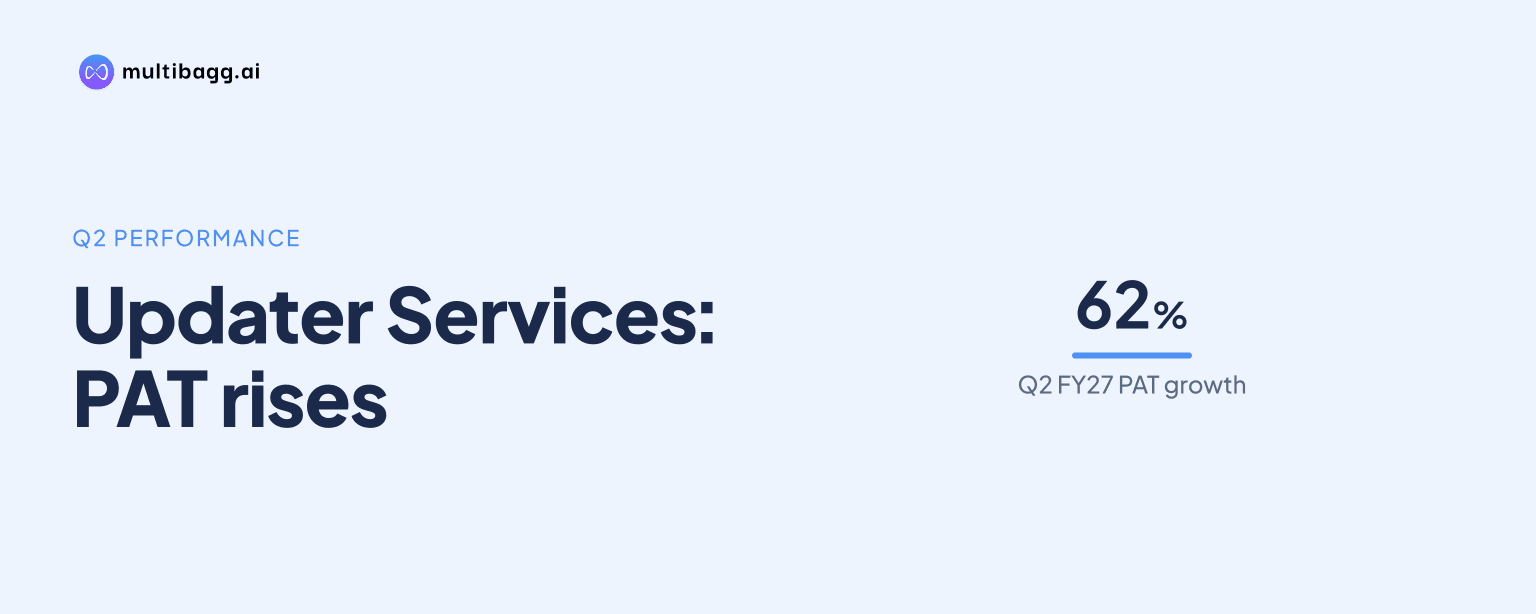
Updater Services reported Q2 FY27 profit after tax of Rs 32.1 crore, up 62% year on year, as revenue from operations grew 11% to Rs 812 crore while employee benefit expenses rose 10%. UDS reduced employee costs to 77.3% of revenue from 78.6% and lifted consolidated EBITDA margin to 5.3% from 4.3%.
Know Updater Services inside out
Results, valuation, peers and who's buying, in one view.
Why did UDS Q2 profit rise faster than revenue?
UDS’s Q2 FY27 profit after tax, or PAT, rose faster than revenue because operating profitability expanded while employee costs grew at a slower rate than sales. Revenue from operations increased 11% to Rs 812 crore, earnings before interest, tax, depreciation and amortisation, or EBITDA, increased 37% to Rs 43.2 crore, and PAT rose from Rs 19.8 crore in Q2 FY26 to Rs 32.1 crore.
The principal reported cost mechanism was employee benefit expenses, which increased 10% to Rs 628 crore in Q2 FY27. Since revenue grew 11%, employee costs fell to 77.3% of revenue from 78.6% in Q2 FY26, a reduction of 1.3 percentage points. Profit before tax rose 47% to Rs 34.7 crore, while earnings per share increased to 4.8 rupees from 3.0 rupees.
The quarterly profit growth was faster than the first-half increase. In H1 FY27, revenue rose 10% to Rs 1,577 crore, EBITDA rose 21% to Rs 85.5 crore, and PAT rose 28% to Rs 62.4 crore. Q2’s 62% PAT growth therefore exceeded the H1 rate, alongside the quarter’s 5.3% EBITDA margin compared with the 5.4% H1 margin.
How did UDS segment margins change in Q2 FY27?
UDS improved margins in both integrated facilities management, or IFM, and business support services, or BSS, during Q2 FY27. IFM revenue grew 11% to Rs 560 crore and generated EBITDA of about Rs 24 crore at a 4.2% margin. BSS revenue also grew 11%, to Rs 267 crore, and generated EBITDA of about Rs 21 crore at a 7.7% margin.
BSS delivered the larger disclosed margin expansion, with EBITDA margin increasing to 7.7% from 5.3% in Q2 FY26 and segment EBITDA rising more than 62%. Management attributed the improvement to new client wins, better delivery and lower cost to serve across BSS businesses. It said the margin gain occurred alongside, rather than instead of, revenue growth.
The revenue mix was approximately 68% IFM and 32% BSS in Q2 FY27, broadly consistent with previous quarters. Although BSS was smaller by revenue, its EBITDA of about Rs 21 crore was close to IFM’s approximately Rs 24 crore because its 7.7% margin was higher than IFM’s 4.2% margin.
In H1 FY27, IFM revenue rose 11% to Rs 1,084 crore while BSS revenue increased 9% to Rs 520 crore. BSS EBITDA rose 36.4% to about Rs 40 crore and its margin improved to about 7.6% from 6.0% in H1 FY26. Management said IFM margins were stable in the half, whereas BSS margins improved.
Got a follow-up? Ask IRIS
Which BSS businesses supported UDS profitability?
Denave was the largest disclosed BSS business in Q2 FY27, reporting revenue of Rs 175 crore, up 17% year on year. Its EBITDA increased 110% to Rs 10 crore and EBITDA margin rose to 5.6% from 3.2%, while PAT increased 160% to Rs 8.5 crore. Management said growth came from both demand generation and field-marketing services.
Management said better delivery in Denave’s outcome-linked demand-generation work, supported by artificial intelligence tools, generated higher outcome-linked income. It also cited technology-services performance and continued cost discipline. Denave is investing in Intellibank, its artificial intelligence-led sales-intelligence platform, and is scaling digital workforce activity in research, qualification and follow-up tasks.
Athena reported Q2 FY27 revenue of Rs 29 crore, EBITDA of Rs 5.5 crore and a 19% EBITDA margin. Its PAT increased 25% year on year to Rs 3 crore, and two client contracts with initial two-year tenures began in July. Management also said two banking, financial services and insurance clients signed in October would ramp up gradually from the upcoming quarter.
Matrix reported revenue of Rs 32 crore, up 2%, EBITDA of Rs 4 crore, up 31%, and PAT of Rs 2 crore, up 14%, in Q2 FY27. Its EBITDA margin rose to 12% from 9.4%, which management attributed to cost discipline, process simplification and tighter vendor management. Employee background verification and global capability centre revenue rose 15% to Rs 14 crore despite uneven white-collar hiring.
What does UDS expect for the rest of FY27?
UDS did not provide formal full-year guidance. Management said investors could use H1 FY27 EBITDA of about Rs 85 crore and PAT of about Rs 62 crore as a basis for an estimate, adding that they could multiply the first-half result by two. It described the H1 EBITDA margin of 5.4% as sustainable but flagged headwinds in Denave and Global, its ground-handling business.
For BSS, management said second-half margins could face some impact, although it expects the segment to deliver better FY27 results than in the prior year. For Global, it cited winter airline-schedule cuts, high aviation turbine fuel prices and disruption in West Asia. Management said it was developing other activities, including its aviation school, and expected steadiness to return in the fourth quarter, with a clearer update after Q3.
Management said the increase in the provident fund ceiling to 25,000 rupees from 15,000 rupees could have created a full-year impact of Rs 5 crore to Rs 6 crore with no customer pass-through. It expects substantial pass-through and placed the worst-case net impact at Rs 1 crore to Rs 2 crore, alongside improving scale and operating leverage.
UDS ended September 2026 with Rs 404 crore in cash, cash equivalents, mutual funds and fixed deposits, no long-term borrowings, and net debt-to-equity of negative 0.21 times. H1 operating cash flow was Rs 46 crore, compared with Rs 33 crore in H1 FY26. Management said capital allocation would prioritise investment in technology and capabilities, selective acquisitions and shareholder returns.
Conclusion
UDS’s Q2 FY27 result combined 11% revenue growth with a 1.3-percentage-point reduction in employee-cost intensity, producing a 37% increase in EBITDA and a 62% increase in PAT to Rs 32.1 crore. Margin improvement in both IFM and BSS supported that outcome, with BSS achieving a 7.7% EBITDA margin against IFM’s 4.2%.
The next results to watch are Q3 FY27, when management said it expects to have a clearer view on aviation conditions affecting Global. Management will also need to convert Athena’s October client wins, sustain BSS profitability amid second-half margin risks, and show the actual effect of the provident fund ceiling change, which it estimates at up to Rs 1 crore to Rs 2 crore after pass-through.