










UDS IFM margin rises to 4.2% as contracts mature in Q2 FY27
Key highlights
- UDS IFM revenue rose 11% year on year to Rs 560 crore in Q2 FY27.
- UDS IFM EBITDA margin increased to 4.2% in Q2 FY27 from 3.8% in Q2 FY26.
- UDS added 13 large IFM logos in H1 FY27, including seven in Q2.
- Industrial and manufacturing customers contribute about one-third of UDS IFM revenue.
powered by IRIS
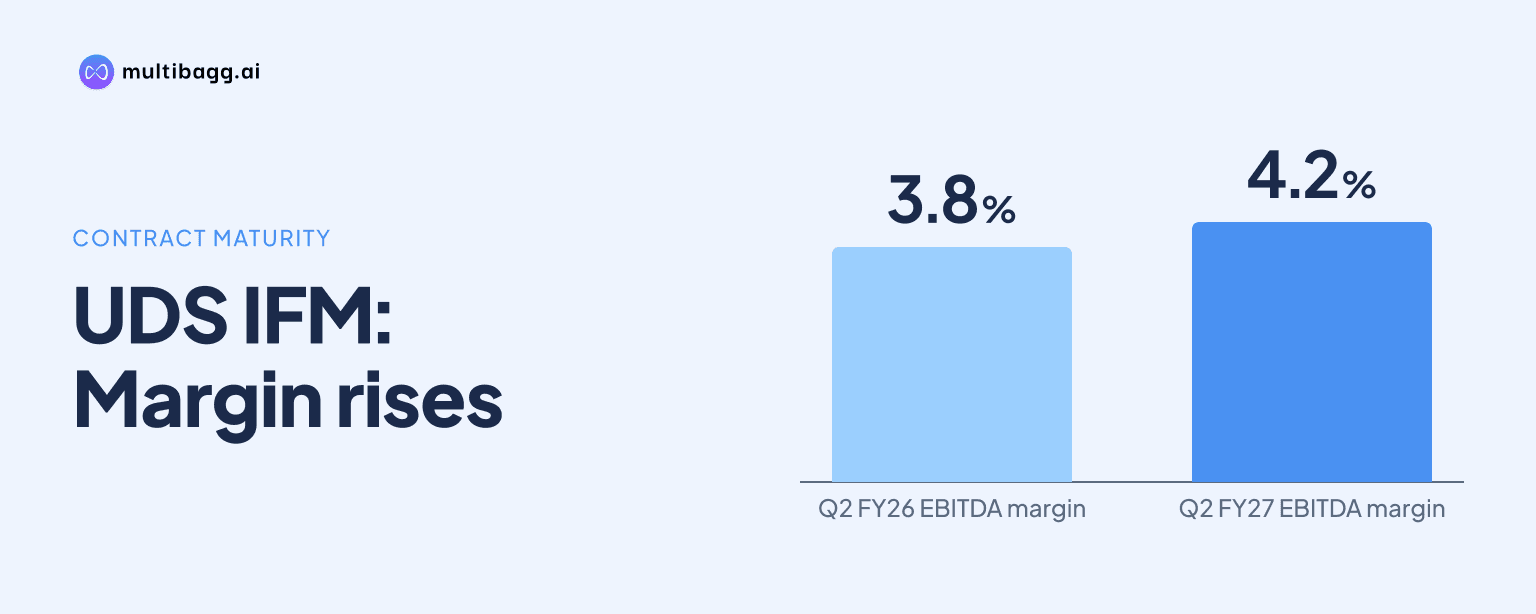
Updater Services Limited, or UDS, lifted IFM EBITDA margin to 4.2% in Q2 FY27 from 3.8% a year earlier, as revenue rose 11% to Rs 560 crore and seven significant logos were added. Management said mature contracts, new work and deeper client spending drove the change, while it plans a greater technical-services mix.
Know Updater Services inside out
Results, valuation, peers and who's buying, in one view.
How did UDS's IFM business perform in Q2 FY27?
UDS's integrated facility management, or IFM, revenue increased 11% year on year to Rs 560 crore in Q2 FY27 from Rs 503 crore in Q2 FY26. IFM EBITDA was about Rs 24 crore, and its EBITDA margin rose 40 basis points to 4.2% from 3.8%. IFM was the larger disclosed operating segment, compared with Rs 267 crore of business support services, or BSS, revenue in the quarter.
For H1 FY27, IFM revenue was about Rs 1,084 crore, up 11% year on year. UDS added seven significant IFM logos in Q2, taking first-half large-logo additions to 13 across manufacturing, commercial real estate and health care. The quarterly revenue and margin improvement therefore came alongside new-client additions rather than from an unchanged customer base.
At the group level, UDS reported Q2 FY27 consolidated revenue of Rs 812 crore, up 11% year on year, EBITDA of Rs 43 crore, up 37%, and profit after tax of Rs 32 crore, up 62%. IFM's approximately Rs 24 crore of EBITDA accounted for more than half of the group's reported EBITDA, although management did not disclose IFM's first-half EBITDA or profit after tax.
What drove UDS's IFM margin improvement?
UDS said the Q2 FY27 margin increase resulted from new clients, higher volumes on large contracts that had moved beyond their ramp-up phase, and greater wallet share within existing marquee accounts. Management said upfront employee costs carried on those contracts a year earlier had largely normalised, linking contract maturation to the rise in EBITDA margin from 3.8% to 4.2%.
Industrial and manufacturing customers remained IFM's largest market, together contributing about one-third of IFM revenue. The 13 first-half logo additions also covered commercial real estate and health care, while UDS identified logistics and commercial facilities as further opportunity areas. Management did not provide revenue values or margin data for these individual verticals.
UDS reported client retention of about 95% over a multi-year window. That retention rate, together with deeper spending from existing clients and higher volumes from mature contracts, indicates that management is seeking growth from both client acquisition and expanded work at retained accounts. The company did not disclose the duration of the multi-year retention window or average contract tenure.
Got a follow-up? Ask IRIS
Which IFM markets are UDS targeting?
UDS is targeting outsourced facility-services demand in manufacturing, infrastructure and commercial real estate, supported by expanding office and industrial activity. Management cited record office absorption of 66 million square feet in the first nine months of calendar 2026, including about 28 million square feet leased by Global Capability Centers, or GCCs. It said larger office footprints increase demand for housekeeping, engineering maintenance, workplace management and IFM.
Management said customers are placing greater weight on operational efficiency, measurable outcomes, compliance and value for money. It also said labour codes, in their first year of implementation, had raised the compliance threshold for enterprises using contract workers. UDS said its response combines operating execution, technology, standardised processes and governance, rather than relying only on staffing growth.
The seven Q2 FY27 logo additions were in manufacturing, commercial real estate and health care, broadening the new-business mix beyond the industrial base that supplies about one-third of IFM revenue. Management also cited opportunities in logistics and commercial facilities, but it did not provide a pipeline value, a target number of logos or a projected revenue contribution from these sectors.
How is UDS changing its IFM service mix and operations?
UDS aims to improve client-level profitability by increasing its mix of services that management described as higher margin, including mechanical, electrical and plumbing, or MEP, energy management and technical annual maintenance contracts, or AMCs. It also plans to win integrated mandates linked to customer outcomes. Management did not set a target technical-services share, an IFM margin target or a timetable for the mix shift.
Technology is part of UDS's planned operating model. The company said it is deploying digital workforce platforms, artificial intelligence-enabled workforce management and predictive-maintenance tools across client sites to optimise manpower deployment, improve service quality and support project margins. While the 4.2% Q2 FY27 margin was higher than 3.8% a year earlier, management did not quantify the financial contribution of any individual technology tool.
UDS has separated operating delivery from new-business responsibilities in IFM. Rajeev Bhardwaj was appointed chief operating officer to oversee operations, while Saravanan, previously chief operating officer, is to focus on growth. Management said the structure gives dedicated attention to service delivery and client acquisition after 13 large-logo additions in H1 FY27.
Conclusion
UDS's IFM business combined 11% Q2 FY27 revenue growth to Rs 560 crore with a 40-basis-point increase in EBITDA margin to 4.2%. Management attributed the improvement to normalised upfront employee costs on mature contracts, higher volumes, new logos and deeper client relationships. Its stated technical-services strategy seeks to extend those contract-level economics into MEP, energy management and technical AMC work.
The next disclosures to watch are progress on client-level profitability, further integrated outcome-linked mandates and evidence that technical services are becoming a larger part of IFM revenue. Management said these priorities remain in place for the rest of FY27, alongside technology deployment and the split of operating and growth responsibilities within the IFM leadership team.