










UDS Group says outsourced IFM market may grow 10.8% annually
Key highlights
- India’s outsourced IFM market is listed at Rs 39,470 crore in 2025 and Rs 67,111 crore in 2029P, implying a 10.8% CAGR outlook.
- Outsourcing penetration is projected to increase from 39.4% in FY25 to 45.3% in FY28P.
- Industrial customers account for 34% of India’s IFM demand, followed by commercial offices at 15% and hospitality at 11%.
- UDS is described as the second-largest outsourced IFM provider with a 2.8% market share, while “Others” account for 80.4%.
powered by IRIS
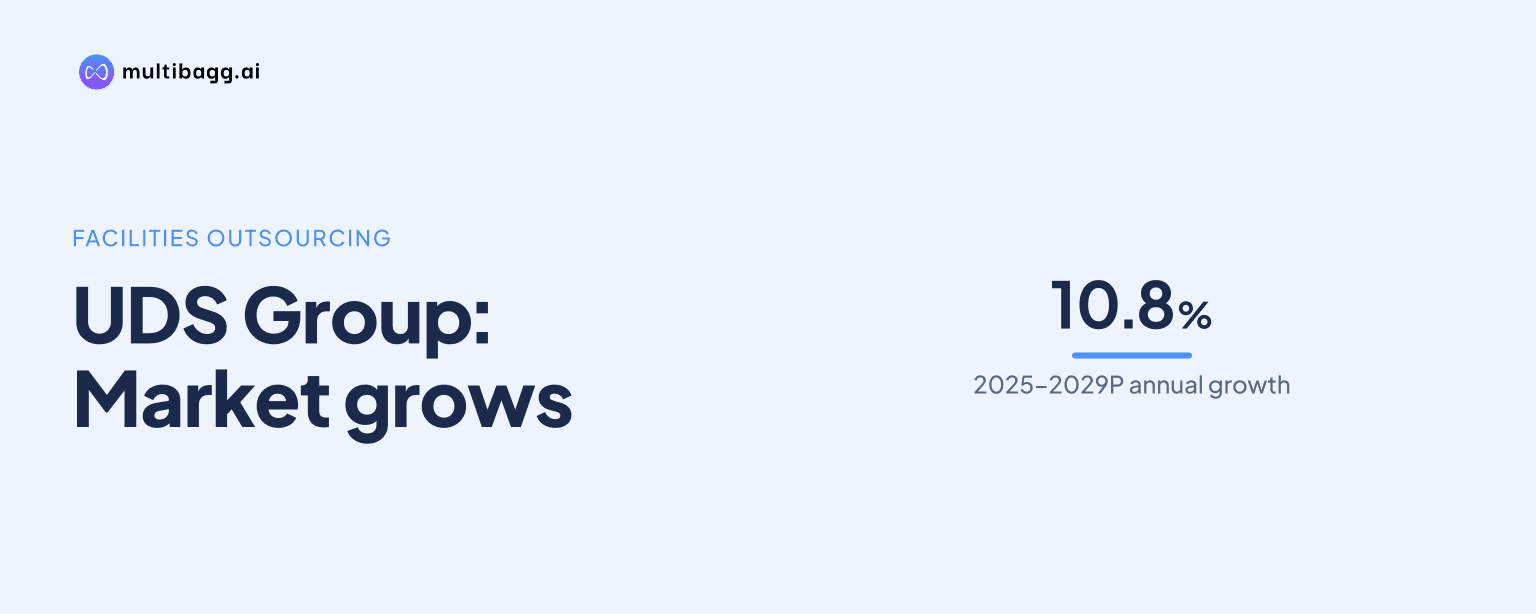
UDS Group’s presentation labels India’s outsourced integrated facility management (IFM) market as growing at a 10.8% compound annual growth rate (CAGR), while listing market size at Rs 39,470 crore in 2025 and Rs 67,111 crore in 2029P. It also projects outsourcing penetration will rise from 39.4% in FY25 to 45.3% in FY28P.
Know Updater Services inside out
Results, valuation, peers and who's buying, in one view.
How fast is India’s outsourced IFM market expected to grow?
The presentation labels the outsourced IFM market outlook at a 10.8% CAGR and lists its size rising from Rs 39,470 crore in 2025 to Rs 67,111 crore in 2029P. IFM refers to integrated facility management, a model that combines facility and workplace services under a provider or contract. The market-size table attributes its figures to Mordor Intelligence.
The listed market sizes imply an increase of Rs 27,641 crore between 2025 and 2029P. However, the slide describes the 10.8% CAGR period as “20243-2029P”, while the table itself is labelled 2025 and 2029P; UDS does not reconcile those date labels in the presentation. The industry graphics on the slide are attributed to Frost & Sullivan, while the market-size estimate carries the separate Mordor Intelligence attribution.
What is changing in India’s IFM outsourcing rate?
Outsourced IFM is projected to account for 45.3% of services in FY28P, compared with 39.4% in FY25 and 36.2% in FY18. The corresponding in-house share is shown falling from 63.8% in FY18 to 60.6% in FY25 and 54.7% in FY28P. This represents a projected 9.1-percentage-point increase in outsourced provision over the FY18-to-FY28P period.
In-house delivery remains the larger model in the FY28P projection, but the difference between the two models narrows materially. The in-house lead falls from 27.6 percentage points in FY18 to 21.2 percentage points in FY25 and a projected 9.4 percentage points in FY28P. UDS presents continued customer preference for outsourcing as the mechanism behind that change.
Which sectors account for India’s IFM demand?
Industrial customers are the largest IFM end-customer group at 34%, followed by commercial offices at 15% and hospitality at 11%. Government infrastructure and retail each represent 10%, while healthcare accounts for 9%. The sector shares are part of the Frost & Sullivan-sourced industry outlook presented by UDS.
The remaining market consists of residential customers at 5%, education at 4% and other end customers at 2%. Industrial’s 34% share is more than twice the commercial-office share and more than three times the hospitality share. The mix shows that the projected outsourcing shift covers industrial, office, public-infrastructure and consumer-facing locations rather than being based on a single customer segment.
Got a follow-up? Ask IRIS
Why are organised integrated IFM providers expected to gain share?
UDS says organised IFM providers are gaining preference because customers seek a basket of services, cost efficiencies, technology implementation, quality and compliance standards, and mechanised cleaning. The presentation describes a shift from single-service contracts to an integrated-services model. These stated drivers link the projected increase in outsourcing with demand for providers able to offer multiple services.
The organised portion of IFM services is projected to rise to 58% in FY28P from 53% in FY25, while the unorganised portion is expected to fall to 42% from 47%. UDS identifies the addition of service activities through mergers or tie-ups with regional players as a consolidation driver. It also cites regulatory and capability challenges that may constrain smaller companies’ ability to scale.
The projected five-percentage-point increase in organised services is distinct from the rise in outsourcing penetration. An IFM contract can be evaluated by whether it is outsourced or in-house, while the organised-versus-unorganised split concerns the service-provider structure described on the slide. UDS’s forecast therefore indicates both a change in delivery model, from in-house to outsourced, and a change in the composition of providers.
What does UDS’s market-share chart show?
UDS is described in the presentation as the second-largest outsourced IFM provider, with a 2.8% market share. Its chart allocates 80.4% of the market to “Others”, indicating that named providers account for a relatively small portion of the displayed market. The largest named competitor has 4.1%, while Comp. 2 is also shown at 2.8%.
The other named providers on the chart hold shares of 2.7%, 2.2%, 1.8%, 1.7% and 1.5%. The 80.4% “Others” category is larger than the combined share of the seven named competitors besides the 4.1% leader. That distribution is consistent with UDS’s presentation of consolidation as an ongoing industry trend rather than a completed market outcome.
UDS also maps its service platform across soft services, hard services, production support, food and catering, mailroom services, employee background checks, retail, trade and channel audits, feminine hygiene, sales enablement, staffing and airport ground handling. The Frost & Sullivan-sourced mapping compares these offerings with competitors’ listed coverage. It says relative strength is based on market share for selected facility categories and qualitative research for the other service categories.
Conclusion
The presentation’s central industry case is that outsourced delivery and organised provision will both occupy a larger share of India’s IFM market. Industrial customers account for the largest end-market share at 34%, while the 80.4% “Others” category in the outsourced-provider chart indicates that the market remains dispersed despite the stated move toward integrated providers.
The disclosed milestones to watch are the FY28P outsourced share of 45.3% and the organised-services share of 58%, compared with 39.4% and 53% respectively in FY25. UDS says demand for multi-service offerings, technology implementation, mechanised cleaning, compliance and cost efficiencies, along with mergers or regional tie-ups, will influence whether those targets are reached.