










Varun Beverages volumes rise 28.7% as EBITDA margin falls
Key highlights
- Varun Beverages' Q3 CY2026 sales volume rose 28.7% to 354.4 million unit cases.
- Q3 CY2026 net revenue increased 33.2% to Rs 6,607.56 crore, while EBITDA rose 25.1% to Rs 1,426.71 crore.
- EBITDA margin declined 140 basis points to 21.6% as packaging costs and a higher-cost non-beverage mix pressured gross margin.
- Q3 CY2026 net profit increased 13.5% to Rs 830.59 crore, trailing revenue and EBITDA growth.
powered by IRIS
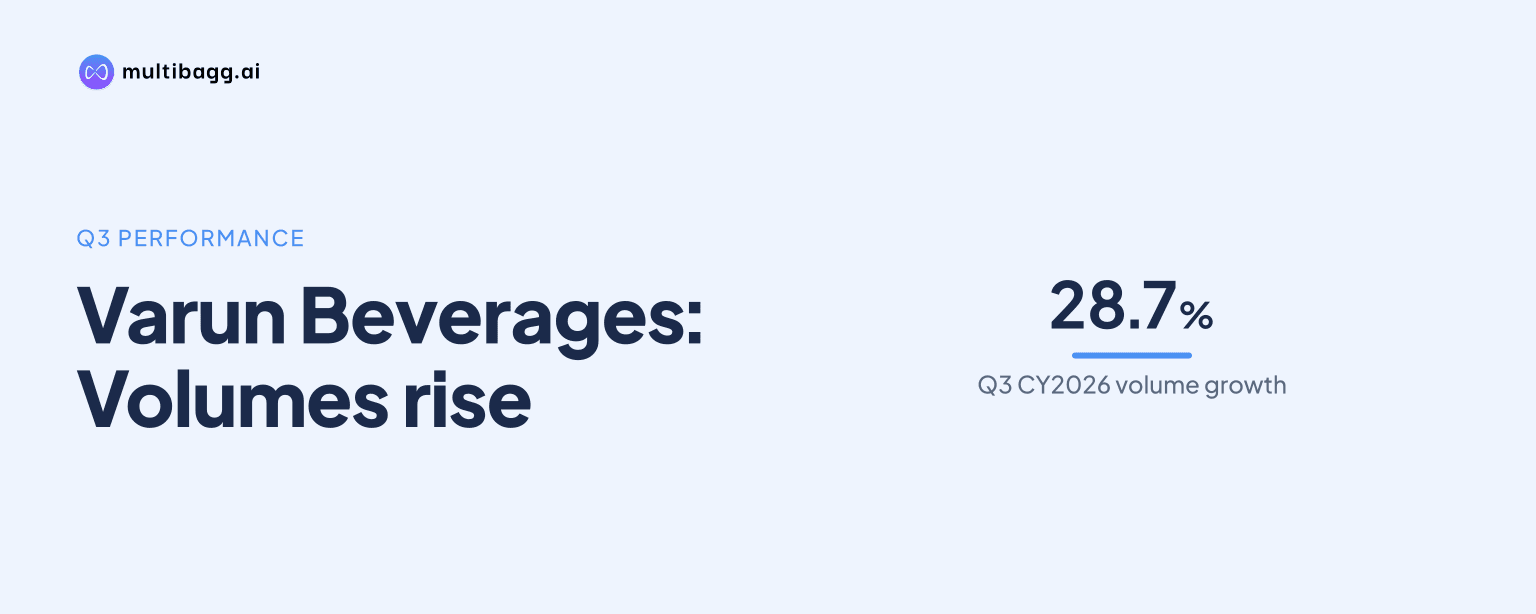
Varun Beverages Limited increased consolidated sales volume by 28.7% to 354.4 million unit cases in Q3 CY2026 and net revenue by 33.2% to Rs 6,607.56 crore. However, higher packaging costs reduced earnings before interest, tax, depreciation and amortisation (EBITDA) margin by 140 basis points, or 1.4 percentage points, to 21.6%.
Know Varun Beverages inside out
Results, valuation, peers and who's buying, in one view.
How much did Varun Beverages grow in Q3 CY2026?
Varun Beverages increased consolidated sales volume to 354.4 million unit cases in Q3 CY2026 from 275.3 million unit cases in Q3 CY2025, a 28.7% rise. India volume grew 22.5%, while international territories grew 39.9%. A unit case equals 5.678 litres of beverage divided into 24 bottles of about 237 millilitres each.
Net revenue rose 33.2% to Rs 6,607.56 crore from Rs 4,960.69 crore, outpacing volume growth. Beverage sales increased 31.6% to Rs 6,273.21 crore, while non-beverage sales rose 72.4% to Rs 334.35 crore. Consolidated beverage realisation per case increased 2.2% to Rs 177 from Rs 173.10.
Q3 CY2026 volume exceeded the 275 million unit cases sold in Q3 CY2025 and the 239 million sold in Q4 CY2025, but remained below the seasonally larger 469 million cases in Q2 CY2026. Carbonated soft drinks represented 73.3% of Q3 CY2026 volume, juice-based drinks 4.8%, and packaged drinking water 21.9%.
What drove Varun Beverages revenue growth?
Varun Beverages attributed growth to demand in India and international territories, expanded manufacturing capacity and investment in chilling infrastructure. Indian beverage realisation per case rose 0.5% to Rs 170 from Rs 169.10, supported by higher-value categories, calibrated discounting and price-pack architecture, according to management.
Management cited dairy beverages and premium launches, including Ad Rush and Evervess mixers, as contributors to Indian realisation. International realisation improved because of South African realisation and foreign-exchange effects. International volume included 15.3 million unit cases from the Twizza business in South Africa during Q3 CY2026.
The India mix of low-sugar and no-sugar products reached 88% in Q3 CY2026, compared with 44% a year earlier. Management said this shift largely offset an approximately 16% increase in sugar prices, after sharing sugar-reduction benefits with PepsiCo through concentrate costs. For 3M CY2026, low-sugar and no-sugar products accounted for about 86% of consolidated sales volumes.
Why did Varun Beverages EBITDA margin decline?
Varun Beverages' EBITDA margin declined to 21.6% in Q3 CY2026 from 23.0% in Q3 CY2025, despite EBITDA increasing 25.1% to Rs 1,426.71 crore from Rs 1,140.41 crore. Operating leverage from the 28.7% volume increase partly offset the gross-margin contraction, but did not fully preserve quarterly margin.
Gross margin declined 334 basis points to 53.1%. Management said costlier preforms, shrink film, closures and cans, linked to geopolitical issues, accounted for about 300 basis points of the reduction. Total expenses rose 35.7% to Rs 5,672.52 crore, faster than the 33.2% increase in net revenue.
Higher sales of Indian non-beverage products also affected the comparison. Standalone non-beverage revenue rose 104.3% to Rs 121.30 crore, and management said products such as preforms and caps carry higher cost of goods sold, reducing Indian gross margin by about 100 basis points. For 9M CY2026, EBITDA margin was 24.2%, compared with 24.9% in 9M CY2025.
Got a follow-up? Ask IRIS
How did Varun Beverages profit compare with revenue growth?
Varun Beverages reported net profit after tax of Rs 830.59 crore in Q3 CY2026, up 13.5% from Rs 731.51 crore in Q3 CY2025. The profit increase trailed both net revenue growth of 33.2% and EBITDA growth of 25.1%, reflecting the lower EBITDA margin and higher below-EBITDA costs.
Depreciation and amortisation rose 34.5% to Rs 419.98 crore, while finance costs increased 53.5% to Rs 71.69 crore. Management attributed these increases primarily to the Twizza acquisition in South Africa and associated debt funding. Other income declined 18.8% to Rs 119.86 crore, which management linked to relatively stable currencies during the quarter.
For 9M CY2026, net revenue grew 23.3% to Rs 21,814.55 crore and EBITDA increased 19.9% to Rs 5,274.58 crore. Net profit after tax rose 15.5% to Rs 3,202.30 crore from Rs 2,772.12 crore. Total expenses increased 25.1% to Rs 17,912.49 crore during the nine-month period.
What changed in Varun Beverages international businesses?
Varun Beverages completed the merger of Twizza with its holding company BevCo in South Africa effective 1 August 2026, after the boards approved the transaction on 2 July 2026. Management expects operational synergies in coming quarters, but did not quantify either the value or timing of those synergies.
VBL Industries (Kenya) Limited acquired the business of Devyani Food Industries (Kenya) Limited effective 1 August 2026 for USD 32 million, or Rs 305 crore at Rs 95.30 per US dollar. As the entities were under common control, Varun Beverages used the pooling-of-interests method and restated comparative periods for presentation purposes.
Varun Beverages also began beverage operations in Kenya and launched BOLT UP and XTREME FIZZ during the quarter. Its Zimbabwe subsidiary signed an exclusive Mondelez distribution agreement on 24 September 2026, effective 1 October 2026, for chocolate, biscuits, candy and gum. The board approved an interim dividend of Rs 0.50 per share, involving an estimated cash outflow of about Rs 169.10 crore.
Conclusion
Varun Beverages delivered higher Q3 CY2026 volume, revenue and EBITDA, with India and international expansion lifting sales to 354.4 million unit cases. The conversion of that growth into profit was constrained by packaging inflation, a higher-cost non-beverage mix and acquisition-related depreciation and finance costs, leaving EBITDA margin at 21.6% and net profit growth at 13.5%.
What to watch next is management's stated expectation of operational synergies from the Twizza-BevCo merger in coming quarters, alongside the rollout of Kenya operations and the Mondelez distribution agreement in Zimbabwe from 1 October 2026. Management also plans to selectively pursue ready-to-drink, alcoholic beverage and allied-product opportunities through KIVA Spirits and Company Limited.