










Vegorama targets Rs 365 crore FY28 revenue in Delhi-NCR
Key highlights
- Vegorama targets Rs 365 crore of FY28 revenue and Rs 1 crore of daily Delhi-NCR sales, versus management’s stated current level of Rs 70 lakh a day.
- H1 FY27 revenue from operations rose 46.53% year on year to Rs 100.06 crore, while the EBITDA margin increased to 14.62%.
- Vegorama plans 15 to 18 Maa Ka Khana kitchens and targets a February 2027 launch for its 5,400 square-foot central kitchen.
- Management identified three proposed Agra outlets and two Jaipur outlets but is prioritising Delhi-NCR before broader expansion.
powered by IRIS
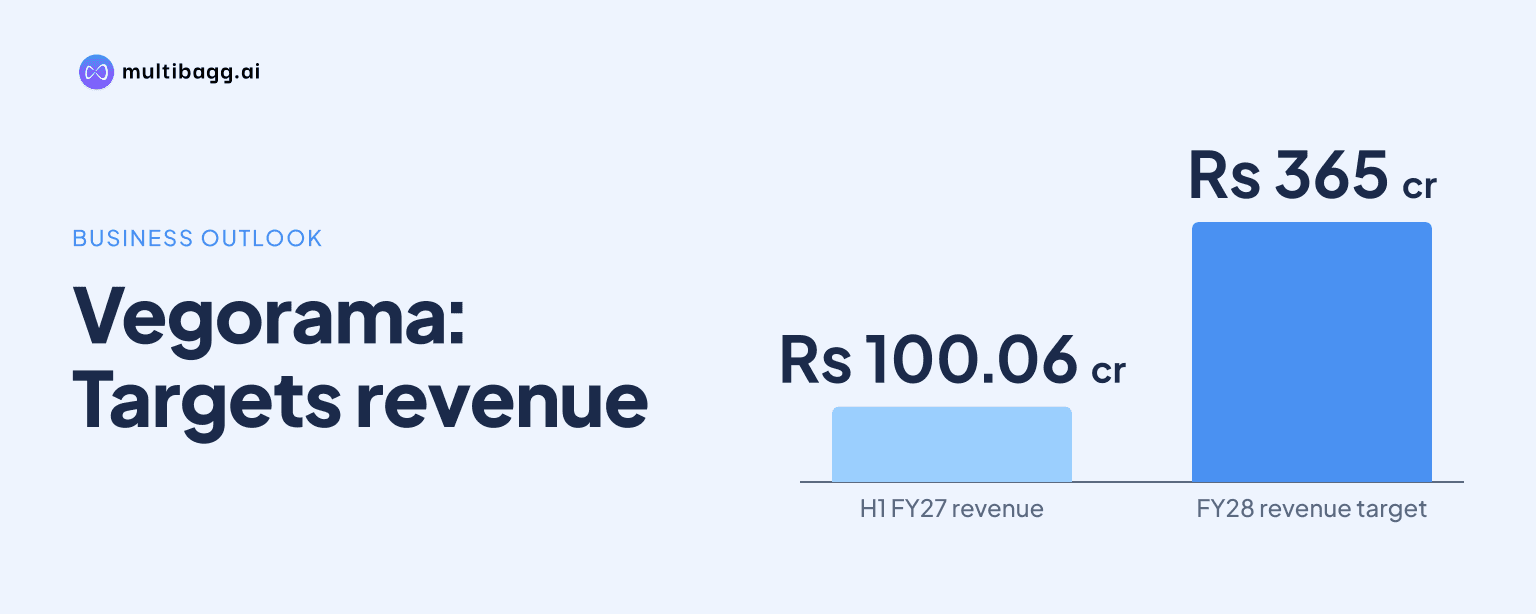
Vegorama Punjabi Angithi Limited is targeting Rs 365 crore of FY28 revenue by raising daily Delhi-NCR sales from about Rs 70 lakh to Rs 1 crore before accelerating expansion into Punjab, Agra and Jaipur. Management’s plan combines 15 to 18 homestyle-food kitchens, a central kitchen and a Gurugram dining project.
Know Vegorama Punjabi Angithi inside out
Results, valuation, peers and who's buying, in one view.
What is Vegorama’s FY28 revenue target?
Vegorama’s FY28 target is Rs 365 crore of revenue, based on management’s mission to reach Rs 1 crore of daily sales. Management said the business was then generating about Rs 70 lakh a day across its network, which it described as roughly Rs 20 crore a month. It said the operating initiatives supporting the target were intended to be in place by April 1, 2027.
The target is substantially above Vegorama’s reported revenue from operations of Rs 140.87 crore in FY26 and Rs 100.06 crore in H1 FY27. Management did not disclose a location-by-location or format-by-format revenue bridge to Rs 365 crore, but identified the Maa Ka Khana homestyle-food brand, Swaad of Punjab, cloud kitchens, centralised production and Gurugram dining as the relevant components.
Management also stated a separate, longer-term mission to reach Rs 1,000 crore of revenue within three to four years. That objective was accompanied by a stated focus on margins, earnings before interest, tax, depreciation and amortisation, and unit economics, but management did not provide a detailed operating plan or annual milestones for that longer-term target.
Why is Vegorama focusing on Delhi-NCR before other cities?
Vegorama is focusing on Delhi-NCR because management believes reaching Rs 1 crore in daily sales in its core market can improve unit economics and margins before broader north Indian expansion. Management said Punjab, Agra and Jaipur had been assessed, but the immediate priority was to establish Delhi-NCR scale and strengthen supply-chain capacity through the central kitchen.
The company said it could launch five Punjab outlets together in April, May or June, while also describing a pipeline of three outlets in Agra and two in Jaipur. It had scouted locations in Mohali and discussed potential coverage of Panchkula and Pinjore, but these were not operating locations at the time of the call. Management also referred to analysis of five to seven outlets for Punjab.
Management’s sequencing reflects staffing and logistics as well as demand. It said it could allocate 20% of its team each to Punjab, Agra and Uttar Pradesh when it expands, but first wants to secure the Delhi-NCR revenue base. It also said Dehradun was already part of its operations, while Delhi remained the market where it had the greatest operational familiarity.
Which new formats support Vegorama’s Delhi-NCR plan?
Vegorama plans to support its Delhi-NCR target with 15 to 18 Maa Ka Khana kitchens, a Swaad of Punjab rollout and a premium Gurugram dining facility. Maa Ka Khana is aimed at college students and office-goers seeking homestyle food, and management said its kitchens would be separate 300 to 450 square-foot facilities located beside existing Punjabi Angithi kitchens.
Management said chimney hoods, water-treatment systems and sewerage work had been completed for the Maa Ka Khana locations, with operations targeted by December 2026. It also said an aggregator had offered three to six months without advertising cost for the new brand. This was management’s description of a proposed commercial arrangement, rather than a reported financial outcome.
Vegorama operated 27 cloud kitchens during H1 FY27 after opening four new kitchens and restarting one location. Management discussed ending the year with 31 kitchens, while another call exchange indicated the combined network, including Maa Ka Khana, could reach 45 to 50 stores in FY28. Both figures were management expectations, not confirmed future store counts.
Swaad of Punjab, which management described as a higher-average-order-value brand, was planned for launch from January 15 across Vegorama’s existing 27 locations. The company also plans an owned vegetarian dining and celebration venue in Gurugram Sector 89, with about 16,400 square feet of covered area. Commercial operations were expected in FY27-28, subject to development completion and other processes.
Got a follow-up? Ask IRIS
How will Vegorama’s central kitchen affect operations?
Vegorama expects its 5,400 square-foot Bahadurgarh central kitchen to improve operating margins by 1.5% to 2% through production, manpower, raw-material and food-waste efficiencies. Management said the two-floor facility covers 550 square yards and is intended to expand production capacity without a proportionate increase in operating costs.
Machinery for the facility had been ordered from Germany and Taiwan and was expected to arrive in December 2026, according to management. It said chimney, gas and sewerage infrastructure was in place, with testing planned from January 15 to January 30 and a targeted February 2027 launch. Earlier prepared remarks had referred to commissioning in the fourth quarter.
The central kitchen is part of Vegorama’s case for delaying a wider cluster rollout. Management said it wants to optimise the new production base before expanding more heavily into Punjab, Uttar Pradesh, Agra and Jaipur. It linked that choice to its aim of reaching the Rs 1 crore daily-sales threshold while improving margins and building a scalable supply chain.
What financial base does Vegorama have for the plan?
Vegorama reported H1 FY27 revenue from operations of Rs 100.06 crore, up 46.53% from Rs 68.29 crore in H1 FY26. Earnings before interest, tax, depreciation and amortisation rose 53.59% to Rs 14.31 crore, while the related margin increased by 152 basis points to 14.62% from 13.10%.
Profit after tax increased 62.58% to Rs 10.40 crore in H1 FY27 from Rs 6.38 crore a year earlier. The profit-after-tax margin rose to 10.39% from 9.35%, an increase of 104 basis points. E-commerce accounted for approximately 91.58% of revenue, compared with 7.05% for takeaway and catering, 0.98% for dine-in and 0.39% for Corporate Thali.
The company’s revenue from operations rose from Rs 65.95 crore in FY24 to Rs 101.31 crore in FY25 and Rs 140.87 crore in FY26. Over the same three years, earnings before interest, tax, depreciation and amortisation increased from Rs 6.49 crore to Rs 11.59 crore and then Rs 17.05 crore, while the margin rose from 9.77% to 12.05%.
As of September 2026, Vegorama reported total assets of Rs 71.82 crore, shareholder funds of Rs 62.70 crore and cash and cash equivalents of Rs 9.53 crore. H1 FY27 operating cash flow was Rs 12.08 crore, while investing activities used Rs 34.21 crore. Management said the Maa Ka Khana rollout and related initiatives would be funded from its own capital.
Conclusion
Vegorama’s Rs 365 crore FY28 goal depends on increasing Delhi-NCR daily sales from Rs 70 lakh to Rs 1 crore before shifting meaningfully into Punjab, Agra and Jaipur. The strategy combines a 15 to 18-kitchen Maa Ka Khana rollout, Swaad of Punjab across 27 locations, centralised production and a 16,400 square-foot Gurugram venue, alongside H1 FY27 revenue growth of 46.53%.
The next disclosed milestones are Maa Ka Khana’s planned December 2026 operationalisation, the January 15 Swaad of Punjab launch and the February 2027 target for the Bahadurgarh central kitchen. Management also targeted April 1, 2027 for its planned initiatives to be operational, before deciding when to activate the Punjab, Agra and Jaipur pipeline.