










Vegorama says own delivery saves only 6 percentage points
Key highlights
- Vegorama said an in-house delivery fleet would cost about 22%, versus a cited 28% aggregator commission.
- Management said zero-commission customer channels generate Rs 2 crore to Rs 3 crore of monthly revenue.
- Vegorama assigns four to five own riders to each outlet for catering, bulk thalis and office bookings.
- Management said its daily customer-service review is handled by three to four people, each covering five to six kitchens.
powered by IRIS
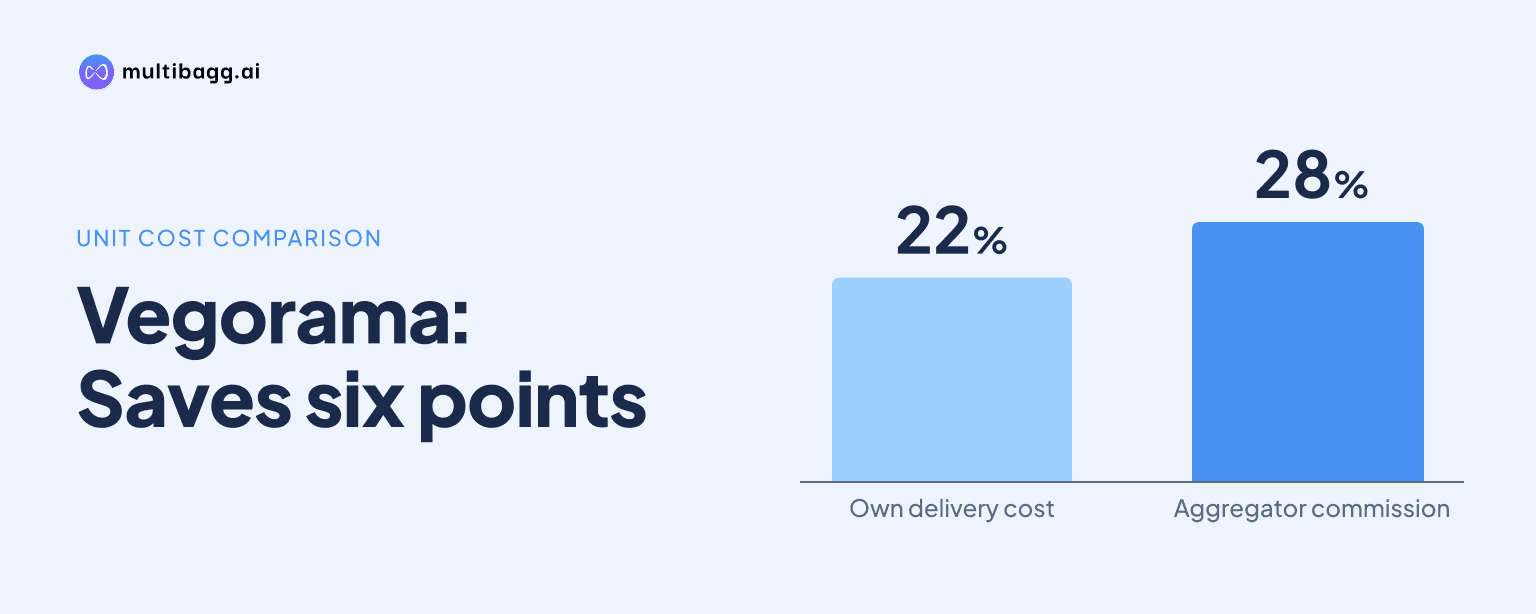
Vegorama Punjabi Angithi Limited said replacing delivery aggregators entirely with its own riders would reduce fulfilment costs by only about 6 percentage points, to 22% from 28%. Vegorama said its app, AI-enabled call centre and zero-commission channels are expanding, with those channels generating Rs 2 crore to Rs 3 crore in monthly revenue.
Know Vegorama Punjabi Angithi inside out
Results, valuation, peers and who's buying, in one view.
Why is Vegorama building direct-order channels?
Vegorama is building direct-order channels to increase customer access while retaining aggregators for smaller orders and peak-demand capacity. Management said the company created its own app after its May 2026 initial public offering, and customers can download it from the Play Store. It also established an artificial intelligence-enabled central call centre that routes callers in Delhi or Gurugram to the appropriate outlet through one company number.
Management said its post-IPO growth study showed sales rising from 11% to 15%-16%, though it did not specify whether those figures represented a revenue share, growth rate or another internal sales measure. It described the app as an early stage of creating a direct customer experience. Vegorama also cited Toing alongside aggregators as a channel through which it is generating Rs 2 crore to Rs 3 crore in monthly revenue from customers at 0% commission.
How do Vegorama's direct channels compare with aggregators?
Vegorama's direct and zero-commission routes offer lower stated commission costs, but management continues to use Zomato and Swiggy to serve small orders. The company said it assigns four to five of its own riders to every outlet, principally for catering, bulk thalis and office bookings. Those larger orders were described as ranging from Rs 5,000 to Rs 20,000, while smaller orders are currently routed to Zomato and Swiggy.
The company contrasted payment cycles across channels. Management said its aggregator settlement cycle is seven days, while newer applications including the Open Network for Digital Commerce, or ONDC, remit the entire revenue within 24 hours with 0% commission. It also said customers sometimes arrange collection themselves or book Porter when Vegorama is offline or when rainy days affect normal delivery availability. These routes extend customer access without requiring the company to staff every delivery itself.
Why does Vegorama say full in-house delivery saves little?
Vegorama says a complete move to its own fleet would still cost about 22%, compared with the 28% commission it cited for aggregators. Management attributed the remaining cost to rider maintenance, salaries and petrol, and said customers ultimately bear delivery-related economics through the order. The implied difference is about 6 percentage points, which is why management did not present own delivery as a simple way to eliminate distribution costs.
Scale is the central operational constraint cited by management. It said that 100 daily orders could be managed with 10 riders, but questioned whether an outlet handling 1,000 orders a day could keep 100 riders. Management also said Domino's uses Zomato and Swiggy when its own riders are busy, and that brands including La Pino'z Pizza and Domino's depend on aggregators to scale during high-volume periods such as Saturdays and Sundays. These were management's industry comparisons, not independently verified operating data for those companies.
Got a follow-up? Ask IRIS
How will Vegorama balance delivery spending and growth?
Vegorama said it will prioritise revenue growth and its food proposition over taking every delivery task in-house. Management said excessive attention to delivery could compromise the affordable and authentic taste it wants to maintain. Its operating model is centred on freshly prepared food, and management said its kitchen preparation time is 15 to 20 minutes from order placement. That preparation requirement differs, in management's view, from a model based on frozen products held at outlets.
The company is using physical presence as another customer-acquisition mechanism. Management said its four-storey Gurugram location will have 250 covers and is intended to raise brand awareness for nearby delivery kitchens, rather than mark a broad dining expansion. It said a dining outlet in an area with 10 to 12 kitchens could lift revenue from those kitchens by at least 30% to 35%. Vegorama said it does not have a plan to open more dining outlets generally, instead seeking one dining location where it has about 10 stores.
What delivery metrics does Vegorama monitor each day?
Vegorama said it monitors delivery and customer-service metrics daily rather than weekly. Management said its office team begins each morning by reviewing orders, quotations, prior work, kitchen preparation time and complaints from Zomato, Swiggy and its own platform. Between 4:00 PM and 6:00 PM, the team resolves customer issues and refunds, while daily promotional offers on Zomato are reviewed from 11:00 AM to 12:00 PM.
Management said three to four people undertake this process, with each person responsible for five kitchens and, in some cases, five to six kitchens. The daily 6:00 PM internal report includes dairy and vegetable costs and an outlet-level sales-and-expense assessment that management called SOA. The team also reviews Instagram and Google feedback, customer counts, order counts and repeat-order ratios. Management gave repeated Rajma Masala complaints as an example of a signal to identify and correct an outlet-specific issue.
Conclusion
Vegorama's stated distribution strategy is not an attempt to replace aggregators immediately. Its app, central AI call centre, ONDC-related options and in-house riders provide direct and zero-commission routes, with Rs 2 crore to Rs 3 crore of monthly revenue already coming from customers at 0% commission. But management's estimate that an owned delivery fleet would still cost about 22%, against 28% through aggregators, supports its decision to retain aggregator capacity for smaller orders and demand peaks.
The next issue to watch is whether direct-order volumes continue to expand without a disproportionate increase in rider and support costs. Management has linked its broader operating plan to a target of Rs 365 crore in annual revenue in 2027-28 and said it expects 45 to 50 stores by March 2028, including the new Maa Ka Khana brand. Its ability to handle higher order volumes while maintaining the cited 15-to-20-minute kitchen preparation time will be relevant to that plan.