










Vi to draw Rs 35,000 crore in phases as PSU loan nears closure
Key highlights
- Vi plans to draw its Rs 35,000 crore financing package in phases rather than upfront.
- Vi arranged more than Rs 4,000 crore of incremental bank funding in Q2FY27.
- Vi more than doubled Q2FY27 capex to Rs 3,946 crore.
- Vi said higher funded loan drawdowns should occur in Q3FY27.
powered by IRIS
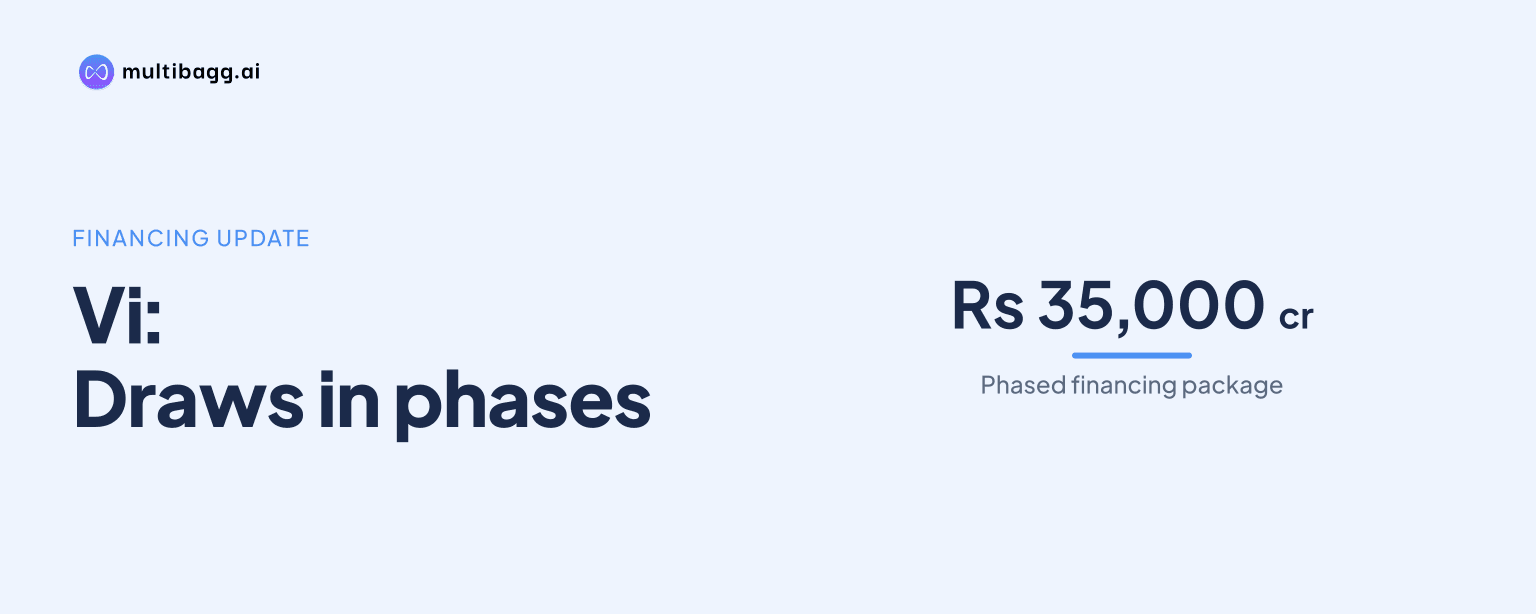
Vodafone Idea Limited said it will draw its Rs 35,000 crore financing package only as required, rather than upfront, while management said its largest public-sector-bank funding tranche was close to closure. Vi more than doubled quarterly capital expenditure, or capex, to Rs 3,946 crore in Q2FY27 and expects higher funded drawdowns in Q3FY27.
Know Vodafone Idea inside out
Results, valuation, peers and who's buying, in one view.
How will Vi draw its Rs 35,000 crore financing package?
Vi plans to draw the Rs 35,000 crore package in phases to sustain its higher capex intensity rather than take the entire amount at once. Management said the package comprises Rs 25,000 crore of funded facilities and Rs 10,000 crore of non-funded facilities, with the immediate priority being continued network investment over the coming quarters.
Vi is engaging three lender groups: a public sector bank consortium led by State Bank of India, Indian private banks and foreign banks for external commercial borrowing, or ECB, facilities. Management described the public sector bank consortium as the largest funding pool and said it was close to closure, although the involvement of multiple lenders had made the process longer than it had previously anticipated.
Management said Vi does not need to wait for every component of the long-term funding plan before continuing the network rollout. The company said the Q2FY27 capex intensity of Rs 3,946 crore, more than twice the Q1FY27 run rate, would continue in the coming quarters as it accesses facilities, existing cash resources and operating cash flows.
What funding has Vi secured and how is it being used?
Vi had secured more than Rs 10,500 crore of total funding by H1FY27, including warrants, funded facilities and non-funded facilities. More than Rs 4,000 crore of incremental bank funding was arranged in Q2FY27, which management said helped finance the material increase in network spending alongside cash balances and operating cash flows.
Vi uses non-funded facilities, particularly letters of credit, or LCs, before drawing funded bank loans for capex deployment. An LC allows equipment and service payments to be supported without immediately appearing as outstanding bank debt, which explains why facilities arranged by Vi exceeded its reported bank-debt balance at September 30, 2026.
Vi said legacy bank debt had been fully repaid by September 30, 2026, and current borrowings represented incremental funding. Its finance chief said almost all of the more than Rs 800 crore of current new drawdowns was part of the new facility, rather than the earlier bank-debt stock.
Funded drawdowns should increase after Vi exhausts LCs and makes payments against them, management said. The company specifically indicated that higher drawdowns would be visible in Q3FY27, showing the intended sequence from non-funded capex support to funded loan utilisation.
Got a follow-up? Ask IRIS
How is Vi funding its faster network rollout?
Vi funded Q2FY27 capex of Rs 3,946 crore through incremental facilities, existing cash resources and operating cash flows. H1FY27 capex was nearly Rs 6,000 crore, while capex orders exceeded Rs 13,200 crore against three-year capex guidance of Rs 45,000 crore.
The Q2FY27 spending supported nearly 9,000 new broadband towers, lifting Vi's unique broadband tower count to close to 214,000. Its 4G population coverage reached 88%, and its 5G services were available in 400 Indian cities and towns, while management maintained its FY28 target of completing the 4G rollout for coverage parity with peers in 17 key circles.
Vi also paid more than Rs 4,300 crore of spectrum dues that fell due in October 2026. That took FY27 spectrum payments beyond Rs 6,000 crore against approximately Rs 7,000 crore of spectrum obligations, alongside the Q2FY27 capex increase.
Management said this combination of accelerated capex and spectrum payments showed that the current mix of facilities and cash flows could support network investment and scheduled commitments while the longer-term financing plan progresses. That is management's assessment of funding availability, not a forecast for future cash generation.
What operating changes accompany Vi's funding plan?
Vi reported Q2FY27 revenue of Rs 11,884 crore, up 6.2% year on year and 1.7% sequentially. Cash earnings before interest, tax, depreciation and amortisation, or cash EBITDA, increased 11.2% year on year to Rs 2,498 crore, and the cash EBITDA margin rose by more than 95 basis points to 21.0%.
Reported EBITDA was Rs 4,981 crore in Q2FY27, up 6.3% year on year, while the EBITDA margin was unchanged from a year earlier at 41.9%. Management said the margin was slightly lower sequentially because of personnel-cost phasing and higher marketing spending linked to the brand refresh, and expects marketing costs to remain at those levels for the balance of FY27.
The customer base rose from 193.1 million in the previous quarter to 194.4 million in Q2FY27. Vi's 4G and 5G subscriber base increased to 131.0 million from 127.8 million in Q2FY26, while prepaid net subscriber churn narrowed from 1.5 million in Q1FY27 to 0.6 million in Q2FY27.
Customer average revenue per user, or ARPU, was Rs 198 in Q2FY27, up 9.7% year on year. Management attributed slower sequential organic growth partly to second-quarter seasonality and segment-specific interventions, and said it expected the ARPU growth trend seen in earlier quarters to resume from Q3FY27 through upgrades and premiumisation.
Conclusion
Vi's financing plan relies on staged use of Rs 35,000 crore of funded and non-funded facilities rather than a single disbursement. The company used incremental bank facilities, LCs, cash balances and operating cash flows to lift Q2FY27 capex to Rs 3,946 crore while paying more than Rs 6,000 crore of FY27 spectrum obligations.
The next disclosed funding milestone is higher funded drawdowns in Q3FY27 as LCs are exhausted and paid. Management also aims to conclude the public sector bank consortium process, maintain the higher capex pace and complete its 4G rollout by FY28 across 17 key circles.