










Vi's prepaid losses narrow as network rollout cuts churn
Key highlights
- Vi cut prepaid net subscriber losses to 0.6 million in Q2FY27 from 1.5 million in Q1FY27.
- Vi added 1.3 million total subscribers in Q2FY27, primarily through M2M and postpaid.
- Vi added nearly 9,000 broadband towers in Q2FY27 and reached 88% 4G population coverage.
- Vi's data usage rose 27.1% year on year to 93.6 petabytes per day in Q2FY27.
powered by IRIS
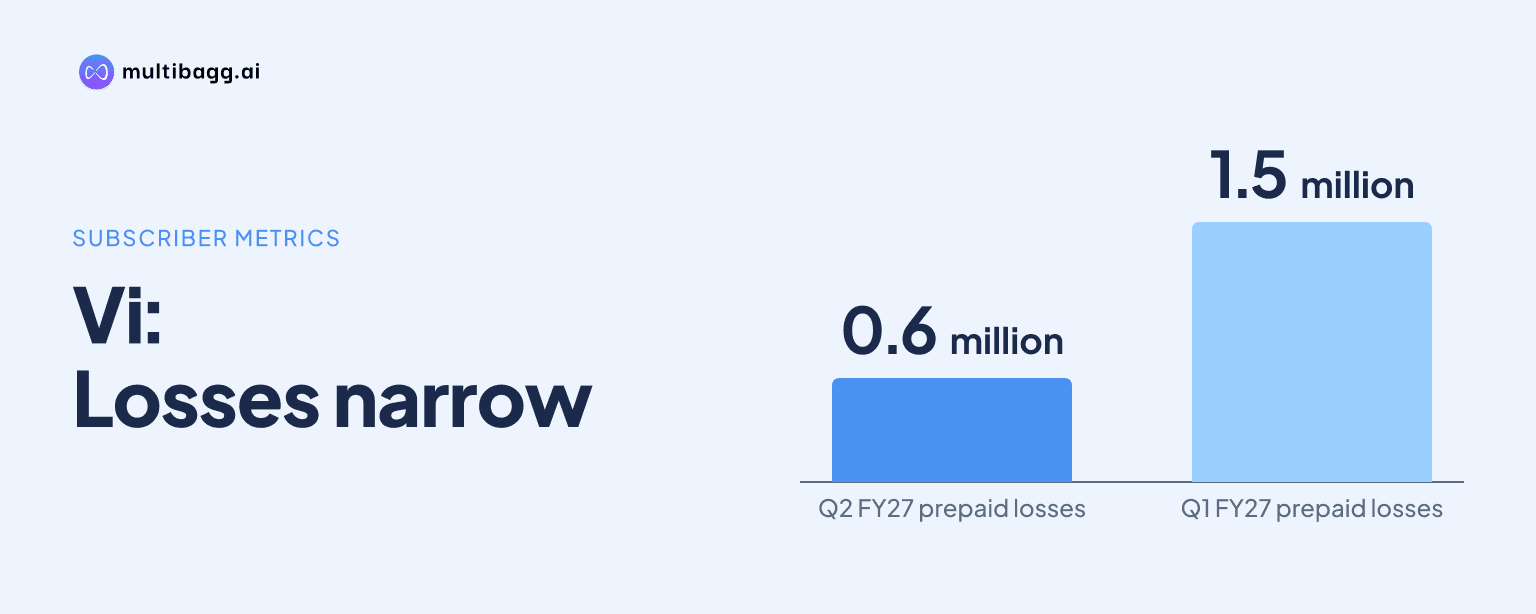
Vodafone Idea Limited reduced its prepaid net subscriber loss to 0.6 million in Q2FY27 from 1.5 million in Q1FY27, a 0.9 million quarterly improvement that management linked to network rollout and retention. Vi added 1.3 million subscribers overall, although machine-to-machine connections and postpaid were the main contributors.
Know Vodafone Idea inside out
Results, valuation, peers and who's buying, in one view.
Is Vi's prepaid subscriber base close to turning positive?
Yes, Vi said prepaid net additions remained marginally negative in Q2FY27 but should turn positive soon if the lower-loss trend continues. The prepaid net loss narrowed by 0.9 million sequentially, from 1.5 million in Q1FY27 to 0.6 million in Q2FY27, which management described as a positive swing of almost 1 million prepaid subscribers.
The 1.3 million total net subscriber addition in Q2FY27 does not mean prepaid has already returned to growth. Management said machine-to-machine, or M2M, connections and postpaid were the significant drivers of the overall addition. It nevertheless highlighted a more than 1 million-customer swing in human-SIM performance between Q1FY27 and Q2FY27 when prepaid and postpaid are considered without M2M.
Vi did not disclose circle-level human-SIM additions, so the call does not establish how many circles have positive non-M2M growth. Management said it has 17 key circles and described the trend as moving “largely” into positive territory, while noting that seasonality causes movement between periods.
How is network rollout reducing Vi churn?
Vi said churn is substantially lower in locations where it has rolled out network capacity than in locations where it is still catching up. Management called retention more important than acquisition because preserving existing customers is a larger and more critical task, even as it builds an acquisition engine.
Vi added nearly 9,000 broadband towers in Q2FY27, taking its unique broadband tower count close to 214,000 and lifting 4G population coverage to 88%. Management said the quarter delivered its highest tower addition since the post-FY24 investment programme began, while its guided pace remains 3,000 to 3,500 unique 4G towers a month.
The churn data show a mixed sequential and annual picture. Management said Q2FY27 churn increased by 0.2 percentage points from Q1FY27, but base churn improved by 0.5 percentage points from Q2FY26. That comparison supports its focus on rollout-led retention, but it also shows that improvement does not move evenly every quarter.
What is driving Vi's human-SIM acquisition and retention?
Vi attributed the improved human-SIM trend to better network availability and experience, stronger acquisition, and more mobile-number-portability port-ins. Management said customers using upgraded network services are finding the experience good and are porting into Vi, although it did not disclose Q2FY27 port-in volumes.
Vi also sees an upgrade opportunity among customers who do not use smartphones and smartphone users who mainly use voice services. Management said it aims to retain these cohorts while moving them towards smartphones, data usage and higher-value plans. Overall data usage rose 27.1% year on year to 93.6 petabytes a day in Q2FY27 from 73.6 petabytes a day in Q2FY26.
Product changes form part of that retention plan. Vi introduced free international roaming on key prepaid and postpaid plans at the end of September 2026, launched a prepaid family plan, and introduced a Rs 200 Vi Movies & TV prepaid pack covering 20 over-the-top, or OTT, platforms with data benefits. It also extended Spotify Premium to selected prepaid plans.
Got a follow-up? Ask IRIS
Can Vi's postpaid momentum offset prepaid losses?
Postpaid is already contributing to growth, with Vi reporting its highest sequential postpaid subscriber increase since FY24 and a 33.9 million postpaid base including M2M in Q2FY27. Management separately said human-postpaid net additions were well into positive territory, although it did not quantify human postpaid additions.
Vi is using differentiated offers to compete for postpaid customers, including international roaming, family plans and REDX. Management said these offers are yielding results, but the disclosed 33.9 million postpaid figure includes M2M and therefore cannot be used as a direct measure of consumer postpaid progress alone.
The customer-mix change coincided with an increase in average revenue per user, or ARPU, to Rs 198 in Q2FY27, up 9.7% year on year. Management said sequential organic ARPU growth was moderated by second-quarter seasonality and segmental interventions, but expects the growth trend of earlier quarters to resume from the next quarter.
Will Vi's funding support the subscriber recovery?
Vi said funding available through H1FY27 was sufficient to maintain rollout momentum while it continues discussions with banks on longer-term financing. It secured more than Rs 10,500 crore in total funding by H1FY27, including warrants and funded and non-funded facilities, with more than Rs 4,000 crore of incremental bank funding arranged in Q2FY27.
Capital expenditure rose to Rs 3,946 crore in Q2FY27, more than double the Q1FY27 run rate, taking H1FY27 expenditure to nearly Rs 6,000 crore. Vi has placed capital-expenditure orders exceeding Rs 13,200 crore against three-year guidance of Rs 45,000 crore, and management said it remains on track to complete its 4G rollout by FY28 for coverage parity in 17 key circles.
The financial backdrop still includes major commitments. Vi paid more than Rs 4,300 crore of spectrum dues in October 2026 and said it had paid more than Rs 6,000 crore of roughly Rs 7,000 crore of FY27 spectrum obligations. Management said it will draw funding as needed rather than require all planned facilities upfront, while the public-sector bank consortium process remained underway.
Conclusion
Vi's Q2FY27 subscriber result was more nuanced than the 1.3 million headline addition: M2M and postpaid delivered most of the reported growth, while prepaid remained in net loss. The key operational change was the reduction in prepaid losses to 0.6 million, alongside lower year-on-year base churn, expanding 4G coverage and higher data usage. These measures indicate a more stable customer base, rather than a completed prepaid turnaround.
The next test is whether Vi converts marginally negative prepaid additions into positive growth in coming months, as management expects. Investors can also watch the planned 3,000 to 3,500 monthly 4G-tower additions, the FY28 rollout target across 17 circles, and progress on the public-sector bank consortium funding that management said was close to closure.