










Visaka ATUM runs at 10 MW, with two-year scaling outlook
Key highlights
- Visaka ATUM is operating at 10 MW against installed annual capacity of 30 MW.
- Management said ATUM needs at least a couple of years to gain traction because the integrated product requires market education.
- Visaka says ATUM can save 40% to 50% of space versus a traditional solar roof while generating almost the same power.
- ATUM patents are held in the United States and South Africa, with a recently obtained patent in Europe.
powered by IRIS
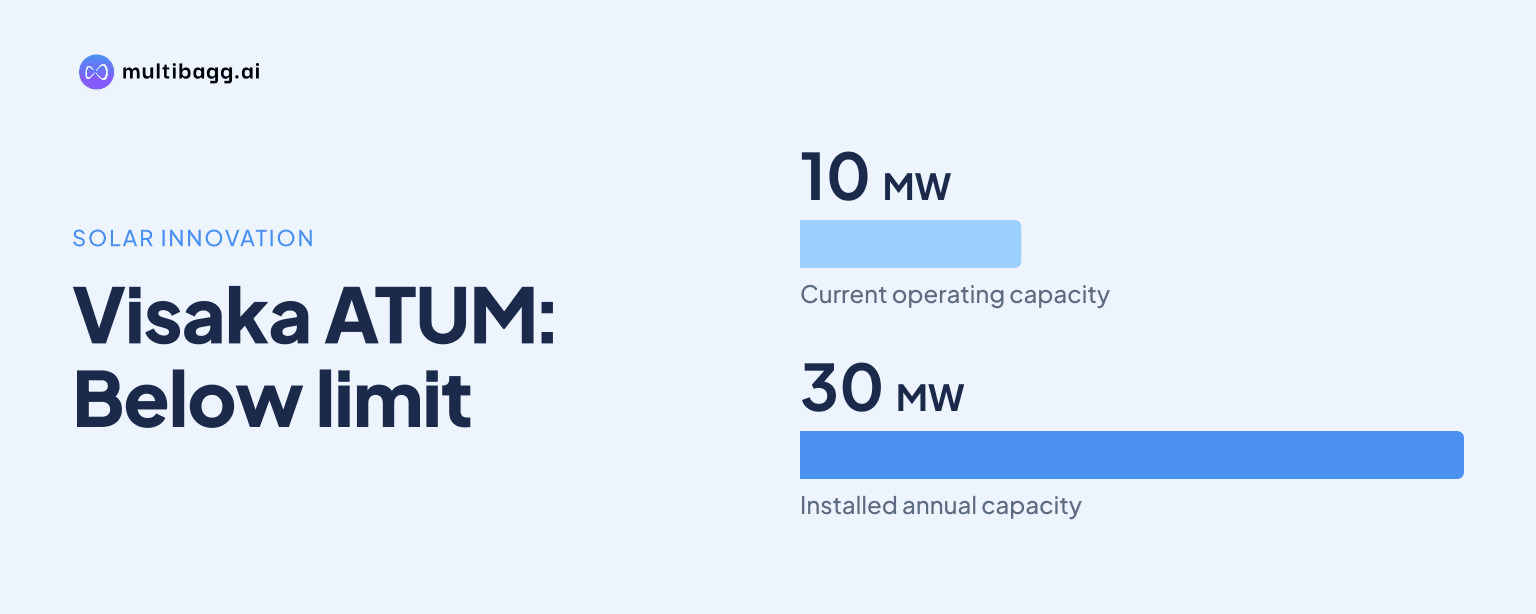
Visaka Industries Limited said ATUM was operating at 10 MW of its 30 MW annual capacity and that meaningful traction may take at least two years. Visaka attributed the low utilisation to the need to create awareness for a new product that combines cement roofing sheets with solar generation.
Know Visaka Industries inside out
Results, valuation, peers and who's buying, in one view.
What is Visaka ATUM's current capacity utilisation?
Visaka ATUM is operating at 10 MW against installed annual capacity of 30 MW, equivalent to one-third utilisation. Management initially referred to about 25 MW in response to a question on ATUM's commercial performance, but immediately clarified that current utilisation, rather than output at 25 MW, was 10 MW. That correction is material because it defines the present scale of the business and the unused production headroom.
Management said ATUM's order book and volumes are currently not material, without giving an order-value or revenue figure. It described ATUM as an emerging market rather than a mature solar category, saying customers still need to understand the benefit of integrating solar panels with cement sheets. The company said it is executing some considerably large projects, but did not identify project locations, customers, values or completion schedules.
The 10 MW level also contrasts with the broader manufacturing plans mentioned during the call. Visaka has announced a Rs 450 crore capital-expenditure plan over three years, although management said it could not provide further details on future capacity additions beyond those already disclosed. For ATUM specifically, the discussion centred on improving the market base and finding partnerships, rather than on expanding the existing 30 MW facility.
Why does Visaka expect ATUM to take two years to scale?
Visaka expects the ATUM model to take at least a couple of years to gain traction because it is a new integrated product that requires market education. Management did not give a revenue target or annual sales forecast for that period. It said that, once the company receives considerable projects, it would execute them and disclose the resulting impact appropriately in its financial statements.
The product combines a roof and solar-power generation in one installation, which makes its addressable use case different from a conventional rooftop solar system. An analyst noted that conventional systems can be installed on existing sheds and homes, while ATUM is more relevant to new construction or roof replacement. Management agreed with that framing, meaning the product's market is not identical to the broader market for solar panels mounted on existing roofs.
Management's sales case rests on installation and design features rather than an announced price comparison. It said ATUM can be installed and executed faster, has lower structural requirements than a conventional rooftop solar system, and offers architectural integration. It also said the system can save 40% to 50% of space compared with a traditional solar roof while generating almost the same power, though it did not provide a project-specific power-output test or customer payback period.
Got a follow-up? Ask IRIS
What market-building steps is Visaka taking for ATUM?
Visaka is building ATUM demand through customer awareness, project execution and potential partnerships rather than through a disclosed retail-store rollout. Management said customers are not yet broadly aware of the advantages of the integrated product, and that creating awareness is central to improving utilisation from 10 MW. It also said it was looking for partnerships to improve the business, without naming prospective partners or setting a partnership deadline.
The company holds ATUM patents in the United States and South Africa and said it had recently obtained a patent in Europe. Those patents give Visaka a basis to explore overseas opportunities, but management said such opportunities had not materialised as of the call. Therefore, overseas patent coverage should not be read as disclosed international revenue, export orders or a committed launch plan.
Visaka's wider distribution position may provide a route to market in building materials, although management did not say how many ATUM dealers it has. In the roofing business, it said the company has had a large India-wide distribution network for more than 40 years and plans to expand its dealer base by state. It has no plan to open its own retail stores, including experience-centre-style outlets proposed by an analyst for fibre-cement boards.
How does ATUM fit within Visaka's wider growth plan?
ATUM is one element of Visaka's stated plan to raise revenue and earnings over the next three years, but management gave no segment-level contribution target for it. Management said it aims for 10% to 12% compound annual growth in top line and about 10% to 12% growth in earnings before interest, tax, depreciation and amortisation, or EBITDA. It separately cautioned that a Rs 2,500 crore turnover target discussed by an analyst was more likely by 2030, not within two years.
The established businesses have more specific capacity and margin commentary than ATUM. Management said fibre-cement boards carry margins of about 14% to 15% and that a Tonk, Rajasthan facility is planned to add 6,000 tonnes per month, or about 72,000 tonnes annually, with operations expected in December 2027 into 2028. By comparison, ATUM has 20 MW of idle annual capacity today and no disclosed revenue, margin or commissioning target.
Roofing sheets remain a seasonal, volume-based business, according to management, while the textile division has no current expansion plan despite 92% capacity utilisation cited by an analyst. Management said it is focusing on improving textile efficiency and profitability rather than adding capacity. This contrast indicates that ATUM's near-term task is market creation, whereas boards are receiving identified capacity investment and textiles are being managed through operational optimisation.
Conclusion
Visaka has provided a clear measure of ATUM's present position: 10 MW utilisation against 30 MW of annual capacity, with volumes and orders not yet material. The product's proposed advantages, including 40% to 50% lower space use than a traditional solar roof for almost the same power, are central to management's effort to create demand. But the company has not disclosed a revenue outlook, project pipeline value or margin target for ATUM.
The next development to watch is whether customer education, partnerships and larger projects lift utilisation beyond 10 MW during management's stated minimum two-year market-building period. Investors can also watch for any disclosure of commercial overseas activity under the United States, South Africa and Europe patents, and for how ATUM progresses alongside the Tonk facility, which management expects to be operational in December 2027 into 2028.