










Visaka H1 EBITDA margin reaches 13% as debt falls Rs 66 crore
Key highlights
- Visaka reported H1 FY27 revenue of Rs 989 crore, up 19% from the corresponding prior-year period.
- Visaka’s H1 FY27 EBITDA margin increased to 13% from 7.6%, while EBITDA more than doubled to Rs 129 crore.
- Visaka’s total borrowings fell by about Rs 66 crore to Rs 237 crore at September 2026.
- Visaka reduced receivable days to 25 in September 2026 from 35 in March 2026.
powered by IRIS
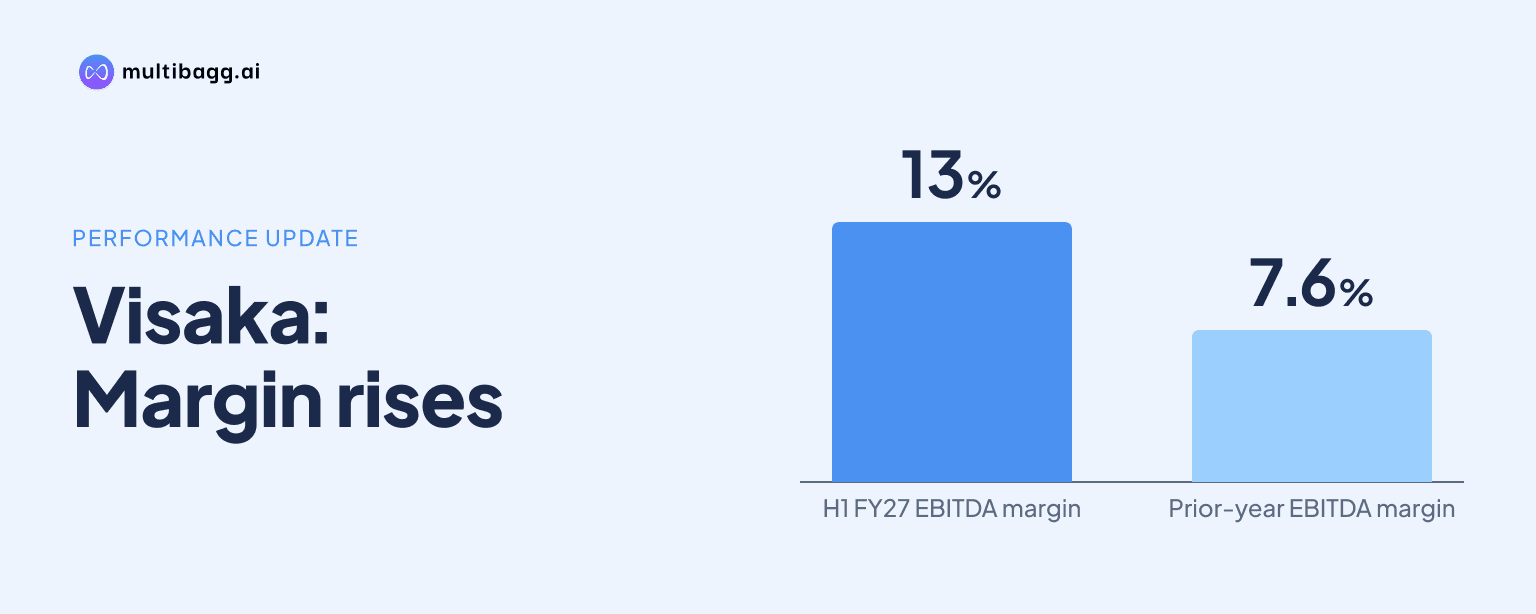
For the first half of FY27, ended September 2026, Visaka Industries Limited lifted earnings before interest, tax, depreciation and amortisation (EBITDA) margin to 13% from 7.6% and reduced borrowings by about Rs 66 crore to Rs 237 crore. Revenue rose 19% to Rs 989 crore, while receivable days fell to 25 from 35.
Know Visaka Industries inside out
Results, valuation, peers and who's buying, in one view.
How did Visaka perform in H1 FY27?
Visaka reported H1 FY27 revenue of Rs 989 crore, up 19% from the corresponding prior-year period, while EBITDA more than doubled to Rs 129 crore. EBITDA margin increased by 5.4 percentage points to 13% from 7.6%, showing a larger operating-profit contribution alongside sales growth.
Visaka’s second-quarter FY27 performance also improved year on year. Consolidated revenue increased 23% to Rs 399 crore and EBITDA more than tripled to Rs 38 crore, lifting margin to 9.4% from 3.6%. Profit before tax, excluding exceptional items, turned positive at Rs 17 crore against a Rs 11 crore loss a year earlier.
Management said exceptional gains contributed significantly to reported H1 profit after tax. In the second quarter, the chief financial officer said operating profit after exceptional items and taxes was about Rs 12.5 crore. This makes EBITDA and profit before tax excluding exceptional items the transcript’s more direct measures of the operating recovery.
What drove Visaka’s operating improvement?
Visaka attributed a substantial part of the improvement to Cement Roofing, where second-quarter volume rose about 20% and turnover increased 34% year on year. H1 volume increased 14%, with management citing improved demand, higher prices for substitute metal roofing sheets and better realisations.
Cement Roofing also creates quarterly seasonality in Visaka’s sales. Management said volumes are normally higher in the first and fourth quarters and lower in the second and third quarters, whereas boards demand is steadier. Delayed or lower rainfall compared with the previous year lifted roofing-sheet volume, and Visaka raised some prices in the first quarter after metal roofing alternatives became costlier.
V-Next boards and panels added growth from other building-material categories. Boards volume rose about 9% and turnover 13% in H1, despite lower exports to Gulf Cooperation Council markets amid the Middle East war situation; Visaka’s five board facilities operated near full capacity in the second quarter. Panels were the fastest-growing division, with second-quarter volume up 55% and turnover up 56%.
Synthetic Yarn recovered after two challenging years, according to management. Capacity utilisation increased to 92% from 89%, second-quarter revenue rose 16%, and segment profit before interest and tax increased to about Rs 5 crore from Rs 2 crore. Management said crude-price volatility raised polyester raw-material costs and higher ocean freight affected exports, though it passed on part of the cost increase.
Got a follow-up? Ask IRIS
How did Visaka’s debt and working capital change?
Visaka reduced total borrowings by approximately Rs 66 crore during H1 FY27 to Rs 237 crore at September 2026, bringing debt to equity to 0.25 times. Receivable days declined by 10 days, from 35 days in March 2026 to 25 days in September 2026, shortening the time taken to collect from customers.
Cash generated from operations increased to about Rs 70 crore in H1 from about Rs 55 crore in the corresponding period last year. The operating-cash figure was lower than H1 EBITDA of Rs 129 crore, but the call did not provide a full reconciliation between the two measures or identify every working-capital and other cash-flow item.
The debt and cash-flow figures included a material non-operating receipt. Management confirmed that Visaka received Rs 69 crore following a favourable court order in a dispute involving an investment in the Hyderabad Cricket Association that had continued since 2016. The chief financial officer said taxes were accounted for and advance tax remitted on the capital receipt.
Management said its capital-allocation priorities were to strengthen existing businesses, invest selectively in growth opportunities and retain balance-sheet flexibility. When asked whether land-sale proceeds would be reinvested in new capacity and expansion, the chief financial officer agreed, although the call gave no amount or timeline for that deployment.
What is Visaka planning after H1 FY27?
Visaka said its proposed fiber-cement-board and calcium-silicate-board facility at Tonk was progressing as planned. Its construction-chemicals project at Tumkur was targeted for completion in January 2027, giving Visaka an adjacent building-material category where management expects to use its existing market and distribution network.
Management said Tonk is intended to support premium products, wider applications and new geographical markets for boards. Visaka also plans to increase premium, value-added and non-asbestos building products. ATUM, its integrated roofing and solar-power product, currently contributes relatively little turnover; management’s near-term focus is customer awareness, installations, engineering, procurement and construction partnerships, referrals and repeat orders.
Over the medium term, management retained its objective of 10% to 15% revenue compound annual growth rate (CAGR) with sustainable EBITDA margins of 10% to 12%. The stated margin range is below the 13% achieved in H1 FY27, so management presented the first-half outcome as performance to sustain rather than as a changed margin target.
Conclusion
Visaka’s H1 FY27 recovery combined higher operating profitability with better collections and cash generation. Revenue rose 19% to Rs 989 crore, EBITDA margin reached 13%, receivable days fell by 10 days and borrowings declined by about Rs 66 crore. However, the Rs 69 crore court-settlement receipt was included in debt and cash-flow figures, so the balance-sheet movement was not solely generated by operations.
The next disclosed milestone is the January 2027 target for completing the Tumkur construction-chemicals project, while the Tonk boards facility remains in progress. Management’s 10% to 15% revenue CAGR and 10% to 12% sustainable EBITDA-margin objectives, Cement Roofing pricing and volumes, board exports to Gulf markets, and Synthetic Yarn’s exposure to raw-material and freight costs are the stated factors to watch next.