










Waaree Energies Commissions 5.15 GWh Gujarat BESS Facility
Key highlights
- Waaree Energies commissioned 5.15 GWh of BESS container capacity in Gujarat in July 2026.
- The Rola facility targets throughput of about 1,000 BESS containers annually, or up to three per day.
- The 78-acre Rola site has about 39 to 40 acres earmarked for construction.
- A 4 GWh battery-cell unit is targeted to begin operations by December 2026, according to PL Capital.
powered by IRIS
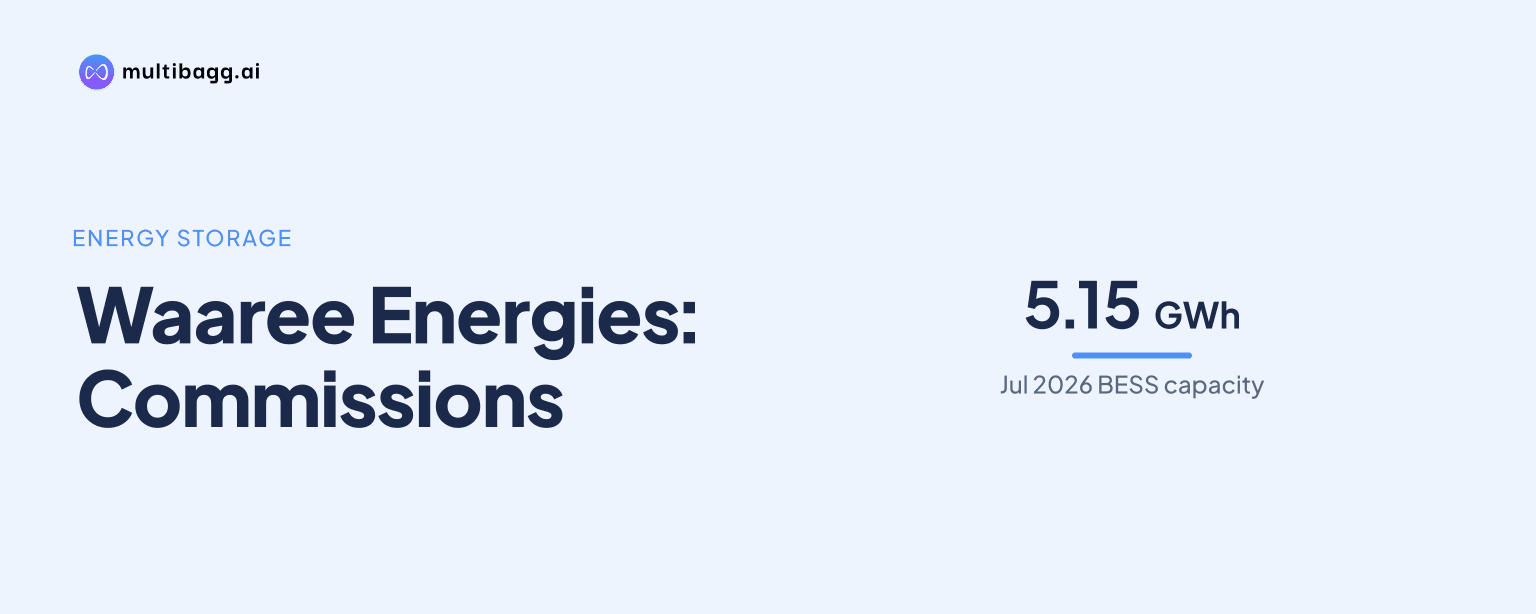
Waaree Energies Limited commissioned a 5.15 GWh battery energy storage system container facility at Rola, Gujarat, in July 2026, marking the first operational phase of its planned 20 GWh energy-storage manufacturing roadmap. The facility adds dedicated container assembly capacity for utility-scale and commercial applications as India builds storage capacity alongside renewable generation.
Know Waaree Energies inside out
Results, valuation, peers and who's buying, in one view.
What did Waaree Energies commission in Gujarat?
Waaree Energies has commenced operations at a battery energy storage system, or BESS, container manufacturing facility through its subsidiary, Waaree Energy Storage Solutions. The plant at Rola has annual capacity of 5.15 GWh and is designed to manufacture containerised storage systems for utility-scale projects and commercial and industrial users.
The 5.15 GWh capacity is higher than the originally planned 3.5 GWh. Waaree Energies attributed the upgrade to production debottlenecking and improved battery-cell energy density. The facility includes automated assembly lines, automated guided vehicles, intelligent material handling, testing systems and quality-assurance equipment, according to the company's announcement.
The Rola site spans 78 acres, of which about 39 to 40 acres have been earmarked for construction. The BESS operation has a planned throughput of about 1,000 containers a year, equivalent to up to three containers a day. Two containers had been completed at the time of the plant visit cited by PL Capital, and one had been collected.
How is the BESS plant operating at present?
The facility currently assembles BESS containers using semi-knocked-down, or SKD, kits imported from China. This means key components are imported in partly assembled form and integrated into containerised systems at the Gujarat unit.
Completely knocked-down, or CKD, pack manufacturing had not begun at the time of the reported visit. The distinction is relevant because Waaree Energies' broader plan covers multiple parts of the storage value chain, including lithium-ion cells, battery packs and final BESS containers. The commissioned operation is therefore an initial manufacturing step rather than a fully localised cell-to-container production chain.
The company has positioned the output for scalable and transportable storage applications. Its intended customer base includes residential customers, commercial and industrial users, telecom companies, data centres, aerospace and defence applications, as well as utility-scale energy-storage projects.
What additional battery capacity is Waaree Energies planning?
Waaree Energies is installing equipment for a 4 GWh battery-cell manufacturing unit at the Rola facility, according to PL Capital's plant-visit assessment, with operations targeted for December 2026. The cell project would complement the already commissioned BESS assembly line.
Separately, the company's July announcement described plans to operationalise 5.15 GWh of battery-pack manufacturing capacity and 3.5 GWh of lithium-ion cell capacity during the current financial year. The differing capacity figures reflect the information reported in the plant-visit note and the company's public release. Both point to Waaree Energies' stated objective of integrating cell, pack and container production.
The planned facilities form part of a 20 GWh energy-storage manufacturing roadmap. Waaree Energies has said the roadmap is intended to support domestic energy-storage manufacturing and reduce dependence on imported technologies. Its earlier plans also referred to a larger BESS-related manufacturing build-out in Andhra Pradesh.
Got a follow-up? Ask IRIS
Why does the new capacity matter for energy storage demand?
The new BESS line matters because storage is increasingly required to manage the variability of solar and wind generation and to support electricity demand from industrial and infrastructure customers. Containerised systems are used in grid-scale projects and behind-the-meter installations, where storage can be configured in modular units.
Waaree Energies is already a major Indian solar-module manufacturer, and the BESS operation extends its manufacturing footprint into an adjacent clean-energy segment. The company stated that the plant will serve utility-scale projects alongside commercial and industrial applications. This customer mix links the capacity to both grid-connected deployments and users seeking on-site storage solutions.
PL Capital said following visits to Waaree Energies' Rola and Sarodhi plants in Gujarat that the new capacities could support steady top-line growth. That assessment is tied to the company bringing additional manufacturing capacity into operation, rather than to any disclosed sales, order-book or profitability figure for the BESS unit.
What are the implications for investors and industry operations?
For investors, the commissioning establishes an operating manufacturing asset with 5.15 GWh of stated annual capacity, but actual production remains at an early stage based on the two containers reported as completed. No BESS revenue, margin, utilisation level or customer order details were disclosed in the available information. As a result, the financial contribution of the facility cannot yet be quantified from the reported data.
For the industry, the project adds domestic assembly capacity for BESS containers while depending initially on SKD kits from China. Progress on CKD pack manufacturing and the planned cell unit will be important indicators of how far the company can move towards the integrated domestic supply chain outlined in its roadmap.
The facility's capacity increase from 3.5 GWh to 5.15 GWh was based on debottlenecking and higher cell energy density, rather than a separately disclosed expansion of the physical site. This suggests Waaree Energies is seeking to raise output from available production infrastructure while further construction and equipment installation continue.
Conclusion
Waaree Energies has added 5.15 GWh of BESS container manufacturing capacity at Rola, giving it an operational foothold in a storage market that serves utility, commercial and industrial applications. The plant's initial use of imported SKD kits and the early volume of completed containers show that the broader integration plan is still being developed.
The next disclosed milestone is the targeted December 2026 start for the 4 GWh cell facility cited by PL Capital. Investors will also watch for progress in CKD pack manufacturing, utilisation of the container line, and further details on the company's 20 GWh energy-storage roadmap.