










Wanbury targets four annual API molecule launches from FY27
Key highlights
- Wanbury plans four commercial API molecule launches each year beginning FY27.
- Metformin and Sertraline represented 51% and 37% of Wanbury's FY26 API sales mix.
- Wanbury has 500 kilolitres of installed reactor capacity and identifies 600 kilolitres of future capacity potential.
- Wanbury estimates a 30% global market share in Sertraline, compared with about 10% in Metformin.
powered by IRIS
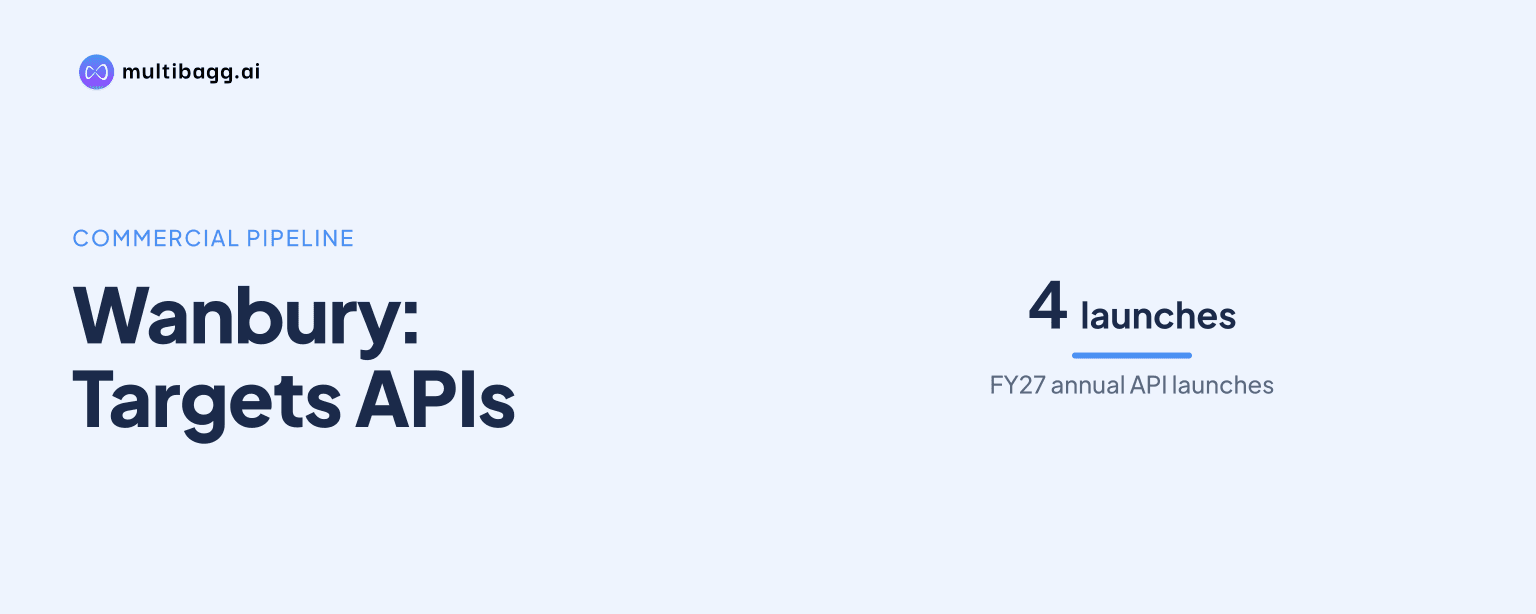
Wanbury Limited targets four commercial active pharmaceutical ingredient (API) molecule launches each year beginning financial year (FY) 2027, after commercialising an anaesthetic in the fourth quarter of FY26. The plan builds on six existing API molecules, the new anaesthetic, 500 kilolitres of installed reactor capacity and an estimated 30% global share in Sertraline.
Know Wanbury inside out
Results, valuation, peers and who's buying, in one view.
What is Wanbury's API launch plan from FY27?
Wanbury plans four commercial API launches each year beginning FY27. The company commercialised an anaesthetic in Q4FY26, adding one molecule to its six-product existing API portfolio. That established range comprises Metformin, Sertraline, Tramadol, Paroxetine, Mefenamic acid and Diphenhydramine, spanning antidiabetic, antidepressant, pain-management, anti-inflammatory and antihistamine categories.
Wanbury says its selection framework will combine either high-value molecules or large-volume molecules with sizable market-share potential. The framework focuses on small-to-mid-size molecules, targets double-digit market share and favours APIs requested by existing marquee clients. Management also identifies patented-molecule supply chains beyond FY29-30 as a future focus area, rather than a current commercial programme.
Which molecules currently underpin Wanbury's API business?
Metformin and Sertraline were Wanbury's two largest API products in FY26, accounting for 51% and 37% of API sales, respectively. Tramadol supplied 7% and other molecules 6%, leaving the top two products with a combined 88% share. API revenue represented 88% of total revenue in FY26, compared with 87% in FY22 and 90% in FY23.
Wanbury's disclosed market position varies substantially across its three leading molecules. The presentation attributes market-size and market-share estimates to Clarivate and company estimates, and uses metric tonnes for global market volumes.
The comparison shows that Metformin serves the largest-volume market, while Sertraline has Wanbury's highest estimated share at about 30%. That product mix makes the stated Sertraline backward-integration programme relevant to the growth plan. Wanbury also identifies Metformin yield improvement as an immediate research and development priority, covering its two largest FY26 API sales contributors.
What manufacturing capacity can Wanbury use for new APIs?
Wanbury has 500 kilolitres of cumulative installed reactor capacity at its Tanuku and Patalganga facilities, and identifies 600 kilolitres of future reactor-capacity potential at existing sites. Tanuku in Andhra Pradesh has 400 kilolitres of reactor capacity and contributes about 70% of revenue, while Patalganga in Maharashtra has 96 kilolitres and contributes about 30%.
Tanuku has stated potential for future brownfield capital expenditure and operates as a multi-purpose plant for Metformin, Sertraline, Tramadol, Paroxetine, Mefenamic acid and Diphenhydramine. It is also listed for the upcoming anaesthetic. Patalganga, in contrast, is a dedicated facility for Metformin and direct-compression-grade Metformin and is described as fully occupied, distinguishing the sites in available expansion flexibility.
The sites also differ in land bank and workforce. Tanuku has 18 acres and more than 450 employees, compared with 2.3 acres and more than 250 employees at Patalganga. The presentation does not disclose a capital-expenditure amount, construction schedule or molecule-by-molecule allocation for the 600-kilolitre potential, so that figure is capacity potential rather than a committed expansion timetable.
Got a follow-up? Ask IRIS
How does Wanbury support regulated-market API growth?
Wanbury exports to more than 50 countries across more than four continents, while its total revenue mix is shown as 20% exports and 80% domestic. Management identifies the United States, European Union and Brazil as regulated-market priorities for both new and existing molecules. The planned FY27 launches are therefore paired with an existing international regulatory and export footprint.
Both API sites are presented as having approvals from the United States Food and Drug Administration since 2000, the European Directorate for the Quality of Medicines and HealthCare since 2007, and the World Health Organization Good Manufacturing Practice programme since 2007. The latest listed inspections were in 2024 for the US Food and Drug Administration, 2025 for World Health Organization Good Manufacturing Practice and European Union written confirmation, and 2026 for South Korea's KFDA.
Wanbury reports 70 total approval, pending and filing entries across the markets listed in its presentation. These include 21 in the United States, nine in Europe including one pending, six in Brazil including five pending, three in South Korea and 31 in the rest of the world. Planned filings include Quetiapine Fumarate for the United States and Europe, Ketamine hydrochloride for Europe, and Paroxetine hydrochloride for Brazil and South Korea, without disclosed filing or approval dates.
What margin and development work does Wanbury target?
Wanbury's product-selection framework aims for gross margins of about 50%. This is a management target rather than a reported current margin. The company says it will assess margin profile alongside client fit, molecule size and market-share potential, with an aim of reaching double-digit market share in selected small-to-mid-size molecules.
The planned development work includes selective backward integration to optimise input costs and improve contribution margins. Wanbury's Tanuku API research and development centre is recognised by the Department of Scientific and Industrial Research and FDA (India), and lists Sertraline backward integration, Metformin yield improvement and four annual molecule commercialisations as immediate focus areas. Its work includes process optimisation, analytical development, impurity control and scale-up from laboratory to commercial production.
Wanbury lists chemistry capabilities including hydrogenation, cyanation, chiral chemistry and high-pressure reactions, allowing it to handle a range of API production processes. Separately, an upcoming 1.5-megawatt solar project at Patalganga is intended to meet 70% of that site's energy needs through captive renewable energy. The presentation does not quantify a cost saving from the solar project or connect it directly to the 50% gross-margin target.
Conclusion
Wanbury's FY27 strategy combines four annual new-molecule launches with a seven-molecule listed portfolio and 500 kilolitres of installed reactor capacity. Its existing API business remains concentrated in Metformin and Sertraline, which accounted for 51% and 37% of FY26 API sales, while Sertraline's estimated 30% global market share exceeds Metformin's estimated 10%.
The next developments to watch are execution against the four-launch annual plan from FY27, any use of Tanuku's brownfield potential, and progress in planned filings for Quetiapine Fumarate, Ketamine hydrochloride and Paroxetine hydrochloride. Beyond FY29-30, management has identified patented-molecule supply chains as a target area, while the approximately 50% gross-margin objective remains a stated target rather than a disclosed result.