










Zappfresh H1 FY27 Revenue Rises 73% as EBITDA Margin Falls
Key highlights
- Zappfresh revenue from operations rose 72.6% year on year to Rs 165.5 crore in H1FY27.
- Zappfresh EBITDA margin fell 552 basis points to 10.4% in H1FY27 from 15.9% in H1FY26.
- Zappfresh PAT increased 3.9% to Rs 7.3 crore, while diluted EPS declined 23.7% to Rs 6.55.
- Zappfresh said seafood was about 25% of H1FY27 non-vegetarian revenue and targets about 30% over the medium term.
powered by IRIS
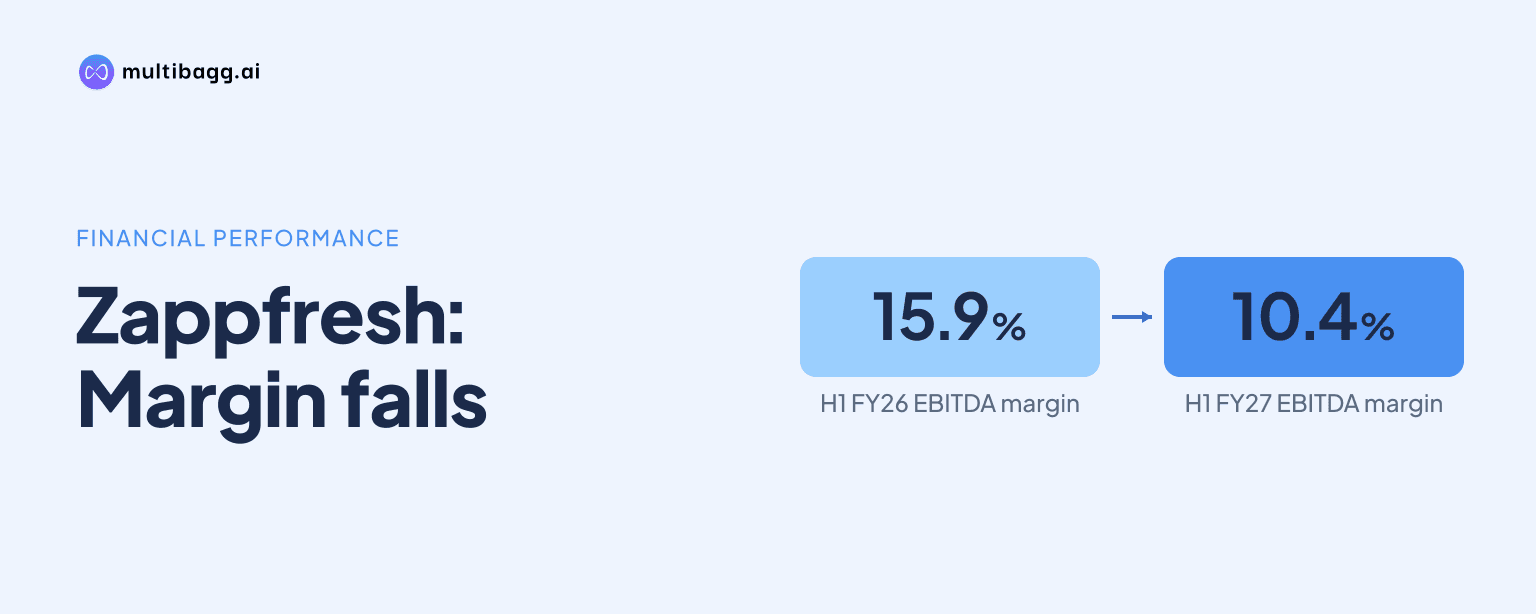
Zappfresh reported revenue from operations of Rs 165.5 crore in H1FY27, up 72.6% year on year, while EBITDA margin fell 552 basis points to 10.4% from 15.9%. Profit after tax rose 3.9% to Rs 7.3 crore and diluted earnings per share declined 23.7% to Rs 6.55.
Know DSM Fresh Foods inside out
Results, valuation, peers and who's buying, in one view.
What were Zappfresh's H1FY27 headline results?
Zappfresh recorded sharply higher revenue in H1FY27, although profit growth did not match the sales increase. Revenue from operations rose from Rs 95.9 crore in H1FY26 to Rs 165.5 crore in H1FY27, a 72.6% increase. Revenue was also 32.4% above Rs 125 crore in H2FY26, while gross profit rose 48.4% year on year to Rs 47.7 crore.
The detailed profit-and-loss statement reports earnings before interest, tax, depreciation and amortisation, or EBITDA, of Rs 17.2 crore in H1FY27, up 12.8% from Rs 15.3 crore in H1FY26. The management-commentary table instead reports EBITDA of Rs 17.6 crore, while retaining the same 10.4% margin; the presentation does not explain the Rs 0.4 crore difference. Profit after tax, or PAT, was Rs 7.3 crore, compared with Rs 7 crore a year earlier.
The H2FY26 comparison also shows that the additional revenue did not produce higher absolute PAT. Revenue increased by Rs 40.5 crore from H2FY26 to H1FY27, but PAT remained Rs 7.3 crore in both periods. Profit before tax, or PBT, declined 11.2% from Rs 11.5 crore in H2FY26 to Rs 10.2 crore in H1FY27.
Why did Zappfresh's EBITDA margin decline in H1FY27?
Zappfresh's EBITDA margin declined because cost of goods sold and other expenses increased faster than revenue on a year-on-year basis. Cost of goods sold rose 84.9% to Rs 117.7 crore from Rs 63.7 crore, exceeding the 72.6% rise in revenue. Gross margin consequently fell 471 basis points to 28.9% from 33.6% in H1FY26.
Other expenses increased 80.6% to Rs 30.5 crore from Rs 16.9 crore. EBITDA therefore increased by Rs 1.9 crore despite a Rs 69.6 crore rise in revenue. EBITDA margin was 10.4%, down 552 basis points from 15.9% in H1FY26 and 225 basis points below the 12.7% recorded in H2FY26.
The gross-margin movement differed between the half-on-half and year-on-year comparisons. Gross margin improved 306 basis points from 25.8% in H2FY26 to 28.9% in H1FY27, but EBITDA margin declined from 12.7% to 10.4%. Other expenses rose 85.9% half on half, from Rs 16.4 crore in H2FY26 to Rs 30.5 crore in H1FY27.
What limited Zappfresh's profit growth below EBITDA?
Zappfresh's PAT growth was constrained by higher depreciation and finance costs, which contributed to lower PBT. Depreciation rose 253.8% year on year to Rs 2.9 crore from Rs 0.8 crore, while finance cost increased 62.2% to Rs 4.5 crore from Rs 2.8 crore. PBT declined 12.5% to Rs 10.2 crore despite the reported increase in EBITDA.
Tax expense declined 37.3% to Rs 2.9 crore from Rs 4.6 crore, helping PAT rise above the Rs 7 crore reported in H1FY26. PAT margin nevertheless fell 292 basis points to 4.4% from 7.3%. The 3.9% increase in PAT was below the 48.4% increase in gross profit and the 72.6% growth in revenue.
Diluted earnings per share, or EPS, also decreased. EPS was Rs 6.55 in H1FY27, down 23.7% from Rs 8.58 in H1FY26 and 1.0% below Rs 6.62 in H2FY26. The presentation reports the per-share decline alongside the marginal year-on-year PAT increase but gives no explanation for the difference.
Got a follow-up? Ask IRIS
How did Zappfresh's balance sheet change by September 2026?
Zappfresh reported higher borrowings and working-capital balances at September 2026 than at March 2026. Long-term borrowings rose to Rs 30.8 crore from Rs 9.1 crore, and short-term borrowings increased to Rs 80 crore from Rs 55.3 crore. Total equity and liabilities increased to Rs 287.7 crore from Rs 194.4 crore over the same period.
Trade receivables rose to Rs 76.9 crore at September 2026 from Rs 55.6 crore at March 2026, while short-term loans and advances increased to Rs 94.3 crore from Rs 52.8 crore. Inventories rose to Rs 11.2 crore from Rs 8.5 crore. Cash and bank balances declined to Rs 4.9 crore from Rs 9.2 crore.
Property, plant and equipment increased to Rs 36.2 crore from Rs 7.9 crore, and total non-current assets increased to Rs 84.9 crore from Rs 44.9 crore. Reserves and surplus rose to Rs 101 crore from Rs 93.7 crore, while equity share capital remained Rs 22.3 crore. The balance-sheet changes were reported alongside Zappfresh's stated aquaculture and product-category expansion initiatives.
What margin recovery plans has Zappfresh disclosed?
Zappfresh has disclosed seafood backward integration as a planned mechanism for procurement control and gross-margin expansion. The company is developing an aquaculture project with about 500 tonnes of annual capacity and a 300-farmer sourcing alliance through a farmer producer organisation, or FPO, model. It also signed a memorandum of understanding with a Ghaziabad-based aquaculture farm operator covering about 270 acres in Village Masurie.
Management expects a gross-margin uplift of about 200 to 300 basis points in the seafood vertical through the FPO sourcing model and related procurement efficiencies. Seafood represented about 25% of non-vegetarian revenue in H1FY27, and Zappfresh is targeting about 30% over the medium term. These are management's disclosed expectations and targets, not reported H1FY27 margin outcomes.
Management also cited Meevaa Foods' entry into ready-to-eat products after the Ambrozia acquisition and the expansion of its retail-partnership network. The Meevaa campaign calendar ran from June to November 2026, including an 11:11 campaign that the presentation says increased online orders by 362% versus June, with more than 80% of buyers being first-time buyers. The source does not quantify Meevaa Foods' H1FY27 revenue or margin contribution.
Conclusion
Zappfresh's H1FY27 results show that revenue expansion was not matched by profit conversion. Revenue rose 72.6% to Rs 165.5 crore, but gross margin declined to 28.9%, EBITDA margin to 10.4% and PAT margin to 4.4%. PAT increased 3.9% to Rs 7.3 crore, while diluted EPS declined to Rs 6.55.
The next reported periods will indicate whether Zappfresh's seafood sourcing programme affects procurement costs and margin. Management is targeting seafood at about 30% of non-vegetarian revenue from about 25% in H1FY27 and expects a 200 to 300 basis-point gross-margin uplift in that vertical. The next update may also clarify the Rs 0.4 crore difference between the commentary-table EBITDA figure and the detailed profit-and-loss statement.