










DSM FRESH FOODS LTD. FY26 cash outflow widened despite profit
Key highlights
- DSM Fresh Foods reported a Rs 47.8 crore operating cash outflow in FY26, compared with a Rs 15.2 crore outflow in FY25.
- DSM Fresh Foods’ working-capital cycle increased to 67 days in FY26 from 43 days in FY25.
- Trade receivables rose by Rs 38.7 crore to Rs 55.6 crore, while short-term loans and advances reached Rs 52.8 crore.
- DSM Fresh Foods reported Rs 78.6 crore in FY26 financing cash inflow, while short-term borrowings rose to Rs 55.3 crore.
powered by IRIS
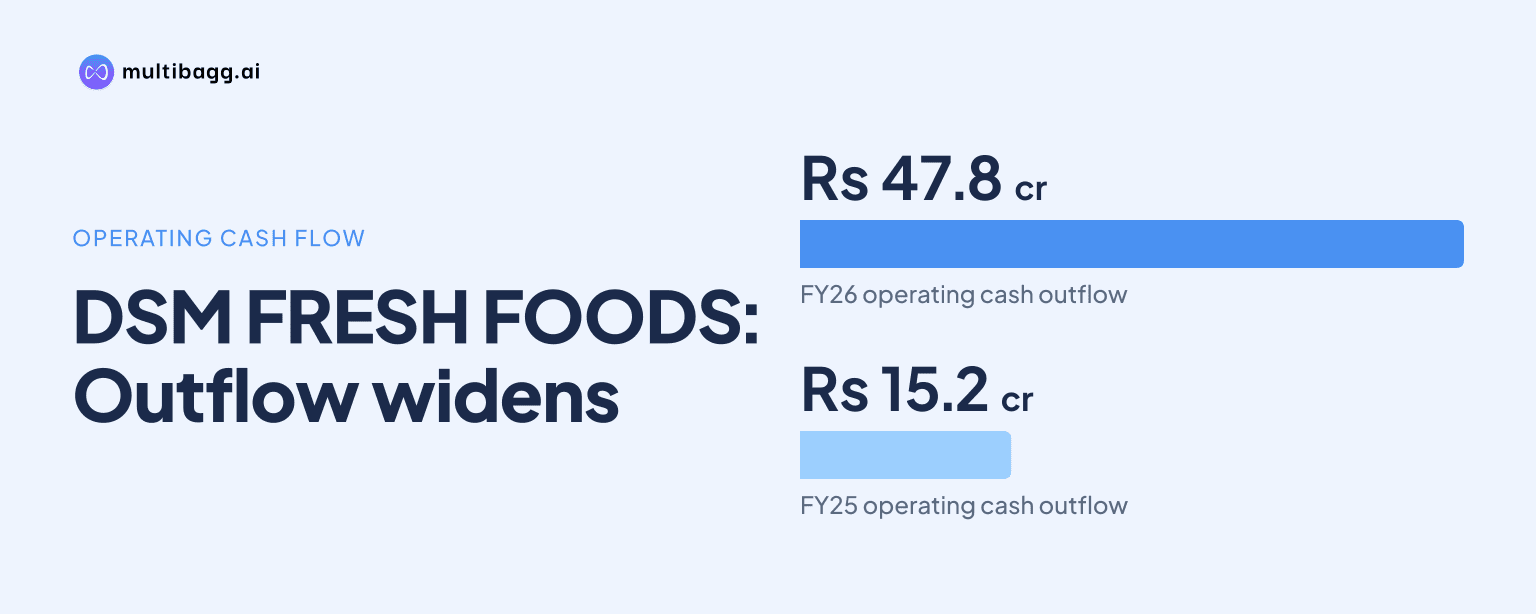
DSM Fresh Foods reported a Rs 47.8 crore cash outflow from operations in financial year (FY) 2026, compared with a Rs 15.2 crore outflow in FY25, although profit after tax rose to Rs 14.3 crore from Rs 9 crore. The divergence coincided with a 24-day increase in its working-capital cycle and higher receivables and short-term loans and advances.
Know DSM Fresh Foods inside out
Results, valuation, peers and who's buying, in one view.
Why did DSM Fresh Foods report a larger FY26 operating cash outflow?
DSM Fresh Foods reported cash flow from operations of negative Rs 47.8 crore in FY26, compared with negative Rs 15.2 crore in FY25. The operating cash outflow therefore widened by Rs 32.6 crore during a year when revenue, earnings before interest, tax, depreciation and amortisation (EBITDA), and profit after tax (PAT) all increased.
The historical cash-flow statement does not provide a reconciliation of individual operating-cash-flow movements. It therefore does not identify the precise contribution from receivables, inventory, advances or payables to the FY26 outflow. The balance sheet nevertheless shows trade receivables rising from Rs 16.9 crore in FY25 to Rs 55.6 crore in FY26, while short-term loans and advances increased from Rs 19.5 crore to Rs 52.8 crore.
DSM Fresh Foods also reported an investing cash outflow of Rs 22.4 crore in FY26, compared with Rs 10.5 crore in FY25. Financing cash inflow increased to Rs 78.6 crore from Rs 22.2 crore, exceeding the FY26 combined operating and investing cash outflows of Rs 70.2 crore and resulting in net cash flow of Rs 8.3 crore.
How did DSM Fresh Foods’ working-capital position change in FY26?
DSM Fresh Foods’ working-capital cycle increased to 67 days in FY26 from 43 days in FY25, extending by 24 days. The presentation reports this change alongside current assets of Rs 149.5 crore and current liabilities of Rs 68.8 crore at the end of FY26, compared with Rs 44.2 crore and Rs 24.1 crore respectively a year earlier.
Trade receivables increased by Rs 38.7 crore to Rs 55.6 crore in FY26. Short-term loans and advances rose by Rs 33.3 crore to Rs 52.8 crore, while inventories increased by Rs 2.2 crore to Rs 8.5 crore. These three asset categories totalled Rs 116.9 crore in FY26, against Rs 38.6 crore in FY25.
On the liabilities side, trade payables rose to Rs 7.2 crore in FY26 from Rs 1.2 crore in FY25, and short-term borrowings increased to Rs 55.3 crore from Rs 21.1 crore. The presentation does not disclose receivables ageing, collection terms, or the purpose of the Rs 52.8 crore in short-term loans and advances.
Got a follow-up? Ask IRIS
Did DSM Fresh Foods’ higher profit convert into operating cash in FY26?
No, DSM Fresh Foods’ PAT of Rs 14.3 crore in FY26 did not convert into positive reported cash flow from operations, which was negative Rs 47.8 crore. In FY25, PAT was Rs 9 crore and cash flow from operations was also negative at Rs 15.2 crore, meaning the difference between reported profit and operating cash flow widened in FY26.
Revenue from operations increased to Rs 220.8 crore in FY26 from Rs 130.7 crore in FY25. EBITDA increased to Rs 31.1 crore from Rs 16.3 crore, and the EBITDA margin rose to 14.1% from 12.5%. Gross profit increased to Rs 64.4 crore from Rs 45.6 crore, although gross margin declined to 29.2% from 34.8%.
PAT margin declined to 6.5% in FY26 from 6.9% in FY25 despite the Rs 5.3 crore increase in absolute PAT. Within the income statement, interest expense rose to Rs 6.9 crore from Rs 3.8 crore, depreciation increased to Rs 2.2 crore from Rs 1.6 crore, and tax rose to Rs 8.8 crore from Rs 2.6 crore. These figures do not substitute for the undisclosed operating-cash-flow reconciliation.
How did financing cash flow compare with DSM Fresh Foods’ FY26 outflows?
DSM Fresh Foods reported Rs 78.6 crore of cash inflow from financing activities in FY26, compared with Rs 22.2 crore in FY25. This financing inflow was larger than the Rs 47.8 crore operating outflow and Rs 22.4 crore investing outflow recorded during FY26, while cash and bank balances increased to Rs 9.2 crore from Rs 0.9 crore.
Short-term borrowings increased by Rs 34.2 crore to Rs 55.3 crore in FY26, whereas long-term borrowings declined to Rs 9.1 crore from Rs 10.6 crore. Total equity rose to Rs 116 crore from Rs 49 crore, including equity share capital of Rs 22.3 crore and reserves and surplus of Rs 93.7 crore at FY26-end. The presentation does not separately identify the components of the Rs 78.6 crore financing inflow.
DSM Fresh Foods reported a net debt-to-equity ratio of 0.5 in FY26, compared with 0.6 in FY25. Return on equity (ROE) declined to 17.4% from 20.8%, while return on capital employed (ROCE) was 23.0% compared with 23.4%. Total assets increased to Rs 194.4 crore in FY26 from Rs 84 crore in FY25.
Conclusion
DSM Fresh Foods’ FY26 financials show higher reported earnings alongside a wider operating cash outflow. Revenue increased by Rs 90.1 crore, EBITDA rose by Rs 14.8 crore and PAT increased by Rs 5.3 crore, while cash flow from operations moved to negative Rs 47.8 crore. The same period included a working-capital cycle of 67 days, receivables of Rs 55.6 crore and short-term loans and advances of Rs 52.8 crore.
The next financial disclosure will be relevant for changes in the 67-day working-capital cycle, receivables, short-term loans and advances, and short-term borrowings of Rs 55.3 crore. The presentation leaves unresolved how much each operating balance-sheet item contributed to the FY26 cash outflow because it does not provide a detailed operating-cash-flow bridge or a working-capital target.