










Zappfresh targets 17-19% FY28 EBITDA margin through expansion
Key highlights
- Zappfresh targets a 17% to 19% EBITDA margin in FY28, compared with 14.1% in FY26.
- Zappfresh reported H1FY27 revenue of Rs 165.5 crore, up 72.6% year on year.
- Zappfresh aims for about 500 retail stores in two years after identifying and onboarding 200 stores in FY26.
- Zappfresh plans about 500 tonnes of annual aquaculture capacity and targets seafood at about 30% of non-vegetarian revenue.
powered by IRIS
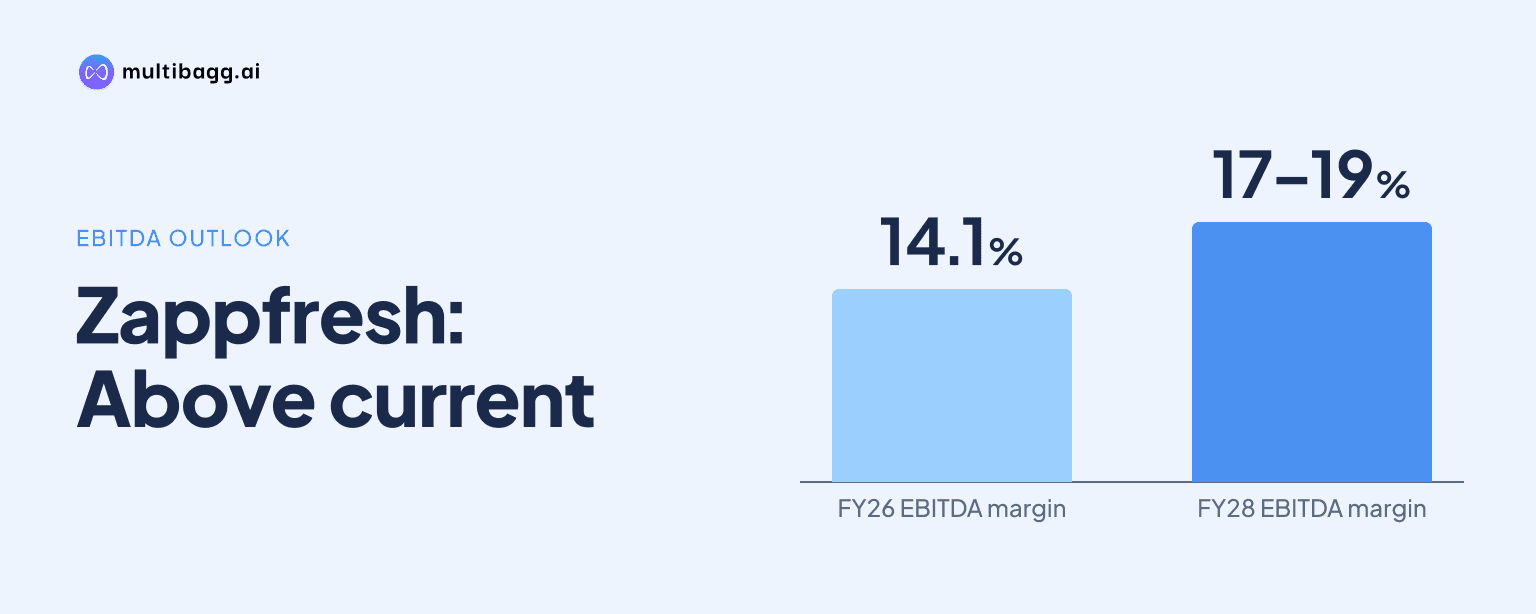
Zappfresh is targeting a 17% to 19% earnings before interest, tax, depreciation and amortisation (EBITDA) margin in FY28, compared with 14.1% in FY26, through acquisitions, broader distribution, ready-to-eat products and seafood backward integration including about 500 tonnes of planned annual aquaculture capacity.
Know DSM Fresh Foods inside out
Results, valuation, peers and who's buying, in one view.
What is Zappfresh's FY28 EBITDA margin target?
Zappfresh is targeting a 17% to 19% EBITDA margin in FY28. The presentation compares this range with a 14.1% margin in FY26, indicating a planned improvement of 290 to 490 basis points, where 100 basis points equal one percentage point. Management identifies four levers: its Acqui-Hiring Model, geographic diversification, a higher ready-to-eat (RTE) and value-added product mix, and backward integration.
The target follows a period of reported revenue growth. Revenue increased from Rs 56.3 crore in FY23 to Rs 220.8 crore in FY26, a 58% compound annual growth rate (CAGR) according to the presentation, while EBITDA margin rose from 5.5% to 14.1%. Zappfresh does not disclose an FY28 revenue target, so the FY28 margin range cannot be converted into a projected EBITDA amount.
The latest half-year figures show a different margin position from FY26. Revenue from operations rose 72.6% year on year to Rs 165.5 crore in H1FY27, but the detailed profit-and-loss statement reported EBITDA of Rs 17.2 crore and a 10.4% margin, down from 15.9% in H1FY26. The H1FY27 margin was nevertheless above the 12.7% recorded in H2FY26.
How will acquisitions and ready-to-eat products support Zappfresh?
Zappfresh plans to use acquisitions and Meevaa Foods to diversify beyond its core category and increase RTE and value-added offerings. The company acquired Dr. Meat, Sukos Food Pvt. Ltd., in July 2023, Bonsaro, Majestic Aliments India Pvt. Ltd., in July 2024, and Ambrozia Frozen Foods Pvt Ltd. in January 2026. Its product roadmap also identifies additional stock-keeping units (SKUs), complementary categories and prospective acquisitions as routes to higher gross margins.
Management presents prior acquisitions as evidence for the Acqui-Hiring Model. One acquired business delivered about fourfold revenue growth in its first post-acquisition year and strengthened Zappfresh's Bangalore presence, while another achieved Rs 10 crore of first-year post-acquisition revenue and entered Mumbai after operational changes. These are management-reported historical examples, rather than forecasts for future acquisitions.
Ambrozia is intended to provide an export-ready manufacturing platform, while products have been launched in domestic channels under Meevaa Foods. The presentation cites a peak revenue run rate of about Rs 16 crore for the acquired operation and an annual recurring revenue run rate of about Rs 30 crore for Meevaa Foods, which is listed on Amazon and Blinkit. Zappfresh does not provide a separate RTE margin target, although it links a greater RTE and complementary-product mix with higher gross margins.
Got a follow-up? Ask IRIS
How will retail, e-commerce and exports broaden Zappfresh's reach?
Zappfresh aims to reach about 500 retail stores in the next two years after identifying and onboarding 200 stores in FY26. Its retail plan combines partner-run co-branded Zappfresh outlets that stock Meevaa Foods with standalone Meevaa Foods stores for the vegetarian frozen range. The company describes this as a partner-led, asset-light network.
The disclosed capital expenditure per outlet is Rs 3 lakh to Rs 5 lakh. Management says the lower upfront investment is intended to enable faster rollout and quicker store break-even, but it does not disclose store-level revenue, a payback period or the aggregate investment needed for the 500-store objective. The two formats are intended to provide neighbourhood access for Zappfresh and direct consumer visibility for Meevaa Foods.
Distribution expansion also includes more serviceable pin codes within existing geographies and a focus on consumption-heavy cities. Zappfresh says its network gives Meevaa Foods pan-city visibility and a scale-up cycle of six months or less without incremental distributor onboarding, while Amazon, Big Basket and Blinkit are listed as live e-commerce platforms. For exports, management identifies Canada, the Middle East, the United States and Europe as intended regulated markets for frozen and RTE SKUs, but discloses no current export revenue or target export mix.
What will seafood backward integration change for Zappfresh?
Zappfresh expects seafood backward integration to lift gross margin in its seafood vertical by about 200 to 300 basis points. Seafood accounted for about 25% of non-vegetarian revenue in H1FY27, and management is targeting about 30% over the medium term. The plan therefore combines a larger seafood revenue mix with a proposed sourcing-cost benefit.
The supply platform includes an aquaculture project with about 500 tonnes of annual capacity and a 300-farmer sourcing alliance using a farmer producer organisation (FPO) model. Zappfresh has signed a memorandum of understanding with a Ghaziabad-based aquaculture farm operator covering about 270 acres in Village Masurie. The presentation does not give a commissioning date, project cost or production ramp for the aquaculture project.
Management lists business-to-business institutional supply, hotel, restaurant and catering partnerships, private-label seafood processing, and export-oriented fish trading as potential monetisation routes. In H1FY27, cost of goods sold rose 84.9% year on year to Rs 117.7 crore, compared with revenue growth of 72.6%, and gross margin declined to 28.9% from 33.6% in H1FY26. The sourcing initiative is therefore linked to procurement efficiency, though its expected benefit is quantified only for the seafood vertical.
Conclusion
Zappfresh's FY28 plan combines a 17% to 19% EBITDA-margin target with acquired brands, the Meevaa Foods product range, expanded retail access, export development and seafood sourcing integration. Revenue grew from Rs 56.3 crore in FY23 to Rs 220.8 crore in FY26, but the reported H1FY27 EBITDA margin of 10.4% remained below the FY26 margin and the FY28 target range.
The next disclosed execution markers are progress toward about 500 retail stores over two years, development of the 500-tonne aquaculture project and 300-farmer FPO alliance, and a medium-term seafood mix of about 30% of non-vegetarian revenue. Management has not disclosed an FY28 revenue target, aquaculture commissioning date, project investment or export-revenue objective, leaving these measures to be clarified in future updates.