










Zappfresh says direct sourcing can add 18-22% to margins
Key highlights
- Zappfresh says bypassing mandis can add 6-8% to margins and bypassing wholesalers or traders can add 12-14%.
- Zappfresh reported H1 FY27 revenue of Rs 165.5 crore, EBITDA of Rs 17.6 crore and PAT of Rs 7.3 crore.
- Zappfresh’s three listed plants have combined annual capacity of about 3,300 tonnes.
- Zappfresh reports an 84% B2B revenue split and a 16% B2C revenue split.
powered by IRIS
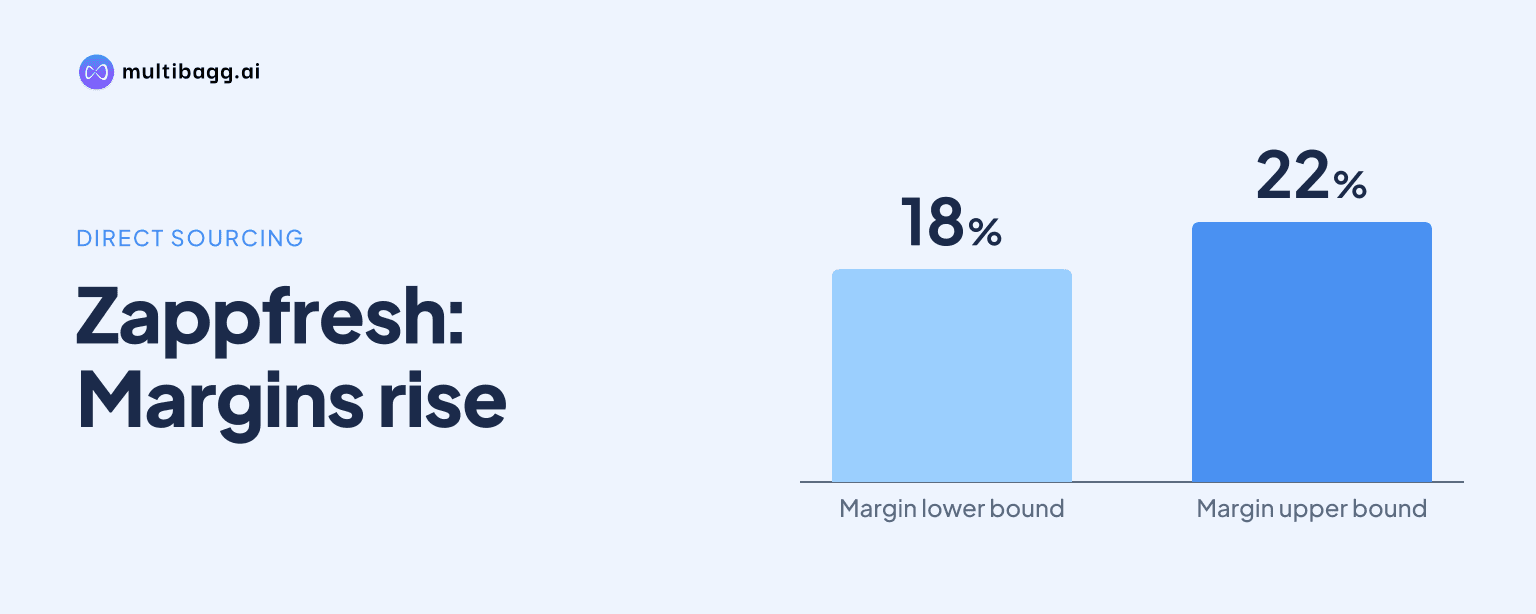
DSM Fresh Foods Ltd. says its Zappfresh brand can add 18-22% to margins by bypassing mandis and wholesalers or traders, with a stated 6-8% contribution from direct farm sourcing and 12-14% from removing the wholesale layer. The claim sits within an H1 FY27 business that reported revenue of Rs 165.5 crore.
Know DSM Fresh Foods inside out
Results, valuation, peers and who's buying, in one view.
How does Zappfresh reach the stated 18-22% margin addition?
Zappfresh reaches its stated 18-22% margin addition by combining a 6-8% benefit from bypassing mandis with a 12-14% benefit from bypassing wholesalers or traders. The presentation does not provide a cost base, gross-margin bridge or calculation supporting those ranges, so they are company-stated operating-model claims rather than disclosed consolidated margin results.
The stated benefit applies to an H1 FY27 portfolio in which chicken represented 55% of revenue, fish and seafood 25%, and mutton 20%. Zappfresh does not disclose the margin contribution by protein category, so the presentation does not show whether the claimed range differs between chicken, seafood and mutton.
Which parts of the supply chain does Zappfresh control?
Zappfresh says it uses direct hormone- and antibiotic-free farm sourcing, followed by centralised slaughtering and cleaning after procurement. This structure is intended to remove the mandi stage and place primary processing under centralised, quality-controlled operations rather than leaving handling to traditional intermediaries.
Zappfresh says its in-house secondary processing covers cutting, portioning and packing, while standardised stock-keeping units, or SKUs, are intended to support consistency, storage efficiency and distribution. The company reports more than 300 SKUs, more than 300 farmer partnerships and operations across five states, providing the disclosed operating scale behind direct procurement and processing.
At the distribution stage, Zappfresh takes orders through its app, website and stores, then uses third-party logistics for cold-chain dispatch. The presentation links temperature-controlled food-safety hygiene in processing with cold-chain delivery, and associates the stated 12-14% wholesale-layer benefit with retaining control from processing through final distribution.
What capacity supports Zappfresh’s processing model?
Zappfresh lists three processing plants with annual capacity of about 3,300 tonnes in total: about 1,800 tonnes in Delhi, 1,000 tonnes in Mumbai and 500 tonnes in Bangalore. These three plants are identified with the Zappfresh brand in the capacity table and align with the presentation’s reference to three advanced meat-processing facilities.
The wider secondary-processing table also includes a Chandigarh plant with annual capacity of about 5,500 tonnes, labelled “meenaa foods” in the presentation. That produces listed capacity of about 8,800 tonnes across four rows, but the company separately identifies only three advanced meat-processing facilities and does not disclose utilisation for any plant.
Zappfresh also reports manufacturing capability in frozen, ready-to-eat, or RTE, and ready-to-cook, or RTC, products. The processing model therefore extends beyond slaughtering and cleaning into portioned and packed products, while the H1 FY27 revenue mix of 55% chicken, 25% fish and seafood, and 20% mutton provides the disclosed category context.
Got a follow-up? Ask IRIS
How is Zappfresh distributed across channels and states?
Zappfresh reports that business-to-business, or B2B, sales accounted for 84% of revenue and business-to-consumer, or B2C, sales for 16%. It also reports about 200 channel-partner stores and support for more than 300 restaurants and partners through its hotel, restaurant and catering, or HoReCa, network.
The company’s Meevaa Foods range is available through five online platforms: zappfresh.com, Amazon, Amazon Now, BigBasket and Blinkit. Amazon was the first marketplace listing after direct-to-consumer sales and had been live since June, while Blinkit had been live since October; e-commerce and quick-commerce net revenue excluding goods and services tax rose 3.7 times in August over a partial July and 8.8% in September over August.
Haryana supplied 36% of H1 FY27 revenue, followed by Maharashtra at 33%, Karnataka at 19%, Delhi at 7% and Uttar Pradesh at 5%. Haryana’s contribution was 31 percentage points above Uttar Pradesh’s, while Maharashtra exceeded Delhi by 26 percentage points; Zappfresh does not provide state-level volume, margin or customer-retention data.
What do Zappfresh’s financial metrics show?
Zappfresh reported H1 FY27 revenue of Rs 165.5 crore, earnings before interest, tax, depreciation and amortisation, or EBITDA, of Rs 17.6 crore, and profit after tax, or PAT, of Rs 7.3 crore. The presentation does not provide H1 FY26 figures for these measures, so it does not permit a half-year comparison of revenue growth or profitability.
For FY23 to FY26, Zappfresh reports revenue compound annual growth of 58%, EBITDA compound annual growth of 116%, and PAT compound annual growth of 74%. EBITDA therefore grew faster than revenue over that period, but the presentation supplies no annual revenue, EBITDA or PAT series to separate the effects of sourcing, processing, product mix or channel mix.
Zappfresh also reports return on capital employed, or ROCE, of 23% and a working-capital cycle of 67 days for FY26. These are reported financial metrics, whereas the 18-22% figure is presented as a supply-chain margin contribution range rather than as an audited or reconciled profitability measure.
Conclusion
Zappfresh’s stated proposition is that removing mandi and wholesale layers can add 18-22% to margins, supported by direct farm sourcing, centralised processing, standardised SKUs and cold-chain distribution. Its disclosed H1 FY27 base included Rs 165.5 crore of revenue, chicken at 55% of sales, and B2B contributing 84% of revenue.
What to watch next is whether Zappfresh discloses a margin bridge, plant utilisation, or profitability by product and channel that can connect the 18-22% claim to reported results. The presentation also identifies an unresolved comparison point in its online rollout: August e-commerce and quick-commerce revenue rose 3.7 times over a partial July, followed by 8.8% growth in September over August.