








Welspun Corp says US pipe capacity is booked through FY29
Max Plan at ₹4,999/yr₹8,999

Find your next multibaggerBe a Pro Investor
Research stocks and track your picks on the go. Download the app.
Key highlights
- Welspun Corp says approximately 1 MTPA of US line-pipe capacity is booked through FY29.
- Welspun Corp identifies US demand visibility through 2032 from LNG, Permian gas evacuation and data-centre power infrastructure.
- Welspun Corp lists approximately 1.3 MTPA of line-pipe capacity in India, compared with approximately 1 MTPA in the US.
- Welspun Corp reports approximately 3 MTPA of line-pipe capacity across four geographies.
powered by IRIS
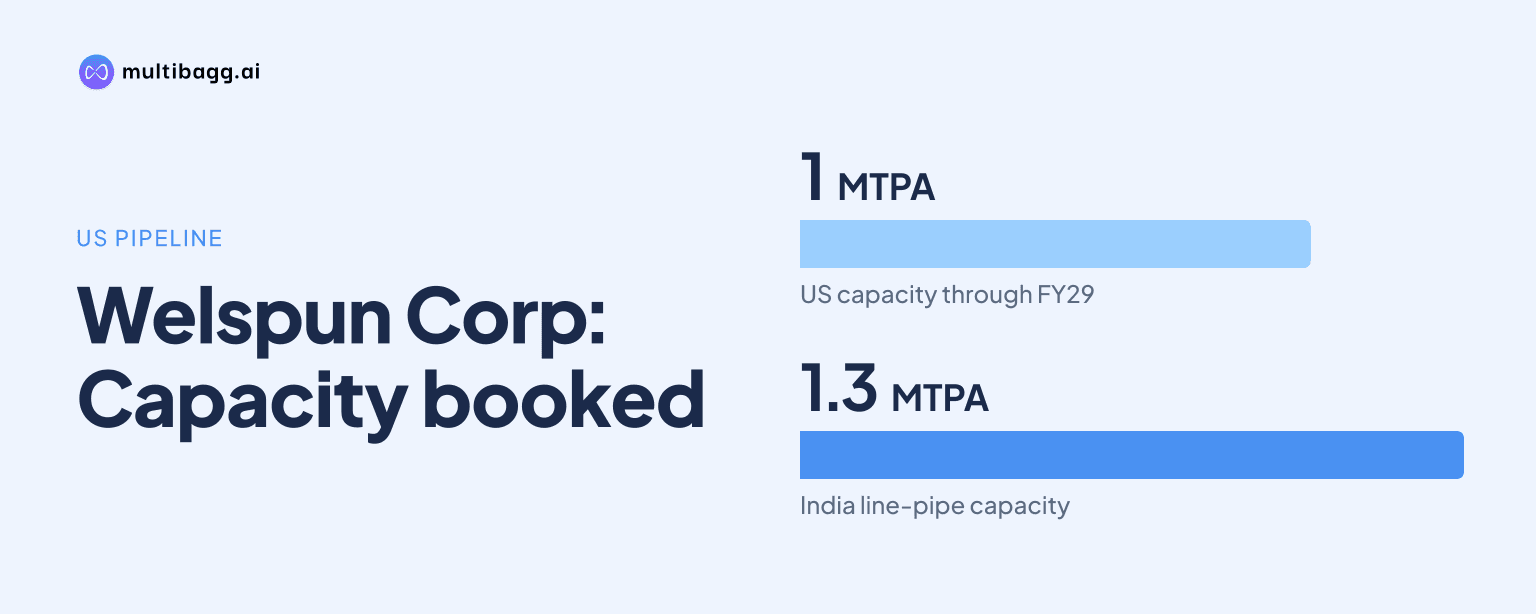
Welspun Corp says its United States line-pipe capacity of approximately 1 million metric tonnes a year is booked through financial year 2029 (FY29), while demand visibility extends to 2032 through liquefied natural gas exports, Permian Basin gas evacuation and gas-powered data-centre infrastructure.
Know Welspun Living inside out
Results, valuation, peers and who's buying, in one view.
Why is Welspun Corp's US capacity booked through FY29?
Welspun Corp attributes its FY29 booking position to a US line-pipe platform with capacity of approximately 1 million metric tonnes per annum (MTPA). The site makes helical submerged arc welded (HSAW), high-frequency induction welded (HFIW) and longitudinal submerged arc welded (LSAW) pipes, with outside diameters from 6 inches to 60 inches. This product range places the US operation in line-pipe supply for energy-infrastructure projects.
Welspun Corp says it booked orders over the last 15 months that it describes as the sector's largest-ever single order win. The presentation also says the US business partners with every midstream oil-and-gas major in the country and is the largest buyer of American Petroleum Institute-grade steel. It does not disclose the volume assigned to individual customers, the contract duration by order or the pricing structure behind the capacity booking.
What supports Welspun Corp's demand visibility until 2032?
Welspun Corp links visibility through 2032 to oil and natural-gas pipeline requirements, new refinery activity and liquefied natural gas (LNG) export terminals. Its presentation identifies the Permian Basin as the largest oil-and-gas reserve and says the region will require additional evacuation pipelines for natural gas. This frames the stated visibility around the infrastructure needed to transport gas, rather than a general claim about an industry-cycle recovery.
LNG terminals and the Permian Basin are shown alongside the Gulf Coast in Welspun Corp's US infrastructure map. The mechanism is that gas must move from producing areas to export facilities through connecting pipelines, while refinery development can require additional pipeline networks. Welspun Corp does not provide a forecast of annual pipeline mileage, a market-size estimate through 2032 or a share of that opportunity it expects to supply.
How do data centres affect Welspun Corp's US outlook?
Welspun Corp says rising domestic power demand, including demand from artificial-intelligence data centres in Texas, is another driver of pipeline requirements. The presentation states that natural gas is the preferred option for meeting the large power-generation need and that captive gas power plants at data centres require dedicated pipeline laterals. A lateral is a connection pipe between a facility and a wider gas network.
This data-centre use case differs from Permian evacuation and LNG exports because it concerns local fuel supply to power generation rather than gas transport to an export terminal. Welspun Corp's map locates Texas data centres, LNG terminals and the Permian Basin within the same US market context. It does not state how much of the approximately 1 MTPA US capacity is allocated to data-centre laterals or identify any order specifically tied to such projects.
Got a follow-up? Ask IRIS
How does Welspun Corp's US capacity compare with its other operations?
Welspun Corp's approximately 1 MTPA US line-pipe capacity is lower than its approximately 1.3 MTPA India line-pipe capacity. India produces HSAW, LSAW and electric resistance welded (ERW) pipe, while the US operation produces HSAW, HFIW and LSAW pipe. Welspun Corp positions India for exports, whereas its US presentation focuses on North American energy and power infrastructure.
Across India, the US, Saudi Arabia and Jordan, Welspun Corp reports approximately 3 MTPA of line-pipe capacity and 850 thousand metric tonnes of ductile iron (DI) pipe capacity. India has 600 thousand metric tonnes of DI-pipe capacity. Saudi Arabia is shown with 500 thousand metric tonnes of HSAW capacity through East Pipes Integrated Company for Industry, while announced capital expenditure, after commissioning, includes 350 thousand metric tonnes of LSAW capacity and 250 thousand metric tonnes of DI-pipe capacity.
What operating features support Welspun Corp's US pipe platform?
Welspun Corp says its US site covers approximately 800 acres and has dedicated railroads, customer and supplier proximity, and access near the Arkansas-Mississippi River system. The presentation calls the location an epicentre of the supply chain. Those logistics features are relevant to a 6-inch-to-60-inch line-pipe operation because steel inputs and finished pipes require transport links to suppliers and project locations.
The US capacity booking through FY29 is a demand statement, not a disclosed measure of utilisation, revenue or profitability. Welspun Corp does not provide a US capacity-expansion plan, a US revenue contribution or a margin outlook in the presentation. The available comparison is therefore between the approximately 1 MTPA US platform and the approximately 1.3 MTPA India platform, rather than between financial results from the two businesses.
Conclusion
Welspun Corp's disclosed US outlook combines a booked-capacity period through FY29 with demand visibility to 2032. The stated drivers are specific infrastructure mechanisms: LNG export connections, additional Permian Basin natural-gas evacuation pipelines, refinery-related needs and dedicated gas laterals for data-centre power plants. Its approximately 1 MTPA US line-pipe capacity provides the operating scale attached to that outlook.
The next developments to watch are execution of the FY29 US bookings and commissioning of overseas projects disclosed in the presentation. In Saudi Arabia, Welspun Corp is building a greenfield DI-pipe facility designed for diameters up to 2,600 millimetres, while its Jordan partnership holds a firm contract for the 450-kilometre Aqaba-Amman Water Desalination Project. The presentation gives no commissioning date, US order-conversion milestone or financial target for these projects.

