








Welspun Living moved from ₹1,534 crore debt to net cash
Max Plan at ₹4,999/yr₹8,999

Find your next multibaggerBe a Pro Investor
Research stocks and track your picks on the go. Download the app.
Key highlights
- Welspun Living moved from ₹1,534 crore net debt in March 2023 to ₹2 crore net cash in H1 FY27.
- Welspun Living's cash conversion cycle fell by 49 days, from 93 days in FY23 to 44 days in H1 FY27.
- Welspun Living reported a 12.9% EBITDA margin in H1 FY27, compared with 9.1% in FY26.
- Welspun Living reported 2.4-times year-on-year pillow-sales growth in Q2 FY27 and no US customer losses during the tariff period.
powered by IRIS
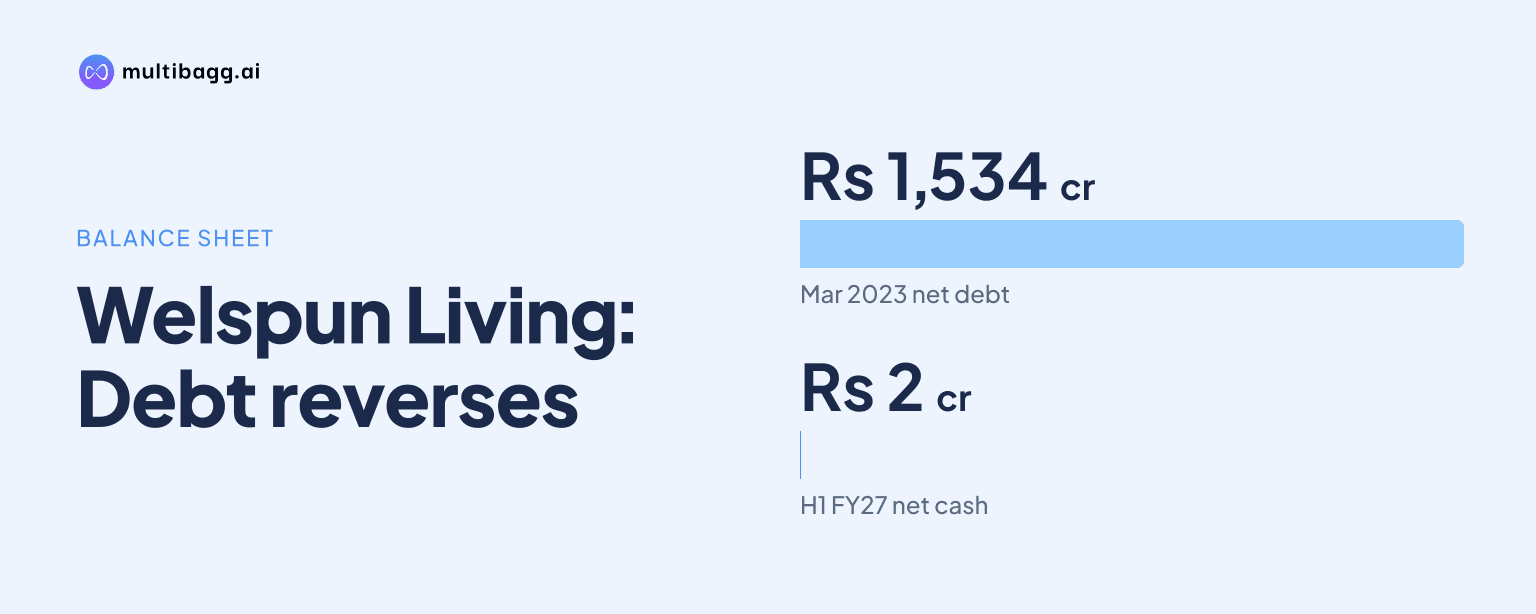
Welspun Living moved from ₹1,534 crore of net debt in March 2023 to ₹2 crore of net cash in H1 FY27, while its earnings before interest, tax, depreciation and amortisation (EBITDA) margin reached 12.9%. The presentation attributes the change to capital discipline, working-capital actions, logistics contracts and planned procurement.
Know Welspun Living inside out
Results, valuation, peers and who's buying, in one view.
How did Welspun Living reach net cash?
Welspun Living reached ₹2 crore of net cash in H1 FY27 after reporting ₹1,534 crore of net debt in March 2023. This represents a ₹1,536 crore movement in the balance-sheet position over the period. The presentation also shows return on capital employed (ROCE) at 12.7% in H1 FY27, compared with 5.7% in FY23.
Welspun Living links the balance-sheet change to enforcing capital discipline rather than to a single financing event. Its stated mechanisms were cash generation, lower inventory, lower receivables and standardised payment terms. The cash conversion cycle fell to 44 days in H1 FY27 from 93 days in FY23, while free cash flow was ₹1,059 crore in H1 FY27 against ₹784 crore in FY23.
How did Welspun Living rebuild revenue and EBITDA margin?
Welspun Living reported a 12.9% EBITDA margin in H1 FY27 after its FY26 margin was 9.1%, a 3.8-percentage-point improvement. The presentation describes this as margin rebuilding and sets an approximate FY27 margin objective of 13%, compared with 10.6% in FY23.
Revenue rose from ₹8,215 crore in FY23 to ₹9,468 crore in FY26, an increase of ₹1,253 crore. Management's FY27 revenue indication is approximately ₹11,000 crore or more. That FY27 figure is a management target rather than a reported full-year outcome, while the H1 FY27 margin of 12.9% is the interim result shown in the presentation.
The comparison shows that revenue expanded between FY23 and FY26 even as EBITDA margin declined by 1.5 percentage points, from 10.6% to 9.1%. The subsequent H1 FY27 margin was higher than both figures. Welspun Living attributes the recovery to long-term logistics contracts and planned procurement, which management says helped drive cost leadership.
Which operating choices does Welspun Living link to the recovery?
Welspun Living says it retained every US customer through the tariff period and increased pillow sales 2.4 times year on year in Q2 FY27. The presentation says the company worked collaboratively with US retailers and did not lose a single US customer. It identifies Ohio and Nevada plants as the move closer to customers that accompanied the pillow-sales increase.
The operational programme combined customer retention with supply-chain and energy actions. Welspun Living cited long-term logistics contracts and planned procurement alongside its 12.9% H1 FY27 EBITDA margin, up from 9.1% in FY26. It also said it had invested early in 60 megawatts of renewable energy and that its Anjar operation was on track to use 100% renewable electricity.
The presentation frames these as linked choices: retaining retailers, supplying from US facilities, reducing logistics and procurement costs, and controlling working capital. The disclosed outcomes are 2.4-times pillow-sales growth in Q2 FY27, a 3.8-percentage-point margin improvement from FY26 to H1 FY27, and a 49-day decline in the cash conversion cycle from FY23. It does not separately quantify each action's financial contribution.
Got a follow-up? Ask IRIS
Has Welspun Living also returned cash to shareholders?
Welspun Living returned ₹1,034 crore to shareholders through dividends and buybacks between FY23 and FY26. The presentation records ₹252 crore in FY23, ₹356 crore in FY24, ₹162 crore in FY25 and ₹264 crore in FY26. This total is presented separately from the cash-flow figures that accompanied the move to a net-cash position.
The disclosed buyback amounts were ₹242 crore in FY23, ₹346 crore in FY24 and ₹254.5 crore in FY26. FY25's ₹162 crore return is shown as a dividend. Welspun Living's labelled share price rose from ₹64 in March 2023 to ₹263 on 20 November 2026, while the presentation states a compound annual growth rate of more than 45% over about 3.5 years.
That share-price comparison is a little more than four times the March 2023 level, consistent with the presentation's description of approximately 4.0-times performance. The share-price data and ₹1,034 crore of distributions are historical figures, whereas the approximately ₹11,000 crore FY27 revenue and approximately 13% EBITDA-margin figures remain management indications. The presentation does not state a future dividend or buyback commitment.
What targets will test Welspun Living's recovery next?
Welspun Living's stated FY27 objectives are revenue of approximately ₹11,000 crore or more and an EBITDA margin of approximately 13%. These objectives follow FY26 revenue of ₹9,468 crore and a 9.1% margin, while the H1 FY27 margin was already 12.9%. Delivering the revenue target while holding the indicated margin would test whether the operational gains persist through a full fiscal year.
The presentation also sets out approximately ₹3,200 crore of investment over the next 18 to 24 months. About ₹1,600 crore is allocated to expanding terry-towel capacity by approximately 30% to about 130,000 metric tonnes, while another approximately ₹1,600 crore is planned for backward integration into spinning and weaving. Management expects backward integration to provide a 200 to 300 basis-point EBITDA uplift through lower input-yarn costs.
Welspun Living's medium-term aspiration is 15% or more revenue compound annual growth, 15% to 16% EBITDA margin and 15% to 16% ROCE. It also says it intends to maintain net debt to EBITDA below 1 time and a cash conversion cycle of 55 to 60 days. These are management aspirations, not reported financial results; the 44-day H1 FY27 cash conversion cycle was below that stated maintenance range.
Conclusion
Welspun Living's recovery combines a ₹1,536 crore swing from March 2023 net debt to H1 FY27 net cash with higher profitability and faster working-capital conversion. Revenue increased by ₹1,253 crore from FY23 to FY26, while H1 FY27 EBITDA margin reached 12.9% after the FY26 level of 9.1%; the presentation associates those changes with customer retention, US pillow production, procurement and logistics measures.
The next measure of execution is management's FY27 indication of approximately ₹11,000 crore or more in revenue and approximately 13% EBITDA margin. Investors will also watch the planned approximately ₹3,200 crore investment over 18 to 24 months, including the proposed 30% terry-towel capacity expansion and the projected 200 to 300-basis-point margin uplift from backward integration.

