








Welspun Living plans Rs 3,200 crore expansion, 200-300 bps uplift
Max Plan at ₹4,999/yr₹8,999

Find your next multibaggerBe a Pro Investor
Research stocks and track your picks on the go. Download the app.
Key highlights
- Welspun Living plans approximately Rs 3,200 crore of investment over the next 18-24 months.
- Approximately Rs 1,600 crore is allocated to lift terry-towel capacity by approximately 30% to approximately 130,000 metric tonnes.
- Backward integration into spinning and weaving is expected to add 200-300 basis points to EBITDA margin through lower yarn costs.
- Welspun Living targets 15-16% EBITDA margin and 15-16% ROCE in the medium term.
powered by IRIS
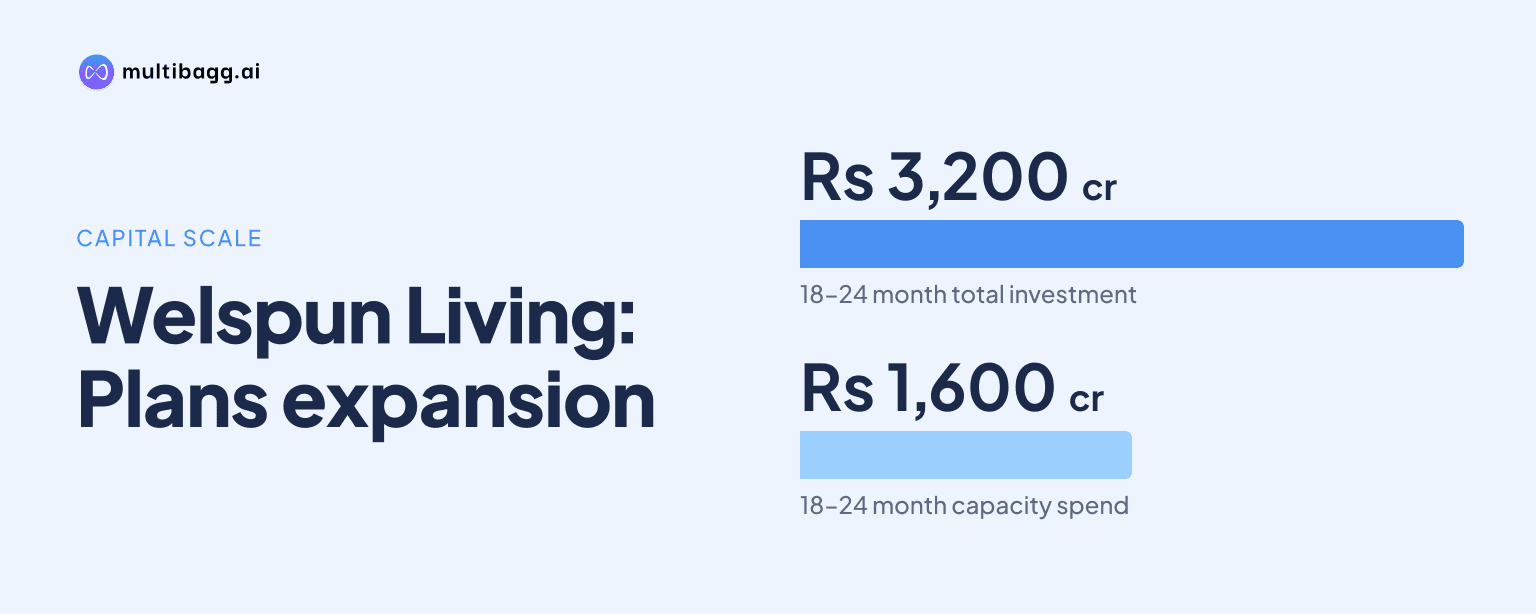
Welspun Living plans to invest about Rs 3,200 crore over the next 18-24 months, with backward integration expected by management to add 200-300 basis points to earnings before interest, tax, depreciation and amortisation (EBITDA) margin and terry-towel capacity set to rise 30%.
Know Welspun Living inside out
Results, valuation, peers and who's buying, in one view.
What will Welspun Living spend Rs 3,200 crore on?
Welspun Living will divide the approximately Rs 3,200 crore programme into two allocations of approximately Rs 1,600 crore over the next 18-24 months. One allocation is for expanding terry-towel production, while the other is for backward integration into spinning and weaving, bringing more yarn-making and fabric-making activity into its supply chain.
The presentation says demand from existing retailers is already in place, providing headroom for the planned incremental output. It also identifies an investment in a research and development centre to support product innovation and value-added capabilities alongside the manufacturing programme.
The planned integration is intended to make the supply chain more efficient and reliable through faster lead times, less dependence on outsourcing partners and improved compliance. These operating mechanisms differ from the 30% capacity increase: integration is intended to change the cost and delivery model, while the expansion raises available terry-towel output to approximately 130,000 metric tonnes.
How much will Welspun Living increase towel capacity?
Welspun Living plans to raise terry-towel capacity by approximately 30% to approximately 130,000 metric tonnes, which the presentation describes as the largest capacity in the world. The approximately Rs 1,600 crore towel investment is therefore directed at a defined production addition rather than a general capital-expenditure pool.
The capacity plan follows a period in which Welspun Living says it retained all United States (US) customers through 50% US tariffs and held market share. Its presentation also reports that pillow sales from its Ohio and Nevada plants were 2.4 times higher year on year in the second quarter of FY27.
The proposed towel expansion is linked to retailer demand already identified by Welspun Living, but the presentation does not provide a commissioning date within the stated 18-24-month investment window. It also does not disclose a capacity split between new lines, sites or geographies, limiting the available detail to the approximately 130,000-metric-tonne end capacity and approximately 30% increase.
Got a follow-up? Ask IRIS
How is backward integration expected to lift Welspun Living's margins?
Welspun Living expects spinning and weaving backward integration to reduce input-yarn costs and add 200-300 basis points, or 2-3 percentage points, to EBITDA margin. The expected benefit is tied specifically to the approximately Rs 1,600 crore investment in internal yarn and fabric capability, rather than presented as an immediate group-wide margin outcome.
The proposed margin benefit follows a recovery already reported in the presentation. EBITDA margin was 9.1% in FY26 and reached 12.9% in the first half of FY27 (H1 FY27), a 3.8-percentage-point improvement, while the FY27 indication on page 15 is approximately 13%, compared with 10.6% in FY23.
Cost actions already cited by Welspun Living include long-term logistics contracts and planned procurement. The presentation also reports 60 megawatts of renewable energy and says its Anjar site is on track for 100% renewable electricity, while lower inventory and receivables reduced the cash cycle from 93 days to 44 days by H1 FY27.
The investment case combines the reported H1 FY27 margin recovery with a projected further gain from lower yarn costs. However, the presentation does not specify how much of the 200-300-basis-point uplift would be realised in FY27, nor does it provide a separate return estimate for the spinning and weaving project.
What medium-term financial targets does Welspun Living set?
Welspun Living sets medium-term aspirations of more than 15% compound annual growth rate in revenue, a 15-16% EBITDA margin and 15-16% return on capital employed (ROCE). These are management aspirations following the planned investment cycle, rather than reported results for a specified financial year.
For comparison, the presentation gives estimated FY27 revenue of approximately Rs 11,000 crore and describes both EBITDA margin and ROCE as being in the low teens for that year. The financial slide presents FY27 revenue as approximately Rs 11,000 crore or more, while the medium-term slide uses approximately Rs 11,000 crore, indicating the same broad FY27 base for the longer-term targets.
Welspun Living also intends to maintain net debt to EBITDA below 1 times and a cash conversion cycle of 55-60 days. That range is above the 44 days reported for H1 FY27, while the balance sheet at that point was described as net cash, pairing the capital programme with stated leverage and working-capital parameters.
Conclusion
Welspun Living's approximately Rs 3,200 crore plan combines more output with more internal control over key inputs: approximately Rs 1,600 crore is earmarked for 30% more terry-towel capacity and approximately Rs 1,600 crore for spinning and weaving. Management links the latter investment to a 200-300-basis-point EBITDA-margin benefit and its medium-term 15-16% EBITDA-margin and ROCE aspirations.
The next disclosures to watch are the pace of spending and commissioning within the 18-24-month window, as well as whether Welspun Living reconciles the allocation figures. The detailed investment page lists approximately Rs 1,600 crore for backward integration, whereas the summary page refers to Rs 1,500 crore, leaving a Rs 100 crore difference between the two presentation pages.

