








Welspun Living links ESG to retailer access and power costs
Max Plan at ₹4,999/yr₹8,999

Find your next multibaggerBe a Pro Investor
Research stocks and track your picks on the go. Download the app.
Key highlights
- Welspun says green energy meets 78% of its overall power requirements.
- Welspun’s S&P Global CSA score rose from 78 to 90 in one year, supporting its stated No. 1 global position in 2025.
- Welspun reports 95% sustainable cotton and an SBTi-validated net-zero target for FY2040.
- Welspun says Anjar manufacturing is freshwater-independent and reports more than 98% OTIF delivery.
powered by IRIS
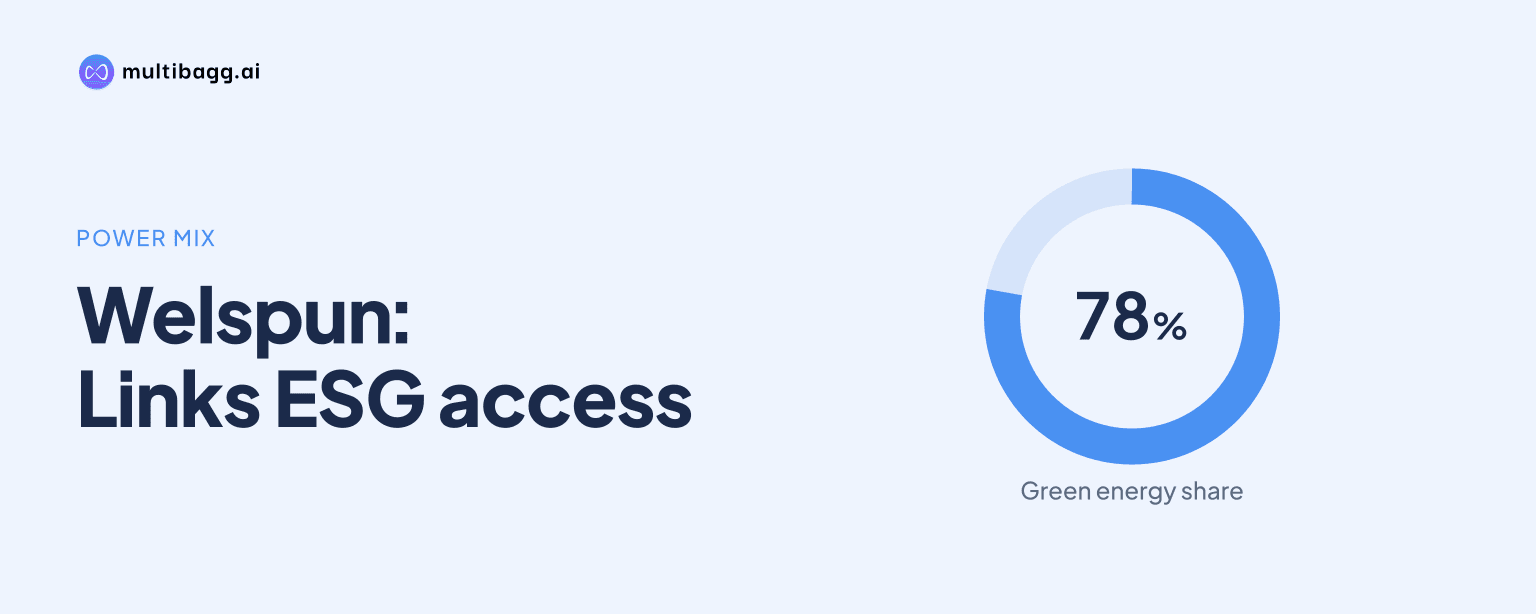
Welspun Living says 78% of its overall power requirement is met by green energy, which it links to lower, more predictable power costs and access to large retailers requiring verified environmental, social and governance (ESG) performance. Its S&P Global Corporate Sustainability Assessment score rose from 78 to 90 in one year, supporting its stated No. 1 global position in 2025.
Know Welspun Living inside out
Results, valuation, peers and who's buying, in one view.
How does Welspun use ESG to gain retailer access?
Welspun uses verified ESG performance as part of its case for winning business from large retailers. Its sustainability table says such performance is required to win with these customers, and presents its No. 1 global position in the S&P Global Corporate Sustainability Assessment (CSA) 2025 as an enabler of access. The CSA score increased by 12 points, from 78 to 90, in one year.
Welspun also links supplier preference to its Science Based Targets initiative (SBTi)-validated net-zero target for FY2040, 95% sustainable cotton and Wel-Trak traceability. The presentation says these credentials can support preferred-supplier status as retailers demand more ESG information. It does not quantify retailer contracts, revenue, or customer wins attributable to the programme.
How does green power affect Welspun’s operating costs?
Welspun says green energy supplies 78% of its overall power requirements and links that share to lower, more predictable power costs. The presentation describes its power costs as industry-best, but does not provide a rupee-per-unit energy cost, a prior-period comparison, or the sources within its green-energy mix. The 78% share is therefore the principal disclosed measure of the energy strategy.
The company places power sourcing within a wider operating proposition of capacity and delivery reliability. Welspun says it is the world’s largest terry-towel manufacturer and is scaling to about 130,000 metric tonnes after capital expenditure. It also reports more than 98% on-time, in-full (OTIF) delivery despite logistics challenges, pairing energy-cost predictability with service continuity.
What does freshwater-independent manufacturing mean for Welspun?
Welspun says manufacturing at Anjar is freshwater-independent, providing room to scale production without straining local water resources. This is a site-specific operating claim, rather than a company-wide water-use metric. The presentation does not disclose Anjar’s production capacity, water volumes, or the technology used to achieve freshwater independence.
Welspun pairs the Anjar claim with traceability and in-house manufacturing control. It says Wel-Trak is part of its 360-degree serviceability framework alongside blockchain, artificial intelligence and internet-of-things-enabled smart factories. The company also reports fibre-to-finish control in-house and a 100% audit pass rate, although it does not define the audit period or scope.
Got a follow-up? Ask IRIS
How is ESG included in Welspun’s retailer service model?
Welspun includes ESG in a five-part customer model covering design and product innovation, integrated value chain, supply-chain management and analytics, omnichannel support, and ESG. The ESG element includes product-level metrics, Welkrishi farming and circular ranges, while the supply-chain element includes demand planning with retailers. This places sustainability data alongside product creation and inventory-planning services.
The model also combines customer-facing digital tools with operational execution. Welspun lists Salsify product information management, Channel Advisor, Retail 360 and digital marketing under e-commerce metrics, while naming BrainTrust, Welspotted and web scraping as consumer-insight tools. It reports more than 98% OTIF delivery and identifies Vision AI applications in US pillows and fabric inspection, but gives no adoption rates or sales contribution for the digital tools.
Conclusion
Welspun’s presentation frames sustainability as a commercial operating tool: the CSA score increase from 78 to 90 supports its retailer-access proposition, 78% green-power sourcing is linked to power-cost predictability, and freshwater-independent manufacturing at Anjar is linked to production headroom. Its 95% sustainable-cotton figure and Wel-Trak platform add sourcing and product-level metrics to that proposition.
The next disclosed milestones are execution against the SBTi-validated FY2040 net-zero target and the planned scale-up to about 130,000 metric tonnes of terry-towel capacity after capital expenditure. Future disclosures could clarify whether green-power sourcing, Anjar’s water model and retailer-facing ESG services are producing measurable customer, cost or production outcomes.

