








Welspun Living targets 30% towel capacity rise with ₹3,200 crore
Max Plan at ₹4,999/yr₹8,999

Find your next multibaggerBe a Pro Investor
Research stocks and track your picks on the go. Download the app.
Key highlights
- Welspun Living plans about ₹3,200 crore of investment over the next 18–24 months.
- About ₹1,600 crore is allocated to lift terry towel capacity about 30% to about 130,000 MT.
- Management expects spinning and weaving integration to lift EBITDA by 200–300 basis points.
- Welspun Living reported net cash of ₹2 crore in September 2026, versus net debt of ₹1,534 crore in March 2026.
powered by IRIS
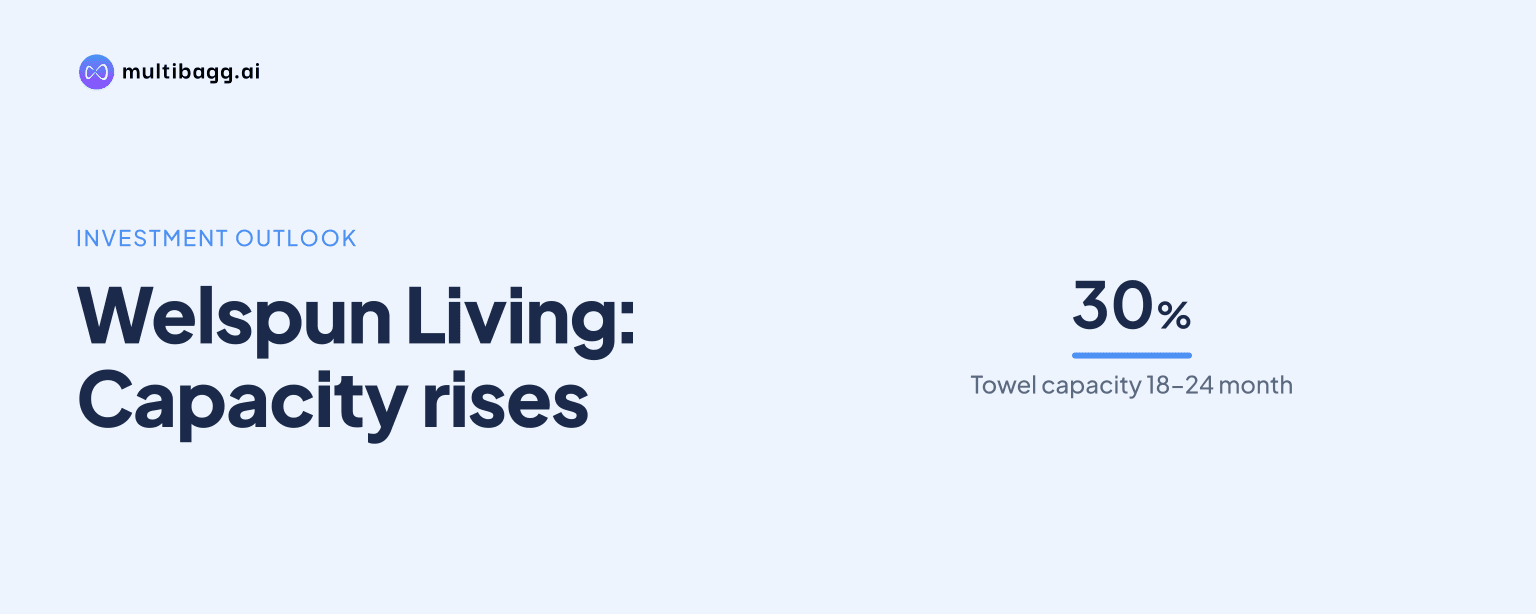
Welspun LIVING plans ₹3,200 crore over the next 18–24 months to raise terry towel capacity about 30% to about 130,000 metric tonnes (MT) and add spinning and weaving, with management projecting a 200–300 basis-point uplift in earnings before interest, tax, depreciation and amortisation (EBITDA) from lower yarn costs.
Know Welspun Living inside out
Results, valuation, peers and who's buying, in one view.
What is Welspun Living's ₹3,200 crore expansion plan?
Welspun Living's plan is a two-part investment of about ₹3,200 crore over 18–24 months, split equally between towel capacity and upstream textile operations. About ₹1,600 crore is earmarked for expanding terry towel production, while another ₹1,600 crore is planned for backward integration into spinning and weaving, the stages that supply yarn and fabric inputs.
The towel investment is intended to raise capacity by about 30% to about 130,000 MT, which management describes as the largest terry towel capacity in the world. The planned increase gives Welspun Living additional production headroom against demand that management says is already available from existing retail customers, rather than relying solely on new customer additions.
The other ₹1,600 crore is directed at producing more yarn and weaving inputs internally. Management's stated objective is lower input-yarn costs, alongside a supply chain with faster lead times, less dependence on outsourcing partners and improved compliance. The programme also includes an investment in a research and development centre to support product innovation and value-added capabilities.
How will Welspun Living's towel capacity and yarn integration change?
Welspun Living expects the towel project to add about 30% to its existing terry towel capacity, taking it to about 130,000 MT. This is a capacity-led expansion in its core towel operation, whereas the spinning and weaving project is designed to change the sourcing model for inputs used in textile production.
Welspun Living says backward integration can produce a 200–300 basis-point EBITDA uplift through lower yarn costs. A basis point is one-hundredth of a percentage point, so the stated range equals a 2–3 percentage-point uplift. This is management's expected benefit from the integration rather than a reported result.
The supply-chain rationale follows recent operating measures described by Welspun Living. During tariff, freight and input-cost disruptions, the company said it maintained more than 98% on-time, in-full delivery performance by rerouting shipments, building stock and securing long-term freight contracts. Internal spinning and weaving are intended to add reliability by reducing reliance on outsourcing partners.
Got a follow-up? Ask IRIS
What financial targets and operating trends frame Welspun Living's plan?
Welspun Living is placing the ₹3,200 crore programme alongside a FY27E revenue aspiration of about ₹11,000 crore and an EBITDA margin of about 13%. FY27E denotes the company's estimate for financial year 2027. Those figures compare with revenue of ₹8,215 crore and an EBITDA margin of 10.6% in FY23, indicating higher planned sales and a wider margin over that period.
Welspun Living also reported that EBITDA margin rose from 9.1% in FY26 to 12.9% in H1 FY27, amid its response to tariffs, freight volatility and rising cotton and crude-linked costs. Its cash conversion cycle, the time taken to turn working capital into cash, fell from 93 days in FY23 to 44 days in H1 FY27, while free cash flow increased from ₹784 crore to ₹1,059 crore across those reported periods.
Net debt was ₹1,534 crore in March 2026 and had moved to net cash of ₹2 crore by September 2026. Management's medium-term aspiration is 15% revenue compound annual growth rate (CAGR) from the FY27E base and EBITDA margin of 15–16%, compared with its FY27E low-teen margin outlook. It also targets return on capital employed (RoCE) of 15–16% in the medium term, against a low-teen FY27E indication.
How does the expansion fit Welspun Living's wider strategy?
Welspun Living positions the ₹3,200 crore programme as part of a strategy to strengthen its core bath and bedding business while expanding its total addressable market. The company intends to grow United States share in those categories and use free-trade-agreement access to scale in other geographies, while the towel capacity addition is designed to serve demand from current retailers.
The company separately targets more than 20% medium-term CAGR in global brands and hospitality. Its India business target is ₹1,500 crore of revenue in the medium term, supported by wider e-commerce and quick-commerce distribution and an expanding global capability centre and hospitality business. These are management priorities alongside the core towel investment, not forecasts of segment-level revenue from the new capacity.
Welspun Living also identifies flooring as an area for growth, with a stated aim to expand flooring EBITDA to the low teens through recalibrated production. Across businesses, management lists backward integration, automation and artificial-intelligence enablement as cost-competitiveness levers. The 200–300 basis-point EBITDA uplift cited for spinning and weaving is specifically tied to lower input-yarn costs rather than to these other initiatives.
Conclusion
The investment combines added towel output with greater control over yarn and weaving inputs, linking retailer-led demand to a plan for lower input costs and reduced outsourcing dependence. It sits alongside a FY27E aspiration of about ₹11,000 crore in revenue and about 13% EBITDA margin, versus ₹8,215 crore and 10.6%, respectively, in FY23.
The next point to watch is delivery of the 18–24 month investment schedule while management pursues its medium-term 15% revenue CAGR and 15–16% EBITDA margin and RoCE targets. Management also says it aims to maintain net debt to EBITDA of up to 1 times and a cash conversion cycle of 55–60 days, following reported net cash of ₹2 crore in September 2026.

