








Welspun Enterprises expects over half of MMR potable water
Max Plan at ₹4,999/yr₹8,999

Find your next multibaggerBe a Pro Investor
Research stocks and track your picks on the go. Download the app.
Key highlights
- WEL reports an approximately Rs 11,000 crore water-treatment order book.
- The Bhandup WTP is under execution with 2,000 MLD capacity.
- The 418 MLD Dharavi STP is expected to be completed in the next 6–7 months.
- WEL says completed projects could handle over 50% of MMR potable water and around 15% of wastewater.
powered by IRIS
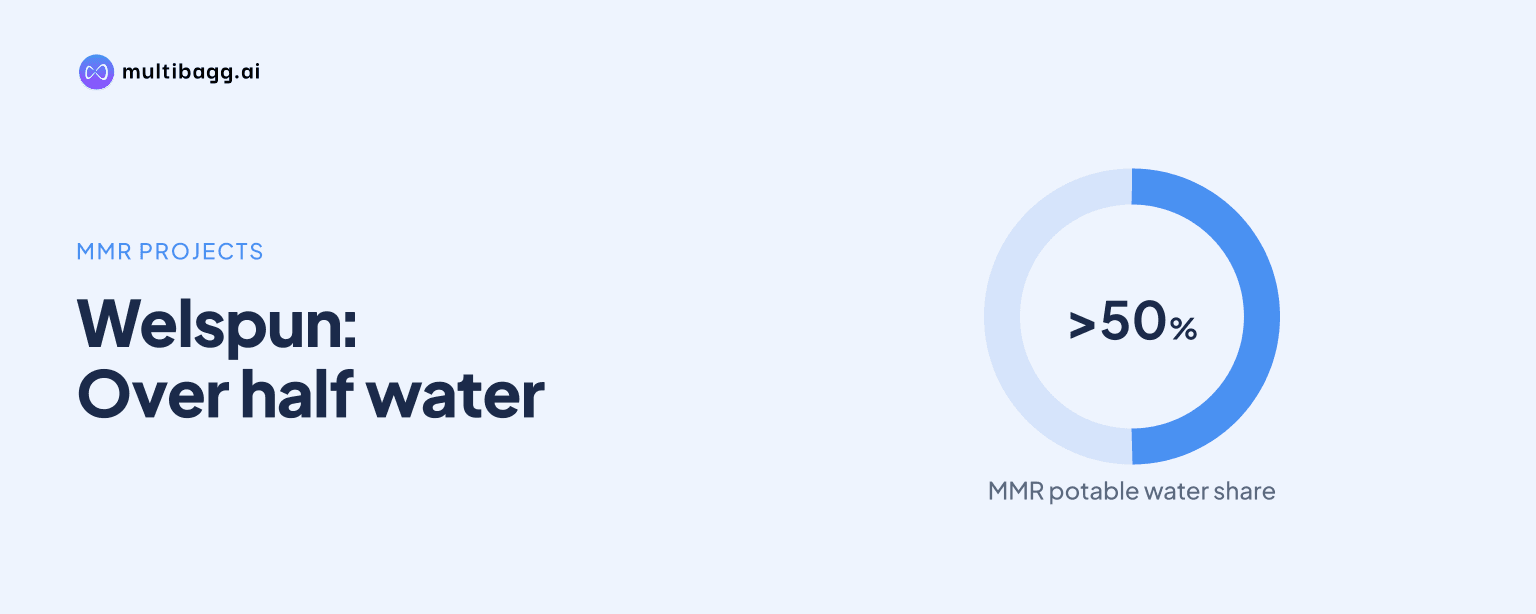
Welspun Enterprises says completed water projects could allow WEL to handle over 50% of potable water and about 15% of wastewater in the Mumbai Metropolitan Region, supported by an approximately Rs 11,000 crore water-treatment order book that includes the 2,000 million litres per day Bhandup water treatment plant.
Know Welspun Living inside out
Results, valuation, peers and who's buying, in one view.
How much MMR water does WEL expect to handle?
WEL expects to handle over 50% of potable water and around 15% of wastewater in MMR after the projects are completed. The presentation frames these as outcomes upon completion, rather than as WEL’s current operating share, and does not disclose a date by which the stated MMR water and wastewater proportions will be reached.
The two percentages cover separate systems: potable-water treatment and wastewater treatment. WEL’s approximately Rs 11,000 crore water-treatment order book is the stated project base for this scale-up, while its listed assets include water treatment plants and a sewage treatment plant, or STP. The presentation does not disclose the current MMR volume managed by WEL or a separate revenue figure for MMR water operations.
The stated potable-water share is larger than the wastewater share by more than 35 percentage points. That distinction matters because the 2,000 million litres per day, or MLD, Bhandup water treatment plant, or WTP, and the 910 MLD Panjrapur WTP are identified as water-treatment facilities, whereas Dharavi is identified as a 418 MLD STP.
Which projects support WEL’s MMR water scale-up?
WEL identifies the Bhandup WTP, Panjrapur WTP and Dharavi STP as the principal disclosed treatment assets supporting its water platform. Bhandup has 2,000 MLD capacity and is under execution, Panjrapur has 910 MLD capacity, and the multi-storeyed Dharavi STP has 418 MLD capacity.
Dharavi is the only one of the three assets with a specific near-term completion indication: the next 6–7 months. WEL says completion of the STP would provide pre-qualification, or PQ, eligibility for larger water projects, linking delivery of the 418 MLD plant to its ability to qualify for further contracts.
Bhandup’s 2,000 MLD capacity is more than twice Panjrapur’s 910 MLD and nearly five times Dharavi’s 418 MLD. WEL calls Bhandup Asia’s largest WTP, but the presentation provides neither a completion date nor a project value for it. It also gives no execution-stage detail or commissioning timetable for Panjrapur.
How do WEL’s disclosed treatment capacities compare?
Bhandup is WEL’s largest disclosed treatment project at 2,000 MLD, followed by Panjrapur at 910 MLD and Dharavi at 418 MLD. The three disclosed capacities total 3,328 MLD, although WEL does not state that this sum represents its entire MMR capacity or directly equate it with the over-50% potable-water claim.
The 2,000 MLD Bhandup facility represents about 60% of the 3,328 MLD combined capacity of the three listed projects. Panjrapur accounts for 910 MLD, while Dharavi’s 418 MLD is the only listed wastewater facility, which means direct comparisons of capacity do not make potable-water and wastewater output equivalent.
The presentation describes Bhandup as a WTP under execution and Dharavi as a multi-storeyed STP nearing completion within 6–7 months. This difference in status means Dharavi has the clearer disclosed milestone, while the timing of the broader MMR handling outcome remains unresolved because no commissioning schedule is supplied for Bhandup or Panjrapur.
Got a follow-up? Ask IRIS
How is WEL positioned across water infrastructure?
WEL says its integrated water platform combines engineering, procurement and construction, or EPC, with operations and maintenance, or O&M, capabilities. The stated model includes long-term O&M streams and specialised tie-ups with global water-technology companies, alongside the approximately Rs 11,000 crore water-treatment order book.
The group maps capabilities across several water-infrastructure components for opportunities in the next 12–15 months. Welspun Corp supplies spiral pipes and ductile-iron pipes, Welspun Michigan Engineers provides tunnelling, WEL supplies EPC and O&M, and Sintex provides UPVC, OPVC and CPVC pipes under Welspun Corp.
WEL identifies river linking and bulk-water transmission as opportunity areas, while listing public-private partnership potable-water projects and desalination as new avenues for future growth. The presentation provides no bid values, awarded contracts, project dates or expected revenue for those potential avenues, so they remain management-identified opportunities rather than disclosed orders.
What does tunnelling add to WEL’s water platform?
WEL says tunnelling adds capabilities in utility tunnelling, pipeline rehabilitation and storm-water management through Welspun Michigan Engineers. The presentation describes this as a specialised segment with few qualified players and identifies water and sewage tunnelling as part of its utility-tunnelling opportunity set.
The group cites the Dharavi-Ghatkopar Tunnel as among the longest and deepest water tunnels, without providing its length, depth, contract value or completion date. Its use of trenchless technology is intended to minimise surface disruption, which complements underground utility and rehabilitation work rather than treatment-plant operations alone.
WEL also identifies large-diameter tunnelling for regional rapid transit system, or RRTS, and passenger traffic as part of the platform’s urban-transit opportunity. These transport-related opportunities sit alongside water and sewage work across metros and other cities, but the presentation does not quantify a tunnelling order book or separate tunnelling revenue.
Conclusion
WEL’s stated MMR ambition is based on a sizeable treatment portfolio: the 2,000 MLD Bhandup WTP, the 910 MLD Panjrapur WTP and the 418 MLD Dharavi STP. On completion of its projects, WEL says it could handle over half of MMR potable water and about 15% of its wastewater, supported by an approximately Rs 11,000 crore water-treatment order book and EPC-to-O&M capabilities.
The next disclosed operational milestone is completion of the Dharavi STP in 6–7 months, which management says could improve PQ eligibility for larger water projects. Progress at Bhandup is also central to the stated scale-up, but WEL has not disclosed its completion date; investors can also watch whether the opportunities listed for the next 12–15 months in bulk-water transmission, public-private partnerships and desalination convert into disclosed orders.

