










Zim Laboratories Limited says Rs 700 crore needs no major capex
Key highlights
- Zim says about Rs 200 crore of completed capex can support roughly Rs 700 crore of revenue.
- Management expects 80%-90% capacity utilisation at around Rs 700 crore of revenue.
- Zim says substantial new capex is not needed before Rs 700 crore, though operational upgrades may be required.
- Management expects an EBITDA margin of 18%-20% at around Rs 700 crore of revenue.
powered by IRIS
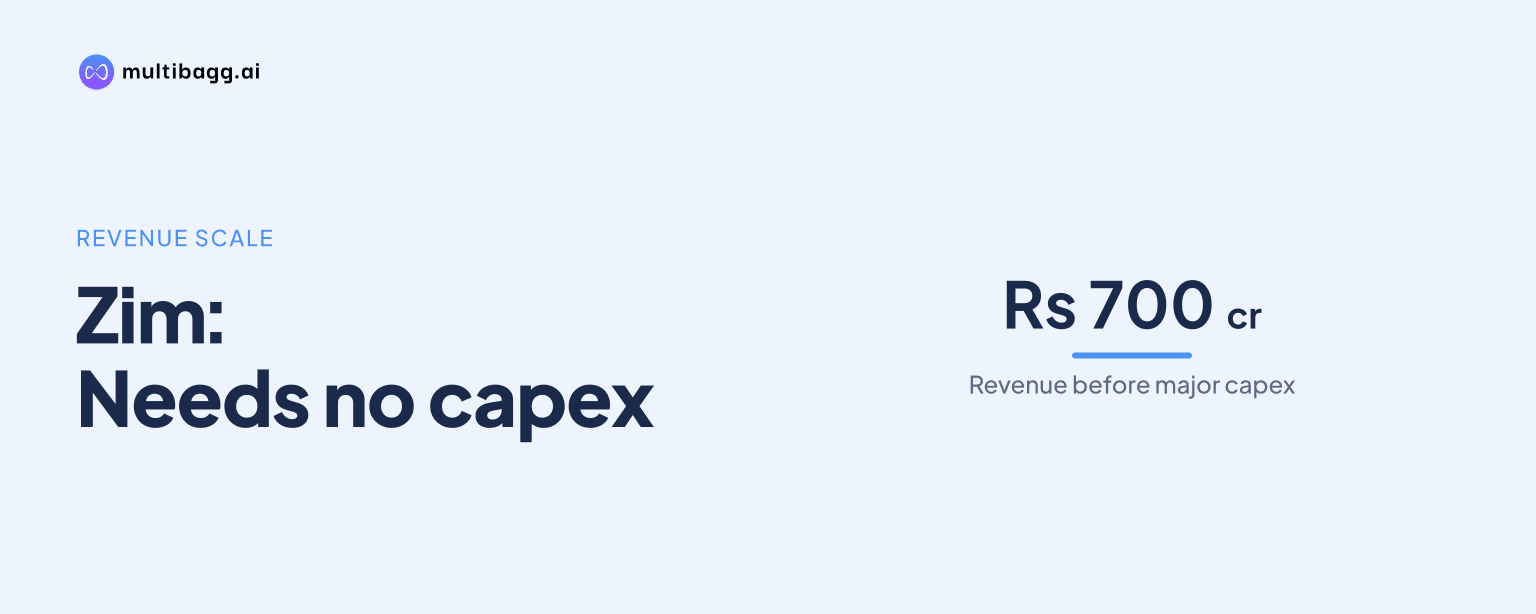
Zim Laboratories Limited said in the second quarter of FY '27 that its completed Rs 200 crore investment can support roughly Rs 700 crore of revenue without substantial new capital expenditure. Management said the new Nutraceutical, CEPHA and Pancreatin capacity would be 80%-90% utilised at that revenue level.
Know Zim Laboratories inside out
Results, valuation, peers and who's buying, in one view.
Can Zim reach Rs 700 crore revenue with existing plants?
Yes. Zim said the capacity created through about Rs 200 crore of completed capital expenditure, including a dedicated Pancreatin suite and a new Nutraceutical facility, is sufficient for approximately Rs 700 crore of revenue. Management said it may incur operational capital expenditure, such as machinery upgrades required in pharmaceutical production, but does not expect substantial investment through FY '30 within that capacity range.
The capacity assessment depends on business arriving in line with planned forecasts and on product mix. Zim said it has room to grow from its current operating level, but that utilisation would reach about 80%-90% at Rs 700 crore of revenue. Management added that continuous production of a single product could permit higher output from the same infrastructure, making the relationship between capacity and revenue dependent on the products supplied.
What capacity additions has Zim already completed?
Zim has completed about Rs 200 crore of capital expenditure for its capacity plan, according to management. The programme includes the dedicated Pancreatin suite, the transfer of Nutraceutical operations to a new facility and the CEPHA project. Management said the required investment for the next phase after EU-GMP regulatory clearance has already been made.
Balance-sheet figures show the effect of that investment. As of September 30, 2026, Zim had total debt of about Rs 146.2 crore, comprising a Rs 84.1 crore term loan and Rs 62.1 crore of working-capital borrowing. The term loan had risen from Rs 60.7 crore at the end of FY '26, while gross block increased to Rs 418.8 crore from Rs 386.2 crore, reflecting the projects intended to support higher revenue.
When would Zim need another capacity expansion?
Zim said it may consider further expansion after revenue moves beyond about Rs 700 crore, rather than before reaching that level. Management indicated that it could review additional capital expenditure one to two years down the line if demand requires output beyond the current 80%-90% utilisation range. It did not disclose the cost, location or scope of any future project.
The nearer constraint is regulatory and commercial execution rather than a stated lack of production space. Zim said its EU-GMP-related capacity is ready, while European authorities had accepted action taken on major audit points up to 90% and sought clarifications. Management expected to submit those clarifications within days and said a one- to one-and-a-half-month timeline was reasonable, while noting that the final timing depends on regulators and meeting schedules.
How would EU-GMP clearance affect Zim’s capacity plan?
EU-GMP clearance would allow Zim to use capacity it says is already installed without additional capital expenditure. Management said the UK could be the first supply market after acceptance of corrective and preventive actions, known as CAPA, based on an informal indication from authorities. It also said partners had provided orders and forecasts, although commercial timing remains subject to the regulatory process.
Zim expects a European launch portfolio of about 8-10 products once EU-GMP clearance is obtained, including products in the NIP and OTF categories and three more products nearing the end of procedure. Management identified Pancreatin and Tamsulosin as major European opportunities, with the UK expected to represent a substantial initial share of Pancreatin business. This product mix matters because Zim said manufacturing output from its current facilities varies with production scheduling.
Got a follow-up? Ask IRIS
What operating leverage does Zim expect at higher revenue?
Zim’s management expects an EBITDA margin of 18%-20% at around Rs 700 crore of revenue, compared with the approximately 8% margin it cited at the current level. EBITDA means earnings before interest, tax, depreciation and amortisation. Management attributed the potential improvement to operating leverage, as a larger revenue base would absorb more operating costs, but said it would not provide a higher target before EU supplies become consistent.
Management said revenue needs to cross about Rs 430 crore-Rs 440 crore for margins to return to the previous level, and that margins should rise sequentially once revenue exceeds Rs 450 crore. It said monthly operating cost was about Rs 15.5 crore in H1 FY '27, compared with an average H1 run rate of about Rs 13 crore. About Rs 5.5 crore of H1 expenditure was identified as one-time remediation and consulting costs, with the monthly run rate expected to settle near Rs 15 crore as those costs reduce.
How does Zim’s near-term target compare with its capacity?
Zim’s near-term revenue targets are materially below the roughly Rs 700 crore level it associates with 80%-90% utilisation. Management initially cited a target of Rs 415 crore-Rs 420 crore and later referred to Rs 420 crore-Rs 425 crore without EU business. Including export incentives, licensing fees and sales, it described total income closer to Rs 425 crore-Rs 430 crore.
If EU orders arrive, management said an additional Rs 30 crore-Rs 40 crore could lift the outcome to Rs 450 crore-Rs 460 crore. That leaves a substantial gap to the Rs 700 crore capacity threshold. Zim said the legacy business could grow by about 10% steadily and projected about 20% growth for the next two to three years after EU-GMP business starts, subject to registrations, order conversion and conditions in Latin America, Southeast Asia, the Middle East and Africa.
Conclusion
Zim has positioned its completed Rs 200 crore investment as a platform to expand from its Rs 425 crore-Rs 430 crore total-income target range toward roughly Rs 700 crore of revenue. At that higher level, management expects 80%-90% utilisation and an EBITDA margin of 18%-20%, while allowing for operational upgrades but not substantial new capital expenditure.
The next item to watch is the CAPA clarification process and its effect on EU-GMP acceptance, which management expected could advance within one to one-and-a-half months but said remains subject to regulators. Management also expects Australian commercial supplies in Q3 FY '27 and meaningful revenue from repeat orders from Q4 and FY '28, while European supply timing depends on regulatory clearance and subsequent orders.