










Zim Laboratories sees UK supply path after CAPA acceptance
Key highlights
- Zim Laboratories expects CAPA acceptance within one to one-and-a-half months, subject to regulatory review.
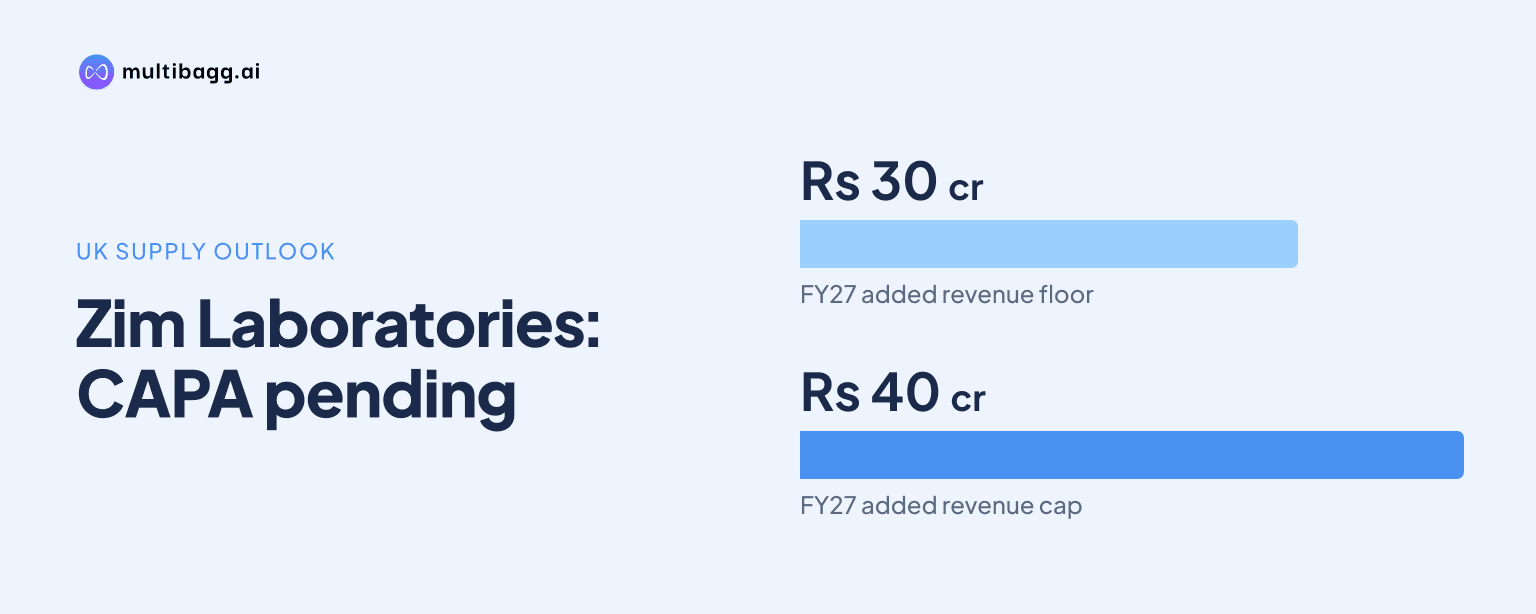
- Management said European Union orders could add Rs 30 crore to Rs 40 crore to FY27 revenue.
- Q2 FY27 operating income increased 19% year on year to Rs 105.4 crore.
- Q2 FY27 NIP and OTF revenue rose 84% year on year to Rs 14.9 crore.
powered by IRIS
Zim Laboratories Limited expects acceptance of its corrective and preventive action plan within one to one-and-a-half months from its November 5, 2026 call, and management said this could allow initial UK supplies before its European Union Good Manufacturing Practice, or EU-GMP, certificate is issued. The remaining inspection matters concern clarifications and documentation.
Know Zim Laboratories inside out
Results, valuation, peers and who's buying, in one view.
What could CAPA acceptance mean for Zim Laboratories' UK supplies?
Corrective and preventive action, or CAPA, acceptance is the first regulatory milestone that Zim Laboratories says could permit supplies to certain UK territories before formal EU-GMP recertification. The Nagpur manufacturing facility underwent a joint re-inspection by German and Portuguese authorities in May 2026. Zim Laboratories subsequently submitted a proactive CAPA response based on the draft final inspection report.
Management said the authorities had asked for further clarification and supporting documentation, rather than additional remediation work. Dr. Anwar Daud said the company expected to respond within days of the November 5 call. He added that informal indications from some authorities, including in the UK, suggested that in-principle CAPA acceptance could support confirmation for supplies to begin.
CAPA acceptance would not itself restore the EU-GMP certificate. Management described it as a trigger for potential UK execution, while the EU certification process would remain separate. Zim Laboratories said partners had supplied forecasts and were following up on potential orders, but it did not disclose signed UK order values, launch volumes or a binding supply date.
When could Zim Laboratories receive its EU-GMP certificate?
Zim Laboratories expects CAPA acceptance in one to one-and-a-half months, although management said the timing remains dependent on regulatory authorities. On the November 5 call, Dr. Daud said the authority’s letter indicated acceptance of the CAPA and action taken on major audit points was about 90% complete, subject to satisfactory replies to remaining clarifications.
After acceptance, management said the process would involve a letter to the European Medicines Agency, or EMA, followed by consideration at an EMA meeting. Management said the EMA meets once every one to one-and-a-half months. It did not provide a firm date for the certificate because agenda timing and authority decisions are outside Zim Laboratories’ control.
The company cited an earlier delay as evidence of that uncertainty. Management said it had expected progress in May 2026 but received the first official draft report only around one month before the November call. The one-to-one-and-a-half-month timeframe is therefore management’s expectation for CAPA acceptance, not a regulatory commitment.
Which products and revenue could regulatory clearance unlock?
Zim Laboratories has a European Union and UK pipeline of 12 new innovative products, or NIP, across seven therapy areas and five oral thin film, or OTF, products across three therapy areas. Three NIP products had reached the end-of-procedure stage in the European Union, but completion of their market-authorization grant process still requires EU-GMP certification.
Management said it could launch about eight to 10 products in the European Union after certification. This includes five to six products positioned for launch, additional NIP products and two to three OTF products, with some overlap in its rounded product categories. Management also said it had signed agreements for almost all products, while two or three products could account for a large share of expected revenue.
For FY27, management is targeting revenue of Rs 420 crore to Rs 425 crore without European Union sales. It said European Union orders could add Rs 30 crore to Rs 40 crore, taking FY27 revenue to Rs 450 crore to Rs 460 crore if regulatory progress allows supply. These are management targets contingent on approvals and customer orders, rather than reported revenue or disclosed purchase orders.
Australia represents a separate market opening. Zim Laboratories said it had received a letter from the Therapeutic Goods Administration, or TGA, and a first small test-market order. Management expects commercial supplies in Q3 FY27, with meaningful revenue beginning in Q4 FY27 and FY28 as repeat orders develop.
Got a follow-up? Ask IRIS
How did Zim Laboratories perform while awaiting clearance?
Zim Laboratories reported Q2 FY27 operating income of Rs 105.4 crore, up 19% year on year and 12% sequentially. Earnings before interest, tax, depreciation and amortization, or EBITDA, were Rs 7.7 crore, more than double Rs 3.4 crore in Q1 FY27. EBITDA was slightly below Rs 7.8 crore in Q2 FY26 as the company carried costs related to new facilities and regulatory remediation.
The pharmaceutical business generated about Rs 83 crore, or 79%, of Q2 FY27 operating income, while exports accounted for about 86% of quarterly income. In H1 FY27, pharmaceutical revenue rose 16% year on year and nutraceutical revenue increased 58%, indicating that growth continued through rest-of-world and emerging markets during the EU-GMP process.
NIP and OTF revenue grew 84% year on year to Rs 14.9 crore in Q2 FY27, accounting for 14% of operating income and 16% when dossier licensing fees are included. H1 FY27 innovative-product contribution including licence income reached Rs 33.7 crore, compared with Rs 20 crore in H1 FY26. Zim Laboratories received four marketing authorizations in Q2, including one NIP and three OTF products.
What cost and capacity changes could affect recovery?
Zim Laboratories is pursuing cost reduction alongside regulatory recovery. Management said EU-GMP consultant fees and certain one-time separation costs recorded in H1 FY27 should not fully recur in H2 FY27. The company has eased operations at older cephalosporin units and moved nutraceutical operations from Unit-3 and supporting units to a newer, more automated facility.
H1 FY27 operating expenses increased by about Rs 20.8 crore year on year to Rs 92.9 crore, including a Rs 13.1 crore increase in employee costs. Management attributed the increase to hiring, contract labour, quality systems and international-business development, as well as power, fuel, maintenance and professional costs. It said the monthly cost run rate could reduce to about Rs 15 crore as around Rs 5.5 crore of one-time H1 expenditure falls away.
Management said existing capital expenditure of about Rs 200 crore, including a dedicated Pancreatin suite and the new nutraceutical facility, can support revenue of roughly Rs 700 crore without substantial additional capital expenditure. At that revenue level, management estimates capacity utilisation of 80% to 90%, depending on the product mix. It said further expansion could be considered after that level.
Conclusion
Zim Laboratories’ near-term regulatory milestone is CAPA acceptance, rather than the eventual EU-GMP certificate alone. Management says acceptance could create a path for UK supplies while the European Union process continues. Its Q2 FY27 operating income of Rs 105.4 crore and Rs 14.9 crore of NIP and OTF revenue show business growth during the regulatory wait, but the potential Rs 30 crore to Rs 40 crore European Union contribution remains conditional.
The next developments to watch are Zim Laboratories’ submission of the requested clarifications, the authorities’ decision on CAPA, and whether the matter advances to an EMA meeting. Management also expects Australian commercial supplies in Q3 FY27 and meaningful repeat-order revenue from Q4 FY27, while maintaining an FY27 revenue target of Rs 420 crore to Rs 425 crore before European Union sales.