










Zim targets Rs 15 crore monthly cost run rate after H1 spending
Key highlights
- Zim reported a monthly operating-cost run rate of about Rs 15.5 crore in H1 FY27 and targets about Rs 15 crore going forward.
- H1 FY27 included Rs 5.5 crore of one-time remediation, consulting and related expenses, according to management.
- H1 FY27 operating income rose 24% year on year to Rs 199.6 crore, while EBITDA margin declined to 5.6% from 8.4%.
- Zim is easing old CEPHA operations and moving Nutraceutical work from Unit-3 support units to a newer automated facility.
powered by IRIS
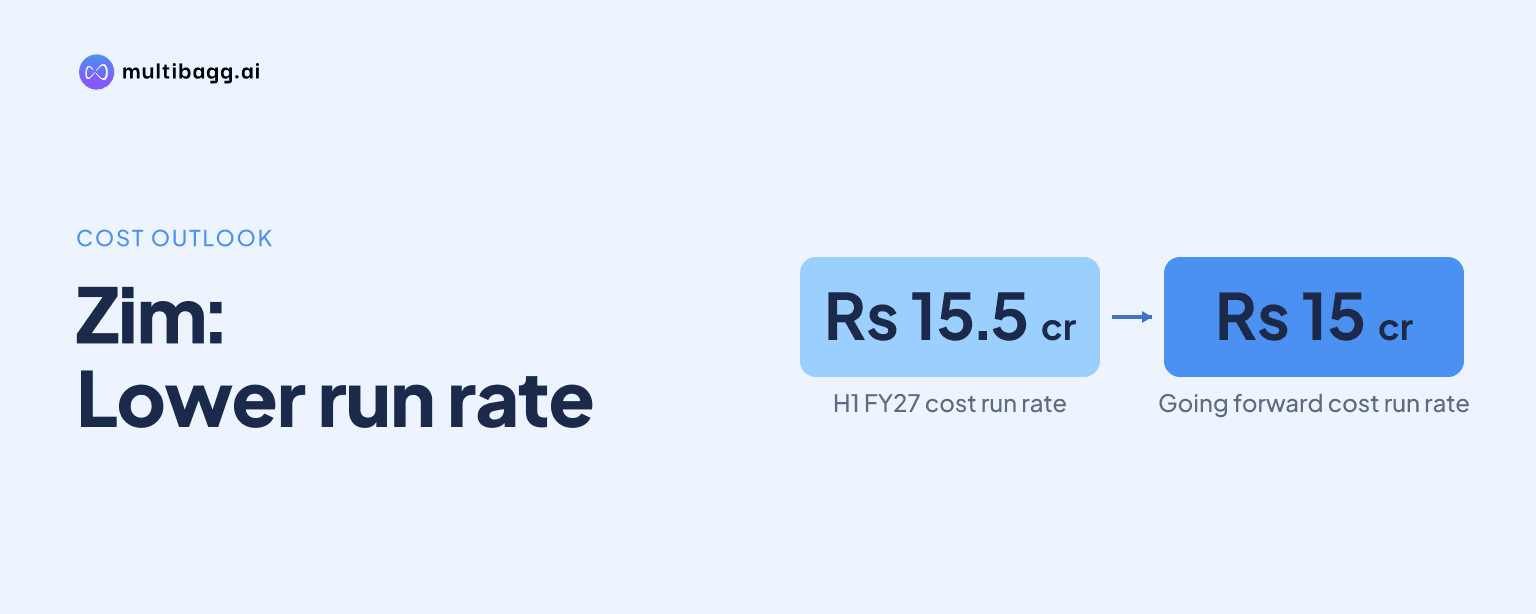
Zim Laboratories Limited is targeting a monthly operating-cost run rate of about Rs 15 crore after H1 FY27 included Rs 5.5 crore of remediation, consulting and related one-time expenses. The company reported a run rate of around Rs 15.5 crore during the half year, reflecting plant validation, senior hiring and European Union good manufacturing practice, or EU-GMP, work.
Know Zim Laboratories inside out
Results, valuation, peers and who's buying, in one view.
What monthly operating-cost run rate is Zim targeting?
Zim is targeting an operating-cost run rate of around Rs 15 crore a month after identified one-time expenses reduce. Director Finance Zulfiquar Kamal said the H1 FY27 monthly run rate was around Rs 15.5 crore, compared with around Rs 13 crore in the earlier period cited on the call. Management attributed the increase to senior-level hiring, validation of the new Nutraceutical and Cephalosporin, or CEPHA, projects, and one-time spending.
The Rs 5.5 crore H1 FY27 expense is central to the planned reduction. Kamal said the amount covered remediation and other costs, including consultation fees, and would reduce from the run rate going forward. Since the Rs 5.5 crore was incurred over six months, the Rs 15 crore monthly target is management's rounded post-remediation view rather than a stated mathematical calculation.
The proposed cost level does not mean every expense will decline. Zim said utility and labour costs may increase with revenue, while research and development, or R&D, spending could remain broadly steady in absolute terms. The company allocated Rs 9.9 crore to R&D in Q2 FY27, equal to 9.4% of operating income, including Rs 4.5 crore for bioequivalence studies and regulatory filings.
Why did Zim's costs increase in H1 FY27?
Zim's costs increased because it added people and compliance capacity while validating two newer facilities and completing the final phase of EU-GMP remediation. The company modernised its Nutraceutical and CEPHA facilities and added leadership across quality assurance, international business development, human resources and procurement. These actions increased employee, utility and consulting expenses before the facilities could serve EU, UK and Australian opportunities fully.
H1 FY27 operating expenses were Rs 92.9 crore, an increase of about Rs 20.8 crore year on year. The rise included Rs 13.1 crore of higher employee costs, including new hires and contract labour, and Rs 1.7 crore of higher operating expenses, mainly for power and fuel, repairs and maintenance, laboratories, audit, legal and professional fees. Zim said its teams and facilities were built for developed-market entry but remained underused while EU-GMP recertification was pending.
The higher cost base coincided with lower half-year margins despite revenue growth. H1 FY27 operating income increased 24% year on year to Rs 199.6 crore, while earnings before interest, tax, depreciation and amortisation, or EBITDA, were Rs 11.1 crore and the margin was 5.6%, compared with 8.4% in H1 FY26. Loss before tax widened to Rs 6.1 crore from Rs 2.3 crore as depreciation and finance costs rose following investment in expansion.
Got a follow-up? Ask IRIS
How is Zim changing its manufacturing footprint to lower costs?
Zim is easing operations at older units and shifting activity to newer automated facilities as part of its cost-optimisation and de-risking initiative. The company said the new CEPHA plant initiative includes easing operations at old CEPHA units. It also took Unit-3 and ancillary units supporting Nutraceutical manufacturing out of use and moved their operations to the new Nutraceutical facility.
Management expects the new Nutraceutical facility's automation and capacity to save costs. The operational change follows capital investment that lifted gross block to Rs 418.8 crore on September 30, 2026, from Rs 386.2 crore at FY26-end. Total debt was Rs 146.2 crore at September-end, comprising Rs 84.1 crore of term loans and Rs 62.1 crore of working-capital loans.
The plan is to remove costs specific to the regulatory transition rather than reverse compliance investment. Zim said EU-GMP consultant fees and certain one-time separation costs recorded in H1 FY27 were not expected to fully recur in H2 FY27. Management also said some remediation spending had been capitalised as infrastructure and systems investment, while consultant and other one-time items were charged as operating expenditure.
What could determine whether Zim's lower cost base improves margins?
Lower costs could improve margins if Zim adds revenue and uses its newer plants more fully, according to management. Q2 FY27 illustrated the effect of higher turnover on quarterly profitability: operating income rose 12% sequentially to about Rs 105.4 crore, EBITDA more than doubled to Rs 7.7 crore from Rs 3.4 crore in Q1 FY27, and the EBITDA margin increased to 7.3% from 3.7%.
The year-on-year comparison shows why both volumes and costs matter. Q2 FY27 EBITDA of Rs 7.7 crore was broadly flat against Rs 7.8 crore a year earlier despite 19% operating-income growth, because the cost base had risen for new businesses and remediation. Pharmaceutical revenue contributed about Rs 83 crore, or 79%, of Q2 operating income, while new innovative products and oral thin films generated Rs 14.9 crore, up 84% year on year.
Management said Zim would need to cross Rs 430 crore to Rs 440 crore of revenue to return to a normalised EBITDA margin, with margins expected to rise as revenue exceeds Rs 450 crore. These are management expectations rather than reported results. Management maintained an 18%-20% EBITDA-margin view at about Rs 700 crore of revenue, when it expects capacity utilisation of 80%-90% and broader absorption of operating costs.
EU-GMP progress remains a key uncertainty in that plan. Management said it had received clarification requests from European authorities and intended to respond within days of the November 5, 2026 call. It said acceptance of corrective and preventive action, or CAPA, measures could support UK supplies before the formal certificate, while estimating the next regulatory step could take one to one-and-a-half months, subject to authorities.
Conclusion
Zim's Rs 15 crore monthly cost-run-rate target identifies Rs 5.5 crore of H1 FY27 remediation, consulting and related one-time spending as a removable part of recent margin pressure. The company is pairing lower activity at older CEPHA and Nutraceutical support units with a shift to newer automated capacity, while H1 operating income rose 24% to Rs 199.6 crore and EBITDA margin fell to 5.6%.
The next point to watch is the company's CAPA response and the timing of EU-GMP acceptance, which management said could support UK supplies and eventually wider European sales. Management is targeting FY27 revenue of Rs 420 crore to Rs 425 crore without EU business and said EU orders could add Rs 30 crore to Rs 40 crore, while the Rs 15 crore monthly cost target depends on H1 one-time costs reducing as planned.