










ZIM H1 operating income rose 24.4% as EBITDA margin fell to 5.6%
Key highlights
- ZIM's H1 FY27 total operating income rose 24.4% year on year to Rs 199.6 crore.
- ZIM's H1 FY27 EBITDA margin declined to 5.6% from 8.4% in H1 FY26.
- Q2 FY27 EBITDA rose to Rs 7.7 crore from Rs 3.4 crore in Q1 FY27.
- ZIM spent around Rs 18 crore on EU-GMP remediation during the previous 15 months.
powered by IRIS
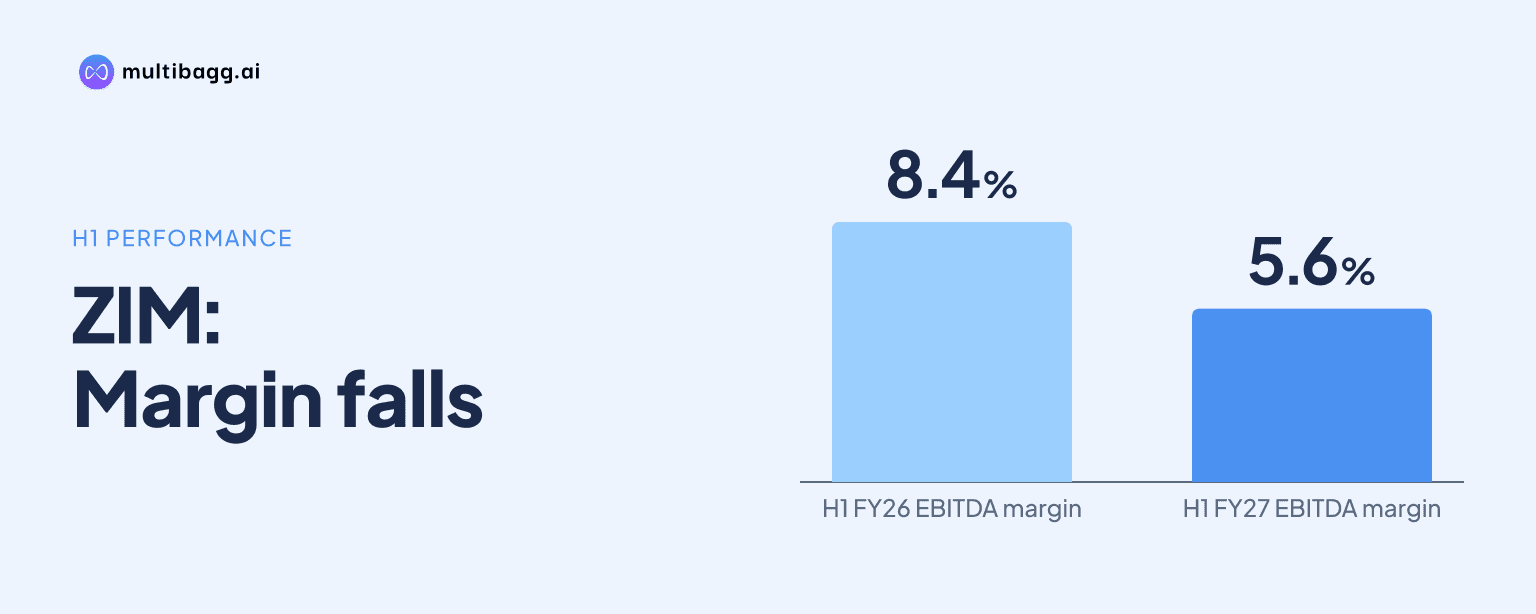
Zeal & Innovation in Medicine (ZIM) reported total operating income of Rs 199.6 crore in the first half of fiscal year 2027 (H1 FY27), up 24.4% year on year, while earnings before interest, tax, depreciation and amortisation (EBITDA) margin fell to 5.6% from 8.4% as developed-market readiness, EU-GMP remediation and duplicate-manufacturing costs increased.
Know Zim Laboratories inside out
Results, valuation, peers and who's buying, in one view.
Why did ZIM's H1 FY27 operating income rise?
ZIM's H1 FY27 total operating income increased by Rs 39.1 crore to Rs 199.6 crore from Rs 160.5 crore in H1 FY26. The company said contribution percentage was in line with budget, while second-quarter (Q2) FY27 export revenue rose 24.7% year on year to Rs 90.8 crore, driven by higher supplies to rest-of-world (RoW) markets.
The quarterly trend improved in Q2 FY27. Total operating income was Rs 105.4 crore, compared with Rs 94.2 crore in Q1 FY27 and Rs 88.7 crore in Q2 FY26, representing growth of 12.0% quarter on quarter and 18.9% year on year. ZIM attributed the increase to its formulation business in RoW markets.
Pharmaceutical products remained the larger revenue component in Q2 FY27, contributing Rs 83 crore, or 79% of total revenue, while nutraceutical products contributed Rs 22.5 crore, or 21%. For H1 FY27, ZIM said pharmaceutical revenue increased 16% year on year and nutraceutical revenue grew 58% year on year.
Why did ZIM's EBITDA margin decline to 5.6%?
ZIM's EBITDA declined to Rs 11.1 crore in H1 FY27 from Rs 13.5 crore a year earlier despite the Rs 39.1 crore increase in operating income. Management attributed the margin decline to higher people and process costs for its developed-market strategy, European Union good manufacturing practice (EU-GMP) remediation, and duplicated manufacturing at the cephalosporin and Unit 3 blocks.
Operating expenses increased to Rs 92.9 crore in H1 FY27 from Rs 72 crore in H1 FY26, a rise of Rs 20.9 crore. The expense bridge showed employee costs rising by Rs 13.1 crore and other operating expenditure increasing by Rs 7.9 crore, partly offset by a Rs 9 lakh reduction in other residual items.
New hiring added Rs 4.98 crore, contract labour added Rs 5.22 crore and other employee-related expenses added Rs 2.86 crore in the H1 FY27 expense bridge. The non-employee increase included Rs 3.14 crore for power and fuel, Rs 1.5 crore for repairs and maintenance, Rs 1.02 crore for laboratories, and Rs 2.21 crore for audit, legal and professional services.
ZIM said it had established plant, process and people for commercial product entry into the European Union, United Kingdom, Australia and other developed markets. Pending EU-GMP re-certification, the business remained limited to RoW markets, leaving assets under-utilised relative to the investments made, according to management.
Got a follow-up? Ask IRIS
Did ZIM's profitability recover in Q2 FY27?
ZIM's Q2 FY27 EBITDA recovered to Rs 7.7 crore from Rs 3.4 crore in Q1 FY27, and EBITDA margin rose to 7.3% from 3.7%. The 365-basis-point sequential improvement accompanied a Rs 11.2 crore quarter-on-quarter increase in operating income, which management said produced a better margin outcome.
The Q2 FY27 recovery did not restore the prior-year quarterly margin. EBITDA of Rs 7.7 crore and a 7.3% margin remained below Rs 7.8 crore and 8.8%, respectively, in Q2 FY26. They were also below the Rs 14.5 crore EBITDA and 13.4% margin recorded in Q3 FY26.
PAT improved sequentially but remained negative. ZIM recorded a PAT loss of Rs 2.1 crore in Q2 FY27, compared with a Rs 4 crore loss in Q1 FY27, while PAT margin improved to negative 1.9% from negative 4.3%. The company linked the continuing loss to higher depreciation after gross-block additions and associated borrowing costs, with benefits from those investments pending.
What could change ZIM's cost base and market access?
ZIM said it had spent around Rs 18 crore over the previous 15 months on EU-GMP remediation, describing this as one-time expenditure not expected to recur. It also said consultant and corrective and preventive action (CAPA) remediation costs had mostly been incurred, although they were not expected to be fully recouped in H2 FY27.
Some one-time settlement costs may arise as ZIM executes cost rationalisation, according to management. The company is closing an old cephalosporin unit after commissioning a new cephalosporin plant, while an ancillary Unit 3 facility making nutraceutical products has been shut and production moved to a new nutraceutical facility.
ZIM said utility and operating expenses were being optimised after the Unit 3 production transfer, while costs associated with the old cephalosporin unit were being rationalised. These actions follow the H1 FY27 expense increase of Rs 20.9 crore and are part of management's plan for a leaner cost base.
Market-access progress remains tied to the EU-GMP process. ZIM submitted its CAPA to European Union authorities, received inspectors' comments and said its final response was being sent that week, with acceptance subject to satisfactory verification. Separately, it received Australian Therapeutic Goods Administration GMP certification and received four marketing authorisations in Q2 FY27, comprising one new innovative product and three oral thin films, from 48 filings across developed, Pharmerging and RoW markets.
Conclusion
ZIM's H1 FY27 result combined 24.4% operating-income growth to Rs 199.6 crore with a 280-basis-point EBITDA-margin decline to 5.6%. Q2 FY27 showed sequential improvement, with operating income of Rs 105.4 crore and EBITDA of Rs 7.7 crore, but the first-half outcome still reflected staffing, remediation, upgrades and duplicated production costs incurred ahead of wider developed-market access.
The next event to watch is European Union authorities' verification and potential acceptance of ZIM's CAPA response for EU-GMP re-certification. ZIM has begun planning raw-material availability and production readiness for European Union and United Kingdom supplies, while the financial effect of plant closures and new-facility transfers remains dependent on execution and regulatory progress in H2 FY27.