








Aarti Industries commissions Zone IV Phase I for FY27 ramp-up

Find your next multibaggerBe a Pro Investor
Research stocks and track your picks on the go. Download the app.
Key highlights
- AIL has commissioned Zone IV Phase I, including calcium chloride, PEDA and part of MPP 1.
- AIL targets progressive commercialisation of all Zone IV manufacturing blocks during FY27.
- AIL reported H1 FY27 consolidated revenue of Rs 6,513 crore, up 58% year on year.
- AIL’s H1 FY27 net debt was Rs 4,652 crore and debt-to-equity was 0.74 times.
powered by IRIS
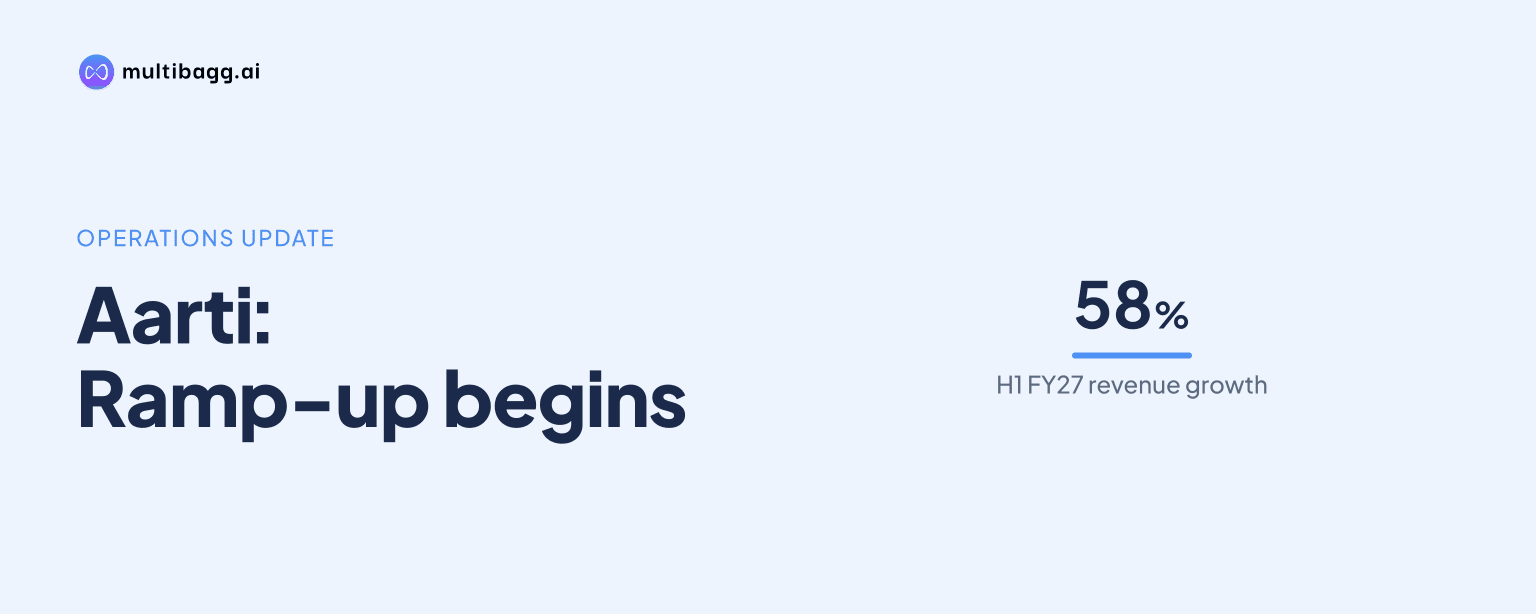
AIL has commissioned Zone IV Phase I, making calcium chloride, 2,6-Diethyl-N-(2-Propoxyethyl) Aniline (PEDA) and part of Multipurpose Plant 1 operational, with progressive commercialisation of all Zone IV blocks targeted during FY27. The FY27 outcome depends on commercial qualification, customer approvals and disciplined ramp-up.
Know Aarti Industries inside out
Results, valuation, peers and who's buying, in one view.
What has AIL commissioned at Zone IV?
AIL has commissioned Zone IV Phase I, comprising calcium chloride, PEDA and part of Multipurpose Plant 1, or MPP 1. The presentation describes these three manufacturing blocks as operational, rather than under construction or trial commissioning. It does not disclose capacity, capital cost, production volumes or the precise commissioning date for Phase I.
PEDA is a downstream addition to AIL’s existing ethylation platform, according to management. The company identifies this as a move into value-added products, while MPP 1 is intended to enable commercial-scale manufacture of multiple products and advanced chemistries. Calcium chloride is listed as operational, but the presentation gives no product-specific end market, capacity or revenue expectation for that block.
The Phase I announcement is part of a broader Zone IV plan rather than confirmation that the whole complex is running. Management’s stated next milestone is progressive commercialisation of all Zone IV manufacturing blocks during FY27. That distinction matters because operational equipment must still pass commercial qualification and secure customer approvals before a broader revenue ramp-up can occur.
How will AIL turn Zone IV capacity into sales?
AIL says commercial qualification, customer approvals and disciplined ramp-up are the required steps before Zone IV reaches progressive commercialisation in FY27. The presentation does not disclose named customers, contracted volumes, pricing, approval timelines or utilisation targets. Commissioning therefore establishes manufacturing availability, but not a quantified sales contribution.
MPP 1 is the key flexibility mechanism disclosed for the first phase. AIL says the plant can manufacture multiple products at commercial scale and support advanced chemistries, while several products are planned from Zone IV. The presentation does not identify how many products will initially be launched or which ones will receive customer approval first.
Management positions the facility for applications across agrochemicals, pharmaceuticals, coatings and polymers. It also says Zone IV strengthens agrochemical and other specialty-chemical offerings. These are opportunity areas rather than disclosed order wins: the company has not provided segment-wise revenue, product-level margins or a split between the calcium chloride, PEDA and MPP 1 operations.
How does Zone IV fit AIL’s FY27 capital programme?
AIL has identified phase-wise commissioning and ramp-up of Zone 4, including MPP, as a capital-expenditure-led growth driver and is targeting commissioning of all projects in FY27. This target sits alongside the stated objective of improving capital efficiency, cash generation and balance-sheet flexibility. No separate Zone IV expenditure figure or remaining project cost is disclosed.
The company reported consolidated capital expenditure of Rs 484 crore in H1 FY27, compared with Rs 585 crore in H1 FY26. That was a decline of Rs 101 crore year on year, while Zone IV Phase I moved into operations. Full-year capital expenditure was Rs 1,125 crore in FY26, down from Rs 1,372 crore in FY25.
Net debt was Rs 4,652 crore at H1 FY27, up Rs 900 crore from Rs 3,752 crore at H1 FY26. The debt-to-equity ratio was 0.74 times at H1 FY27 versus 0.66 times a year earlier. The presentation does not attribute this movement specifically to Zone IV, so it cannot be treated as a measure of the project’s cost or financial return.
Got a follow-up? Ask IRIS
What does AIL’s current performance say about the ramp-up backdrop?
AIL reported consolidated revenue of Rs 6,513 crore in H1 FY27, 58% above Rs 4,118 crore in H1 FY26, while earnings before interest, tax, depreciation and amortisation, or EBITDA, rose 58% to Rs 802 crore. These group-level results provide the financial backdrop for Zone IV’s FY27 ramp-up, but management does not isolate any contribution from the newly commissioned first phase.
Profit after tax, or PAT, was Rs 324 crore in H1 FY27, compared with Rs 149 crore in H1 FY26, a 117% year-on-year increase. Revenue had reached Rs 9,018 crore in FY26 from Rs 8,046 crore in FY25, and EBITDA rose to Rs 1,172 crore from Rs 1,016 crore. The source does not connect these historical gains to Zone IV, whose Phase I commissioning is disclosed in the presentation.
Management lists several other near-term volume and margin initiatives alongside Zone IV: acid, dichlorobenzene and nitrochlorobenzene value-chain ramp-up; ethylation and nitrotoluene volume growth; methyl methacrylate expansion; and fluorination and specialty-chemical ramp-up. It says these initiatives are on track as planned, whereas Zone IV remains specifically subject to phase-wise commissioning, qualification and customer approvals.
What other FY27 projects could affect AIL’s execution?
AIL’s near-term strategy lists Zone 4, including MPP, Augene and the Re Aarti joint venture as commissioning and ramp-up projects under a target to commission all projects in FY27. Zone IV is therefore one part of a wider execution programme. The presentation does not provide a consolidated budget, revenue target or sequence of expected commissioning dates for these projects.
The Augene downstream DCA joint venture with Superform is under commissioning trials, with commercial volumes expected to begin soon. Separately, Re Aarti’s chemical-recycling project is progressing with delivery of critical equipment and engagement with potential pyrolysis-oil customers, but its stated commissioning target is calendar year 2027, not FY27. DCA is the abbreviated project description used by AIL; the source does not expand it.
AIL also says a pilot has been commissioned to support new-product development. Its longer-term plan is to use research and development and MPP capabilities for quicker development, qualification and commercialisation in agrochemicals and pharmaceuticals, with chlorotoluene commissioning and ramp-up expected to open opportunities in those segments. These plans support the stated role of flexible manufacturing, but do not establish a timetable or commercial outcome for individual Zone IV products.
Conclusion
The presentation frames Zone IV as a downstream-integration and flexible-manufacturing initiative, with PEDA extending AIL’s ethylation platform and MPP 1 supporting multiple products and advanced chemistries. Its financial contribution remains unquantified because AIL has disclosed no capacity, cost, customer, volume, utilisation or revenue figures for Phase I, while consolidated H1 FY27 revenue was Rs 6,513 crore and EBITDA was Rs 802 crore.
The next disclosed checkpoint is progressive commercialisation of all Zone IV manufacturing blocks during FY27. Management’s progress on commercial qualification, customer approvals and disciplined ramp-up will determine that outcome, alongside the wider project-commissioning programme and the H1 FY27 net-debt position of Rs 4,652 crore.

