










Aatmaj Healthcare debtor days fall to about 251 in H1 FY27 from FY24
Key highlights
- Aatmaj Healthcare reported debtor days of about 251 in H1 FY27, down from about 507 days in FY24.
- Closing trade receivables declined to Rs 23.30 crore in H1 FY27 from Rs 24.54 crore in FY26.
- Post-tax operating cash flow rose to Rs 42.39 lakh in H1 FY27 from Rs 12.00 lakh in H1 FY26.
- Management said more than 80% of the Rs 23.30 crore receivables balance was with institutional or government panels.
powered by IRIS
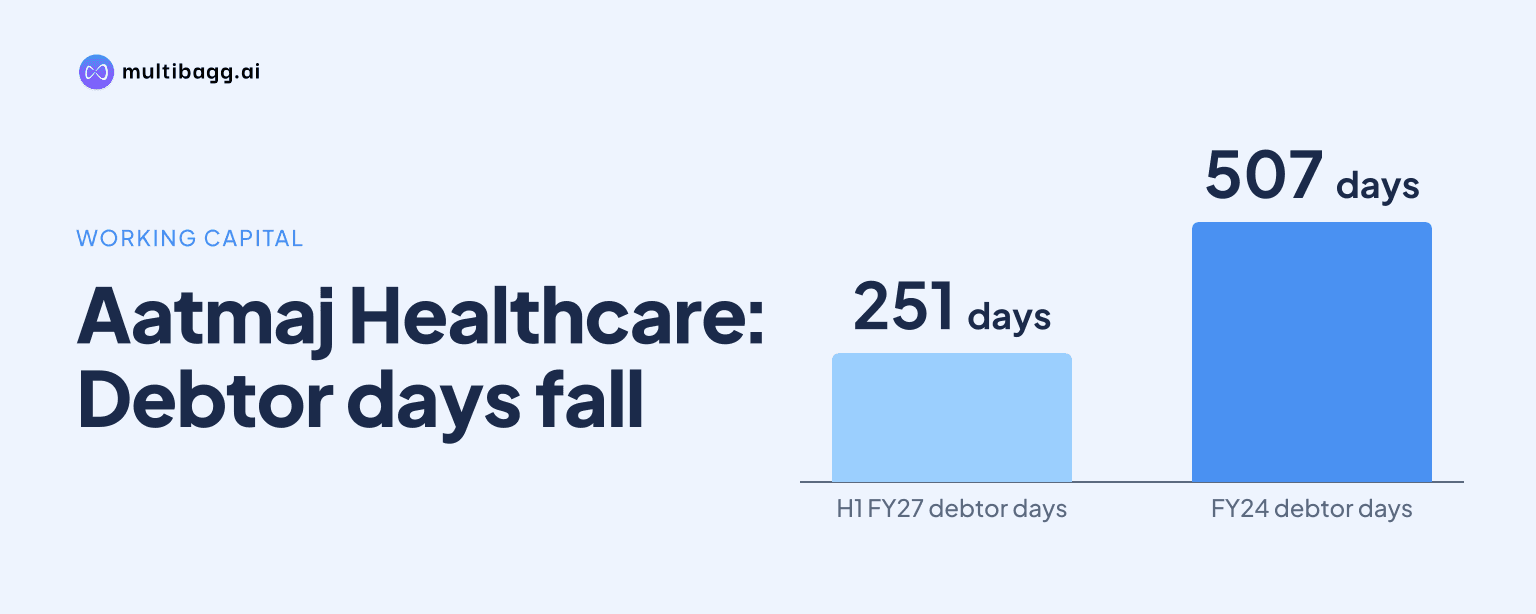
Aatmaj Healthcare Limited reported debtor days of about 251 in H1 FY27, down from about 507 days in FY24, while closing trade receivables declined to Rs 23.30 crore. Aatmaj Healthcare attributed the reduction to credit control and aged-debt recovery, alongside post-tax operating cash flow of Rs 42.39 lakh in H1 FY27.
Know Aatmaj Healthcare inside out
Results, valuation, peers and who's buying, in one view.
Why did Aatmaj Healthcare's debtor days fall in H1 FY27?
Aatmaj Healthcare reported a multi-year reduction in debtor days, also known as days sales outstanding (DSO), from about 507 days in FY24 to about 468 days in FY25, about 397 days in FY26 and about 251 days in H1 FY27. The H1 FY27 measure was 256 days below FY24 and 146 days below FY26.
The presentation shows closing trade receivables rising from Rs 20.62 crore in FY24 to Rs 24.58 crore in FY25, before easing to Rs 24.54 crore in FY26 and Rs 23.30 crore in H1 FY27. It labels H1 FY27 revenue as annualized in the DSO table, so the 251-day reading is not a completed full-year measure.
Has lower receivables improved Aatmaj Healthcare's operating cash flow?
Yes, Aatmaj Healthcare reported post-tax operating cash flow of Rs 42.39 lakh in H1 FY27, compared with Rs 12.00 lakh in H1 FY26. Management reported net cash flow from operations before tax of Rs 56.74 lakh in H1 FY27 and linked the increase to improving working-capital realisation.
Revenue growth outpaced earnings before interest, tax, depreciation and amortisation (EBITDA) growth during H1 FY27. Revenue from operations increased 56.89% year on year to Rs 16.96 crore from Rs 10.81 crore, while EBITDA rose 15.25% to Rs 2.04 crore from Rs 1.77 crore. Profit after tax declined 27.45% to Rs 0.37 crore from Rs 0.51 crore over the same period.
What remains outstanding in Aatmaj Healthcare's receivables?
Aatmaj Healthcare had Rs 23.30 crore of trade receivables outstanding in H1 FY27, despite a Rs 1.24 crore reduction from the Rs 24.54 crore balance reported in FY26. Management said more than 80% of outstanding balances were with institutional or government panels, which it described as carrying minimal default risk but having longer realisation timelines.
Management said it targets liquidation of a substantial portion of aged receivables in H2 FY27, but did not quantify the collection target or provide an ageing schedule for the Rs 23.30 crore balance. The outstanding balance exceeded H1 FY27 revenue from operations of Rs 16.96 crore, making collection timing relevant to the company’s cash conversion.
How is Aatmaj Healthcare trying to prevent new receivables from building up?
Aatmaj Healthcare said it has instituted a dedicated credit-control team, shortened third-party administrator (TPA) billing processing cycles, tightened corporate-client credit limits and begun weekly monitoring of aged government-scheme claims across Gujarat and Madhya Pradesh. These measures support management’s stated aim of lowering debtor days below 200, although no timetable was disclosed.
Management also said it is changing its payer mix by expanding direct-cash patients and faster-settling private TPA insurance policies, while retaining strict billing milestones for institutional partners. The collection plan accompanies management’s approximately 80% FY27 revenue-growth target from FY26 revenue of Rs 22.53 crore, implying full-year FY27 revenue of about Rs 40.55 crore and H2 FY27 revenue of about Rs 23.59 crore.
Got a follow-up? Ask IRIS
How do borrowings and profit affect Aatmaj Healthcare's working-capital position?
Aatmaj Healthcare reported total borrowings of Rs 23.16 crore in H1 FY27, compared with Rs 21.03 crore in FY26. The H1 FY27 balance comprised Rs 10.28 crore of long-term borrowings and Rs 12.88 crore of short-term borrowings, while cash and cash equivalents were Rs 12.78 crore compared with Rs 1.15 crore in FY26. Management said borrowings financed hospital development and temporary working-capital needs.
Finance costs of Rs 98.74 lakh in H1 FY27, along with depreciation on newly commissioned hospital assets, clinical equipment and the Indore facility setup, were cited by management as reasons for lower net profit. Profit before tax declined to Rs 0.50 crore from Rs 0.61 crore, and management said it plans to use operating cash flow and recovered receivables to repay high-cost short-term bank borrowings.
What should readers watch in H2 FY27?
Readers should watch whether the Rs 23.30 crore receivables balance continues to decline as H2 FY27 collections progress. Aatmaj Healthcare reported lower DSO, a Rs 1.24 crore reduction in receivables from FY26 and post-tax operating cash flow of Rs 42.39 lakh, but management’s collection plan still depends substantially on institutional and government-panel settlement timelines.
Management has disclosed three near-term markers: its plan to liquidate a substantial portion of aged receivables in H2 FY27, its below-200-day DSO objective and its approximately 80% FY27 revenue-growth target. Reaching the implied FY27 revenue of about Rs 40.55 crore requires about Rs 23.59 crore in H2 FY27 revenue, while management also plans to apply collections toward reducing high-cost short-term borrowings.
Conclusion
Aatmaj Healthcare’s reported DSO declined from about 507 days in FY24 to about 251 days in H1 FY27, alongside a Rs 1.24 crore reduction in receivables from FY26 and an increase in post-tax operating cash flow to Rs 42.39 lakh. Revenue from operations rose 56.89% to Rs 16.96 crore in H1 FY27, although profit after tax fell to Rs 0.37 crore as finance costs and depreciation increased.
The next disclosures to watch are progress toward management’s below-200-day DSO objective, collection of aged institutional and government-panel balances, and H2 FY27 revenue needed to support the approximately Rs 40.55 crore full-year target. Management’s stated use of recovered receivables and operating cash flow to reduce short-term borrowings may also affect future finance costs.