








Addictive Learning says AI cut evaluation costs by 90% in October
MAX Plan at ₹4,999/yr

Find your next multibaggerBe a Pro Investor
Research stocks and track your picks on the go. Download the app.
Key highlights
- Addictive Learning says 100% of descriptive assignments were AI-evaluated, reducing evaluation costs by 90% in October 2026.
- Addictive Learning reports that AI solved 42% of student-support chats and reduced first-response time from 24 hours to about four hours.
- Addictive Learning says paid registrations were four times higher from March to October on 45% lower advertising spend.
- Addictive Learning completed 45 technology projects in four months, with 23 live as of 23 November 2026.
powered by IRIS
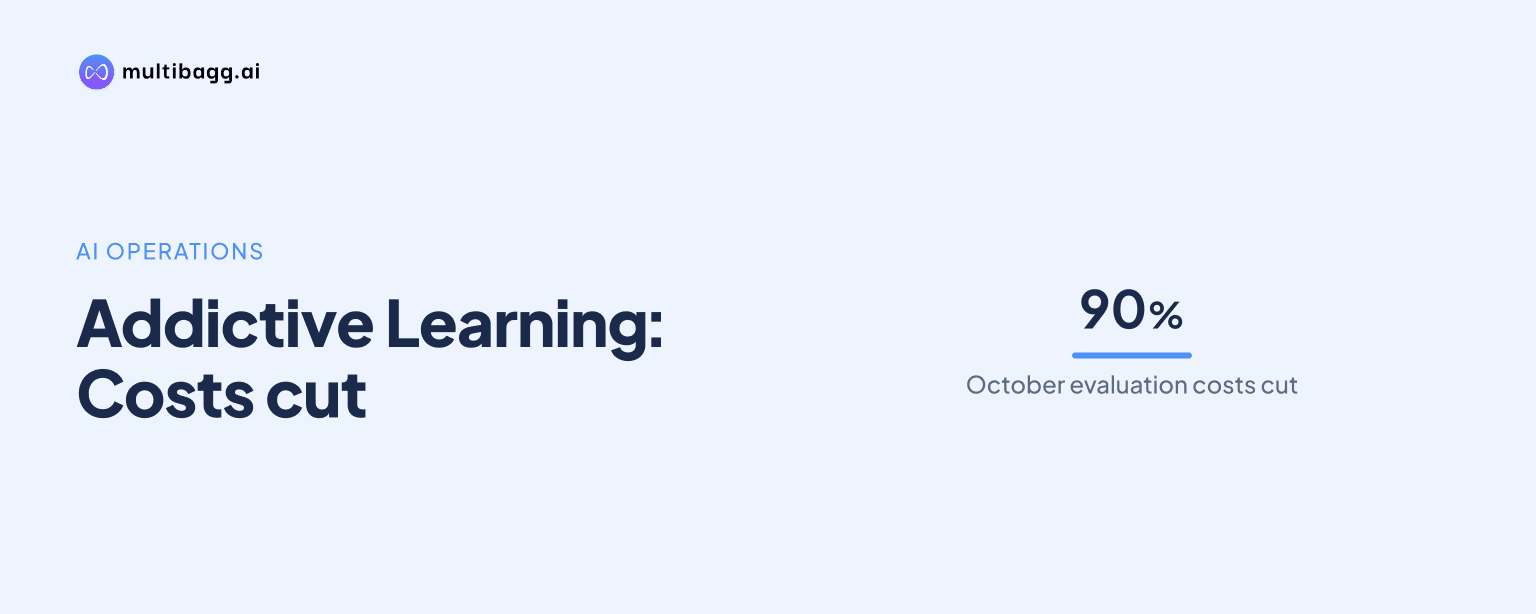
Addictive Learning says its artificial-intelligence, or AI, systems cut descriptive-assignment evaluation costs by 90% in October 2026 while evaluating 100% of those assignments. The company also reported that AI solved 42% of student-support chats and reduced first-response time from 24 hours to about four hours, based on internal data.
Know Addictive Learning Technology inside out
Results, valuation, peers and who's buying, in one view.
What operational gains does Addictive Learning report from AI?
Addictive Learning reports that AI evaluated 100% of descriptive assignments in October 2026, reducing evaluation costs by 90%. This is the presentation's most specific efficiency measure because it combines full workflow coverage with a stated cost reduction.
The company places assessment, support, acquisition and sales systems in its third business layer, called “Our Edge”. It said it completed 45 technology projects in four months, with 23 live as of 23 November 2026; about 18 projects use AI directly, while the remainder are automation work or replacements for paid software.
The 90% figure applies to descriptive-assignment evaluation costs, not to Addictive Learning's total operating costs, employee expenses or company-wide spending. Addictive Learning does not disclose the cost before or after deployment, the volume of assignments, or the calculation method, so no rupee saving can be established from the presentation.
How has Addictive Learning changed student support and assessment?
Addictive Learning says AI solved 42% of student-support chats in October 2026 and reduced first-response time from 24 hours to about four hours. The reported comparison indicates a reduction of about 20 hours in the initial response interval, although the presentation does not define the support channels included in that measure.
The company identifies an AI Support Hub and an AI onboarding call for every student as parts of its student-experience systems. It also says AI class-audit coverage rose from 10% to 100%, extending automation beyond chat handling into review of classes.
Assessment and support use different coverage measures. All descriptive assignments were AI-evaluated, while AI solved 42% of support chats; the remaining 58% of chats were therefore not reported as solved by AI. Addictive Learning provides no assessment-accuracy rate, appeal rate, instructor-review measure or learner-satisfaction result.
The live Support Team Hub centralises access, course and batch-change requests, as well as onboarding actions, and lets other teams submit requests directly. The app is one of four live back-office applications out of seven listed by Addictive Learning as of 23 November 2026.
How did AI affect Addictive Learning's customer acquisition?
Addictive Learning reports that paid registrations were four times higher from March to October while advertising spend was 45% lower. It also says automatically built funnels produced half of October's paid sign-ups, leaving the source without a stated breakdown for the other half.
The acquisition systems include AI video advertisements, AdHook and Kit Importer. Addictive Learning says AdHook predicted which advertisements would work before spend, reporting a 67% result against 48% “by chance”; the presentation does not define the test method, sample size or success criterion.
Kit Importer is described as launching funnels automatically. The disclosed March-to-October comparison shows higher registrations alongside lower advertising spend, but Addictive Learning does not provide either period's registration count, advertising outlay, cost per registration, revenue per learner or retention data.
The acquisition figures are internal data from Addictive Learning's Meta Ads accounts and include goods and services tax, or GST. They are distinct from the company's support and assessment measures because they track marketing outcomes rather than service handling or assignment processing.
Got a follow-up? Ask IRIS
Which back-office processes has Addictive Learning automated?
Addictive Learning says seven in-house applications cover refunds, certificates, support, audits and invoicing, with four live and three in testing as of 23 November 2026. Management states that these systems are intended to reduce the number of people needed per learner as the business grows.
The live Master Refund Tracker captures refund requests, retrieves learner records and call summaries, checks compliance, and routes approvals to finance. Payment remains the only manual step, so the system automates the workflow before payout rather than the full refund process.
The live Certification App selects eligible learners daily from test results, follows up on electronic know-your-customer, or e-KYC, requirements, and sends batches for printing and dispatch. It supports National Skill Development Corporation, or NSDC, and Skill India certificates, while the live Learner Data Portal creates audit reports using learner histories and call transcripts.
Three applications were still being tested on 23 November 2026. Call Transcriber converts calls in Hindi, Hinglish, Tamil, Bengali and other languages into English transcripts with speaker labels and notes; Invoice App is designed to send the correct GST invoice after payment; and Learner Trace seeks to identify a learner from one detail in a complaint, review or social post.
What do Addictive Learning's automation metrics show?
Addictive Learning's internal data show automation across assessment, support, acquisition and back-office work: 100% AI evaluation of descriptive assignments, 42% of support chats solved by AI, 50% of October paid sign-ups from automatically built funnels, and four live back-office apps. These systems form part of 45 technology projects completed in four months.
The presentation does not connect these operating measures to reported operating margin, cash flow, headcount or total expenses. It also does not disclose pre-automation support staffing, assignment volumes, transaction volumes per app, or absolute costs, limiting comparison of the 90% evaluation-cost claim with wider company finances.
Implementation remains incomplete in the figures disclosed. Of the 45 projects, 23 were live as of 23 November 2026, while seven back-office applications were split between four live and three in testing; Addictive Learning does not give launch dates for the testing applications.
Conclusion
Addictive Learning reports that AI and automation are being used across several operating functions, rather than in a single customer-facing product. Its clearest quantified results are 100% AI evaluation of descriptive assignments at a reported 90% lower evaluation cost, plus a fall in first student-support response time from 24 hours to about four hours.
The next disclosed matter to watch is the progress of Call Transcriber, Invoice App and Learner Trace, which remained in testing on 23 November 2026. Future disclosures on assignment volumes, evaluation quality, support outcomes, staffing and absolute costs would show how the reported October 2026 operating measures translate into broader financial results.

