








Addictive Learning Q2 Revenue Rose 21%, EBITDA Margin 30.5%
MAX Plan at ₹4,999/yr

Find your next multibaggerBe a Pro Investor
Research stocks and track your picks on the go. Download the app.
Key highlights
- Addictive Learning reported Q2 FY27 revenue of Rs 25.3 crore, up 21% year on year.
- Q2 FY27 EBITDA was Rs 7.7 crore, up 59% from Q1 and equal to a 30.5% revenue margin.
- Profit after tax was Rs 2.29 crore, about seven times the Q1 level.
- Cash and bonds were Rs 10.7 crore, while Addictive Learning reported zero debt.
powered by IRIS
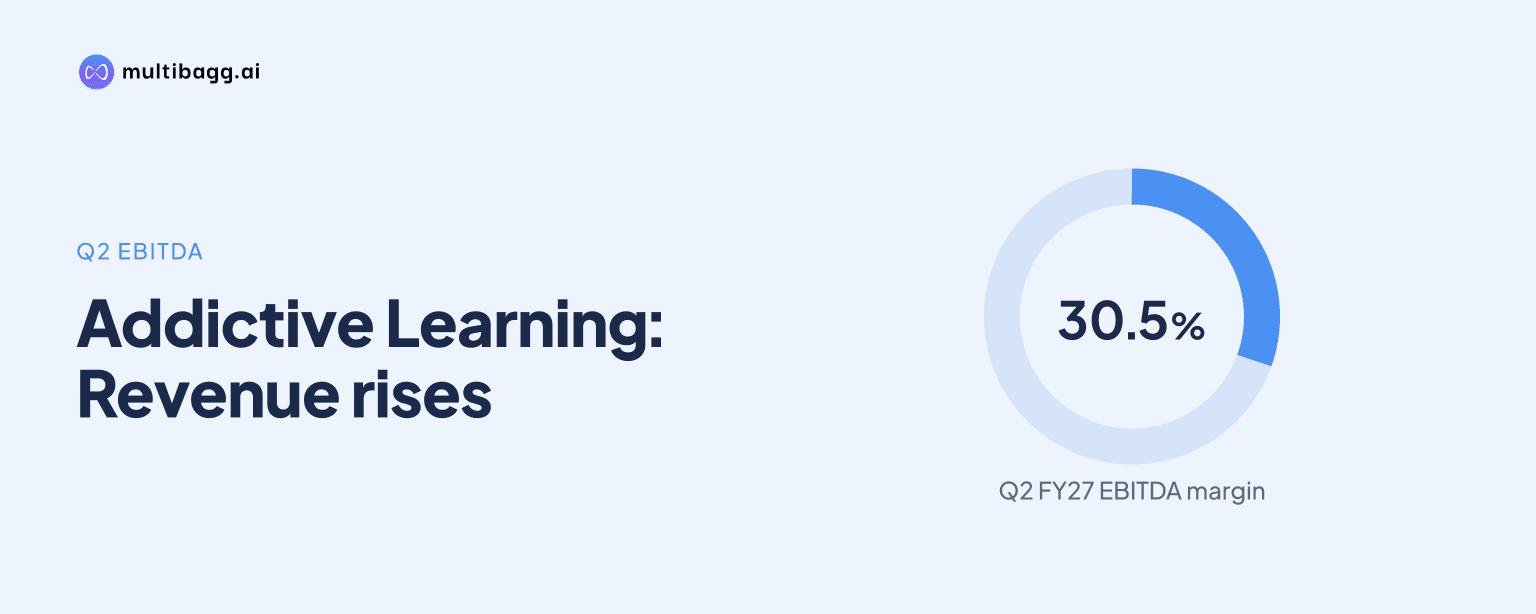
Addictive Learning reported Rs 25.3 crore of revenue in Q2 FY27, up 21% year on year, while Rs 7.7 crore of EBITDA equated to a 30.5% margin. The July to September 2026 result exceeded management's August revenue indication and came with Rs 10.7 crore of cash and bonds, zero debt and internally funded investment.
Know Addictive Learning Technology inside out
Results, valuation, peers and who's buying, in one view.
How did Addictive Learning perform in Q2 FY27?
Addictive Learning exceeded its August revenue indication of Rs 24 crore to Rs 25 crore, reporting Rs 25.3 crore for Q2 FY27, the July to September 2026 quarter. The result was Rs 0.3 crore above the top end of that indicated range and represented 21% year-on-year revenue growth. Management described it as the highest reported Q2 revenue among the listed Indian edtech peers it compared: Aptech, NIIT, NIIT Learning Systems, CL Educate, Zee Learn and Veranda.
Profit after tax was Rs 2.29 crore in Q2 FY27, at about seven times the Q1 level, while EBITDA was Rs 7.7 crore, up 59% from Q1. Addictive Learning defines EBITDA as profit before tax plus depreciation and amortisation; the Rs 7.7 crore figure equated to 30.5% of Rs 25.3 crore quarterly revenue. The company filed its consolidated Q2 FY27 results on November 4, 2026.
The comparison shows the quarter was above Addictive Learning's stated revenue range as well as higher than its prior-year revenue base. The Rs 7.7 crore EBITDA and Rs 2.29 crore profit after tax separate the quarter's operating profitability and post-tax outcome from the Rs 25.3 crore revenue figure.
What drove Addictive Learning's Q2 FY27 improvement?
Addictive Learning attributed the quarter's change principally to rebuilding its advertising engine after Meta advertising costs rose in late 2025. Cost per lead for a Rs 100 to Rs 200 community sign-up moved from about Rs 1,000 to Rs 1,250 and peaked above Rs 2,000, while a free sign-up cost Rs 150 to Rs 250. In Q1 FY27, the company rebuilt its funnels around a Rs 10 entry product and software designed to launch funnels automatically.
In Q2 FY27, Addictive Learning increased the number of advertisements in market threefold and introduced AI video advertisements, which it identified as its cheapest sign-up source. From March to October 2026, paid registrations rose from 7,260 to 31,753 a month while Meta spending declined from Rs 1.76 crore to Rs 0.98 crore. These registrations are paid entries into Rs 10 and Rs 100 to Rs 200 funnels, not recognised revenue.
The cost per paid registration fell 81% between March and October 2026, while monthly paid registrations increased 4.4 times and Meta spending fell 45%. Addictive Learning noted that some of the lower blended cost reflected a greater mix of the Rs 10 funnel, so the Rs 262 figure is not fully like-for-like with the Rs 100 to Rs 200 community funnel. The company separately reported that the community sign-up cost was Rs 560 in October, up from Rs 438 in September.
Got a follow-up? Ask IRIS
How much financial capacity did Addictive Learning report?
Addictive Learning reported Rs 10.7 crore of cash and bonds in Q2 FY27 and said it had zero debt. It also said all investment was paid from its own cash, linking its reported financial position to internally funded investment rather than borrowing. The presentation does not disclose a separate operating-cash-flow figure for the July to September 2026 period.
The stated balance-sheet position should be read alongside the Rs 7.7 crore quarterly EBITDA and Rs 2.29 crore profit after tax, rather than as evidence that all cash and bonds arose during the quarter. Addictive Learning disclosed the combined cash-and-bonds amount and its zero-debt position, but did not provide a split between cash, bond holdings or individual investment categories.
What is Addictive Learning building beyond its current courses?
Addictive Learning is building a six-step work platform spanning training, verification, finding work, winning work, delivering work and growing a professional track record. The company said BoardReady is live for board-seat opportunities, while Offshore Accountant, aimed at US accounting, is in development. Its stated model is to connect training and work instead of leaving these functions divided among course providers, job boards, freelance marketplaces and sales tools.
Addictive Learning said ClientLens is live and Offerly is in testing, while signal-monitoring and outreach tools are being built. These products correspond to the platform's work-finding and work-winning stages, where the company expects AI to identify potential client needs and support research, offers and outreach. The presentation says Addictive Learning knows more than 1.7 lakh professionals across law, accounting, compliance and finance who have been trained, assessed and verified.
Addictive Learning also identified expert data as an adjacent opportunity, but described its agreements with leading global AI-data companies and multinational technology companies as exploratory and non-binding. It said it is collaborating with AI labs on specialised benchmarks for legal, accounting, governance and marketing tasks. This opportunity remains distinct from Q2 FY27 revenue because the presentation provides no revenue contribution, contract value or launch date.
Conclusion
Addictive Learning's Q2 FY27 result combined 21% year-on-year revenue growth to Rs 25.3 crore with Rs 7.7 crore of EBITDA, a calculated 30.5% margin, and Rs 2.29 crore of profit after tax. The presentation links the outcome to lower digital-acquisition costs: paid registrations increased from 7,260 in March to 31,753 in October while Meta spending fell from Rs 1.76 crore to Rs 0.98 crore.
The next disclosed execution points are Offshore Accountant's development, Offerly's testing and the construction of signal-monitoring and outreach tools for the six-step platform. Readers can also watch whether the October 2026 Rs 560 cost for the Rs 100 to Rs 200 community funnel changes from its September level of Rs 438, which Addictive Learning says it is monitoring.

