








Addictive Learning says 4x leads expose sales funnel bottlenecks
MAX Plan at ₹4,999/yr

Find your next multibaggerBe a Pro Investor
Research stocks and track your picks on the go. Download the app.
Key highlights
- Addictive Learning said qualified paid registrations increased 4x while Meta spending fell 45% from March to October.
- AI-generated video ads accounted for 50% of November sign-ups, up from almost none in July.
- Addictive Learning said a video ad generated a sign-up at Rs 61 versus Rs 174 for an image ad.
- Bootcamp bookings fluctuated between Rs 4 crore and Rs 6 crore in some months, according to management.
powered by IRIS
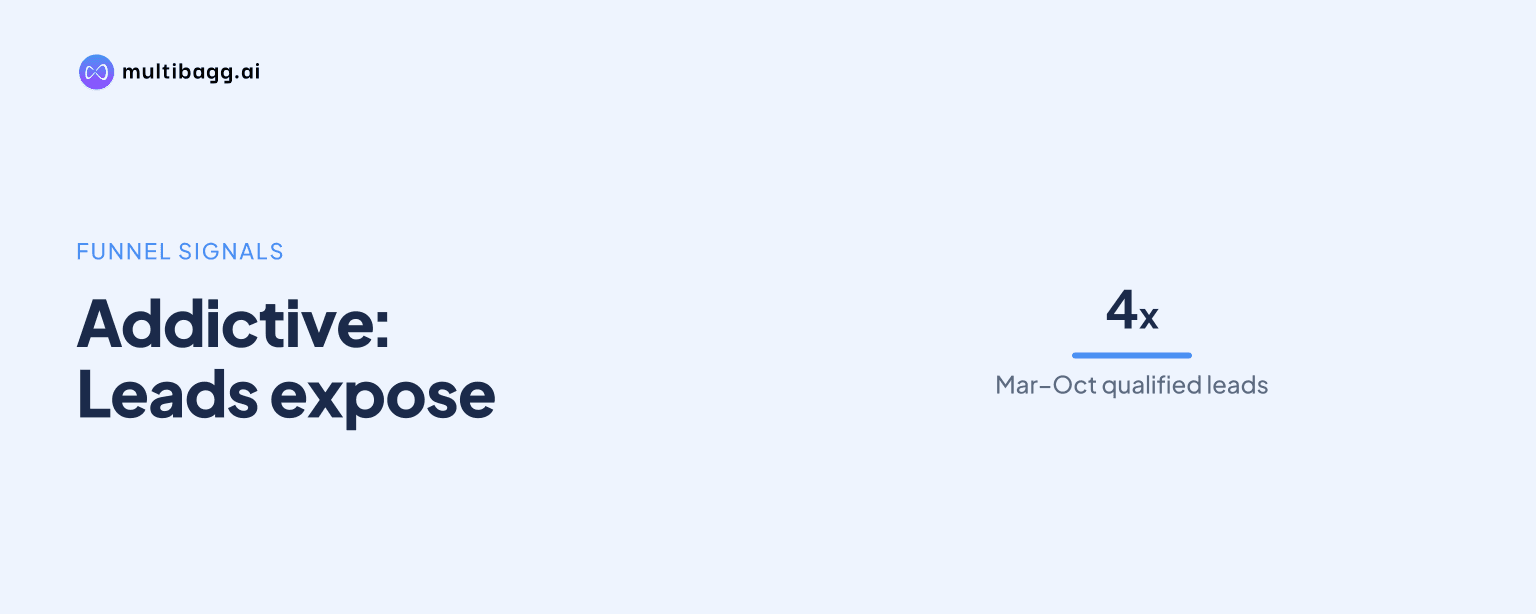
During the quarterly investor call, Addictive Learning said qualified paid registrations increased 4x, but course enrolments did not rise proportionately because its bootcamp warm-up, delivery and sales systems could not handle the larger lead flow. Management said rebuilding these middle-funnel systems is now the principal execution task.
Know Addictive Learning Technology inside out
Results, valuation, peers and who's buying, in one view.
Why did Addictive Learning’s qualified paid leads rise 4x?
Addictive Learning said qualified paid registrations grew 4x after it rebuilt its Meta advertising engine with artificial intelligence, or AI, while Meta spending was 45% lower. Management described this as a major change in customer-acquisition economics: paid registrations per month increased and cost per paid registration fell between March and October, although it did not disclose the underlying absolute volumes or spend.
The company attributed the improvement to high-volume AI-generated creative and internal advertising tools. In November, it said 2,418 ads were running, compared with ads made by humans in January. A video ad produced a sign-up at Rs 61 versus Rs 174 for an image ad, according to management, and video accounted for half of November sign-ups after contributing almost none in July.
Addictive Learning also said its AdHook machine-learning model assesses whether an ad opening is likely to retain viewers before money is spent. Its Ad-Maestro tool flags campaigns that data suggests may become expensive and calls for replacement creative. Management said these systems reduced human decision errors on Meta, but that Google Ads had not yet reached the same degree of automation.
Why have more leads not produced matching course enrolments?
Addictive Learning said more qualified paid registrations have not produced 4x course enrolment because the funnel broke after lead acquisition. Management distinguished a paid registration, such as a Rs 10 bootcamp or community registration, from a course enrolment. It said registrations are qualified leads rather than completed course sales, and that the higher lead volume exposed capacity constraints that were less visible before the advertising improvement.
The first constraint is bootcamp attendance and conversion. Management illustrated the issue with 10,000 bootcamp sign-ups: whether 10%, 15%, 20% or 30% attend a live session materially changes the ultimate outcome. The company said it must improve how many registrants appear for the session, how many subsequently buy a programme, and how much of those bookings it recovers as cash.
The second constraint is the sales organisation. Addictive Learning said a caller who can manage 200 leads a month will not necessarily sell more if assigned 400 leads; management said conversion can instead “crash.” Per-head sales has increased, it said, but hiring, training and deploying sales staff has not expanded proportionately with leads. This explains why management rejected the suggestion that its sales team had been fully solved.
Where is Addictive Learning’s bootcamp funnel failing?
Addictive Learning said the principal leak is the warm-up stage between bootcamp registration and live-session attendance. Management said the top of the funnel now works far better because advertising generates more registrations, but the middle of the funnel is weaker because audiences coming from different categories need personalised communication and preparation before a bootcamp.
The company said it attempted to run more bootcamps, but increasing their number did not increase results in a linear way. Management said the outcome was worse rather than “2 plus 2” equalling four, prompting it to scale back. Demand was present, it said, but the company was not ready to fulfil it consistently because the delivery and warm-up systems needed redesign before further scaling.
Bookings illustrate the variability management is seeking to remove. It said bootcamp bookings reached Rs 6 crore in some months but fell to Rs 4 crore in others, rather than progressing steadily from Rs 6 crore to Rs 8 crore and then Rs 10 crore. Management linked those reversals to systems failing under higher lead volumes, rather than to a stated shortage of demand.
Got a follow-up? Ask IRIS
How is Addictive Learning trying to repair lead conversion?
Addictive Learning is building personalised, AI-driven warm-up sequences and apps, beginning with its independent-director category. Management said these applications are intended to give registrants a tailored learning experience before conversion, but it explicitly said the work is not finished and that it cannot yet claim results from the approach.
The company is also redesigning delivery systems around an AI-first operating model. Management said some redesigns should land in the current quarter, while other work may be needed in the following quarter. It identified the warm-up engine and delivery team as items investors should monitor, alongside whether its Meta advertising gains can be replicated in Google Ads and later on LinkedIn, Reddit and other platforms.
Sales capacity is being reorganised as well. Addictive Learning said it is moving more sales employees into its offices, where management said it has observed better outcomes than under remote work. The transition has created a temporary setback because a limited number of leaders are simultaneously managing the move and sales operations, but management said in-office teams have shown improvement.
What do the bottlenecks mean for Addictive Learning’s revenue and cash plans?
Addictive Learning said the bottlenecks limit revenue visibility because course launches alone do not determine sales. Management said visibility also depends on having enough counsellors, running effective bootcamps, getting registrants to attend, and converting those attendees. It therefore declined to provide net-cash guidance for the next quarter, saying performance was not progressing as well as in the previous quarter.
The company nevertheless reported progress in its Communities business, which management said crossed Rs 1 crore in monthly revenue and was nearing Rs 2 crore in monthly bookings. Average quarterly bookings were Rs 1.72 crore, while cash recovery was about Rs 1 crore. Management said sign-ups had grown and their cost had fallen, but identified further room to improve collections and conversion.
Management said net cash is its current “North Star” and that investment decisions will depend on cash generation. It said the previously mentioned approximately Rs 2 crore monthly net-cash run rate had not arrived evenly, with some months performing well and others poorly. Management’s stated goal is a cash balance of Rs 20 crore to Rs 24 crore, but it provided no date or formal forecast.
Conclusion
Addictive Learning’s advertising improvement has lowered Meta-led acquisition costs and expanded qualified paid registrations by 4x, but the commercial benefit is constrained by attendance, warm-up, delivery and sales capacity. The contrast between cheaper lead generation and unstable Rs 4 crore to Rs 6 crore monthly bootcamp bookings shows that the immediate issue is execution after a prospect registers, not simply generating more traffic.
The next indicators are whether personalised warm-up systems and redesigned bootcamp delivery begin improving attendance and conversion, and whether the expanded in-office sales model scales without another capacity constraint. Management also plans to automate Google Ads in the current quarter and has postponed its proposed US university project to March 2027 while it fixes funnels, opportunity platforms and data-sales initiatives.

