








Addictive Learning paid registrations rise 4x as Meta spend falls
MAX Plan at ₹4,999/yr

Find your next multibaggerBe a Pro Investor
Research stocks and track your picks on the go. Download the app.
Key highlights
- Addictive Learning said paid registrations rose 4x while Meta advertising spend fell 45% from March to October.
- AI-generated video ads cost Rs 61 per sign-up versus Rs 174 for image ads, according to Addictive Learning.
- Video ads generated half of November sign-ups after contributing almost none in July.
- Addictive Learning said communities crossed Rs 1 crore in monthly revenue and averaged Rs 1.72 crore in quarterly bookings.
powered by IRIS
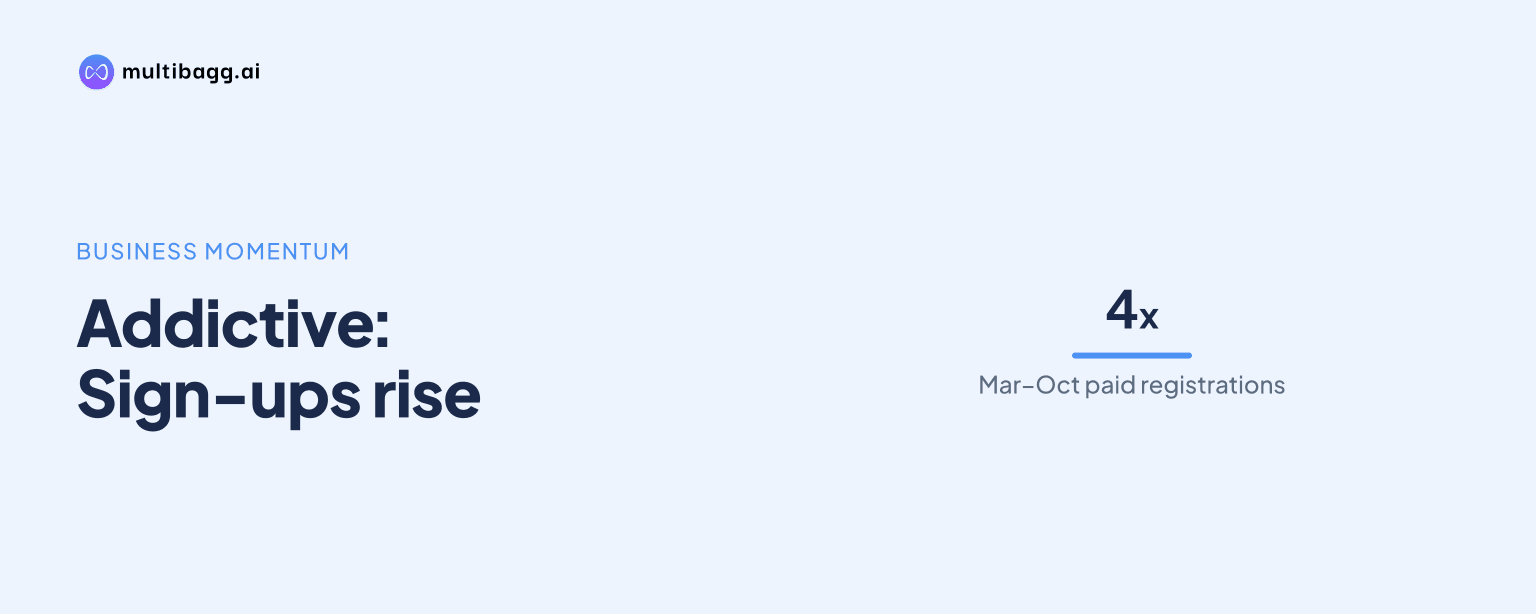
Addictive Learning said paid registrations rose 4x while Meta advertising spend fell 45% from March to October, following an artificial-intelligence rebuild of its ad engine. Management said the change lowered funnel costs, helped revenue grow 21% year on year in the latest quarter, and increased the volume of ads running to more than 2,000 in November.
Know Addictive Learning Technology inside out
Results, valuation, peers and who's buying, in one view.
How did Addictive Learning improve Meta customer-acquisition efficiency?
Addictive Learning said it delivered 4x growth in paid registrations on 45% less Meta spend between March and October. Management defined paid registrations as qualified paid leads in funnels, including community registrations and Rs 10 bootcamp registrations, rather than completed course enrolments. That distinction is material because management said course enrolment did not increase fourfold.
The result followed an earlier disruption in which management said the ad engine had broken and cost per lead had reached as much as Rs 1,250. Addictive Learning said it rebuilt funnels in the first quarter with internal AI models, tools and workflows, then scaled ad production in the second quarter. Management attributed most of the latest-quarter margin improvement to advertising-system gains and AI-driven automation.
Management said costs declined across Meta funnels, including free bootcamp sign-ups and the Rs 10 entry-level funnel. It did not disclose complete cost series for each funnel, but said cost per sign-up and cost per paid registration had both fallen. This contrasts with the earlier period when higher lead costs had made some bootcamps and communities unviable, according to management.
What AI tools does Addictive Learning use for Meta ads?
Addictive Learning said AdHook and Ad-Maestro were central to its Meta advertising changes. AdHook is an internal machine-learning decision model, not a large language model, that assesses whether the opening of a video advertisement is likely to retain viewers before money is spent on it. Management said the tool reduced errors in selecting ad creative.
Ad-Maestro monitors running campaigns and flags ads expected to become expensive, according to management. The system directs the team to develop replacement creative before costs rise further. Addictive Learning did not disclose either tool’s prediction accuracy or the separate savings attributable to AdHook and Ad-Maestro.
The company said creative production expanded from human-made ads in January to more than 2,000 running ads in November, including AI-generated videos and static ads. It said it no longer required a dedicated team to shoot advertisements, although employees continue to work with the AI tools. This production scale was presented as a mechanism for testing and replacing more ads.
Addictive Learning gave one direct comparison of ad formats: image ads cost Rs 174 per sign-up, while AI-generated video ads cost Rs 61 per sign-up. Video generated half of November sign-ups after contributing almost none in July. The comparison links the lower acquisition cost to both campaign monitoring and a shift toward video creative.
Did Addictive Learning’s fourfold lead growth lift course enrolment?
No. Addictive Learning said the 4x increase in paid registrations did not translate into 4x course enrolment. Management said course purchases, attendance, sales capacity and collections depend on later funnel stages, while paid registrations represent qualified leads entering community and low-ticket bootcamp funnels.
Management said the middle funnel became a constraint after the top of the funnel expanded. It used an example of 10,000 bootcamp sign-ups and cited possible live-session attendance rates of 10%, 15%, 20% or 30%, without providing its actual rate. The company said it needs to improve warm-up processes between registration and attendance.
Sales capacity has also not risen in line with the volume of leads, according to management. It said a caller able to handle 200 leads a month may not sell more if assigned 400 leads, because the system can break down. Addictive Learning said sales per employee had increased, but recruitment, training and deployment still needed improvement while sales teams moved into offices.
The bootcamp business illustrates the operating volatility management described. Monthly bookings reached Rs 6 crore in some months but declined to Rs 4 crore in others, rather than rising steadily from Rs 6 crore to Rs 8 crore and Rs 10 crore. Management attributed this to systems failing to handle higher lead volumes, while saying demand was available.
Got a follow-up? Ask IRIS
What has changed in Addictive Learning’s communities business?
Addictive Learning said its communities business crossed Rs 1 crore in monthly revenue and was approaching Rs 2 crore in monthly bookings. Average quarterly bookings were Rs 1.72 crore, while recovery was around Rs 1 crore. The difference means the reported booking amount is not equivalent to revenue or cash collection.
Management said communities had grown sequentially month on month, whereas bootcamp bookings had fluctuated between Rs 4 crore and Rs 6 crore in different months. It linked communities to an expert network of about 1.7 lakh qualified professionals, for whom the company tracks data including learned skills, assignments, assessments, class participation, work samples and career goals.
Addictive Learning also described its work with experienced women returning to employment after marriage, childbirth or relocation. It said these participants may take freelance assignments or grow businesses and may also join the expert network. Management did not disclose a participant count, revenue contribution or conversion rate for this programme.
Management said total revenue rose 21% year on year in the latest quarter, while profit after tax and earnings before interest, tax, depreciation and amortisation, or EBITDA, also increased. The transcript did not provide absolute revenue, profit or EBITDA figures. Management cited lower advertising costs, AI-led automation and delivery-cost improvements as contributors to the reported financial change.
Can Addictive Learning extend its Meta result to Google Ads?
Addictive Learning said it has not yet reached on Google Ads the automation level it reported on Meta. Management said it aims to do so in the current quarter, which is a plan rather than a completed result. It named LinkedIn, Reddit and other channels as possible later expansion areas after Google.
Management said the company had avoided the seasonal advertising-cost spike recorded in the prior year, when community and paid-funnel costs rose 98% during October, November and December. This time, it said costs changed little and declined in some categories. Management attributed the difference to better ads, more creative volume and a better understanding of Meta’s algorithms.
The company is developing personalised warm-up sequences and an AI-driven learning app, beginning with the independent-director category. It is also redesigning delivery systems after finding that simply increasing the number of bootcamps did not produce proportionate output. Management said parts of the redesign would land in the current quarter, with some work possibly continuing into the next quarter.
Addictive Learning said it had 45 technology projects under way from July to November, without disclosing project-level budgets or completion dates. It has also postponed its planned US university project to March 2027. Management said it wants to first fix bootcamp funnels, opportunity platforms and expert-data opportunities before progressing with that project.
Conclusion
Addictive Learning’s disclosure indicates that its top-of-funnel acquisition economics changed materially between March and October: paid registrations rose 4x as Meta spend fell 45%. The Rs 61 video-ad cost per sign-up, versus Rs 174 for image ads, provides the clearest disclosed comparison supporting management’s view that AI-generated creative and campaign monitoring improved performance.
The next measure is whether the larger lead base converts into enrolment, collections and net cash. Management identified warm-up, delivery, sales deployment and Google Ads automation as current priorities, and said its US university project is postponed to March 2027 while those operational issues are addressed.

