








Addictive Learning Repositions for Mid-Career AI Training
MAX Plan at ₹4,999/yr

Find your next multibaggerBe a Pro Investor
Research stocks and track your picks on the go. Download the app.
Key highlights
- Addictive Learning says 70% of its learners are over 30, based on internal learner data.
- Addictive Learning developed 6 IIT Roorkee Innovation Hub programmes in the preceding 6 months.
- Addictive Learning added 15 new courses and upgraded 22 courses in Q2 FY27.
- Addictive Learning built 14 AI applications into courses in Q2 FY27.
powered by IRIS
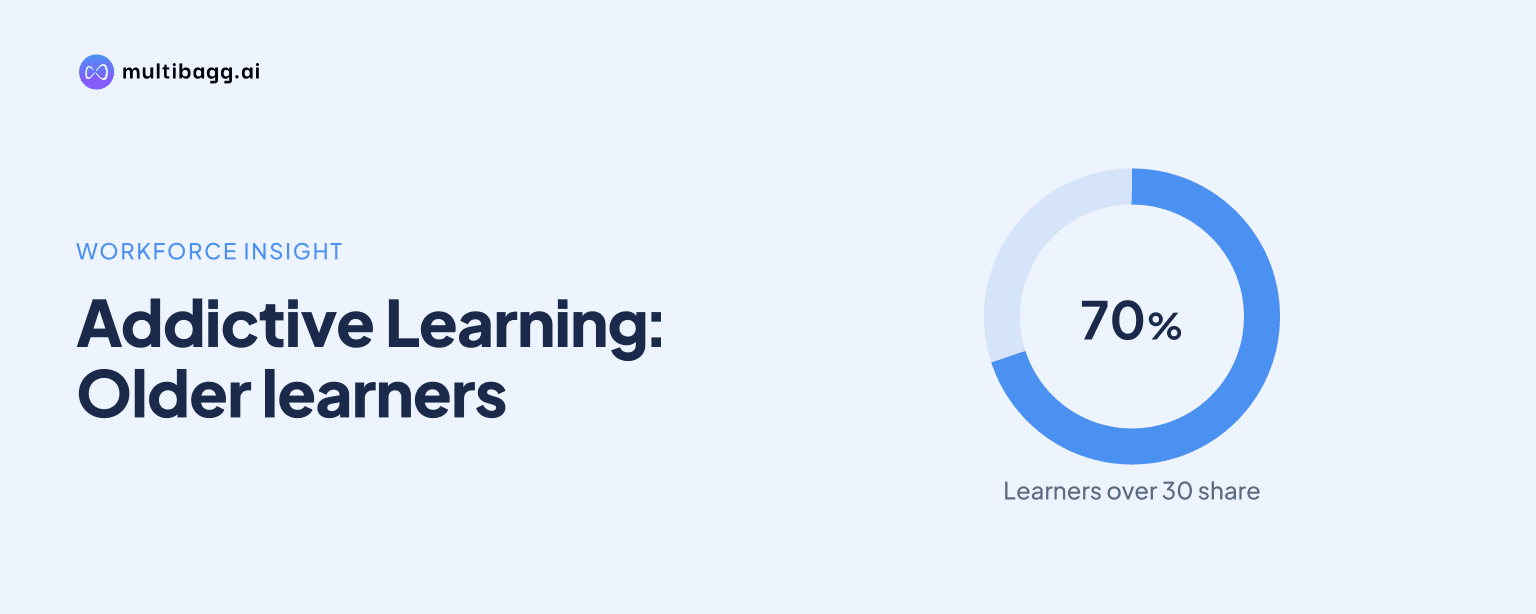
On 23 November 2026, Addictive Learning Technology Limited said 70% of its learners were over 30 as it repositioned from practical legal skills for younger entrants to artificial intelligence (AI) training for working professionals across law, finance, accounting, compliance and human resources, supported by six IIT Roorkee Innovation Hub programmes developed in six months.
Know Addictive Learning Technology inside out
Results, valuation, peers and who's buying, in one view.
What is driving Addictive Learning’s move to mid-career AI training?
Addictive Learning is targeting mid-career professionals because it expects AI to alter routine work in the professional fields it serves. The presentation cites a 2025 ServiceNow and Pearson estimate that 10.35 million roles in India could be redefined by agentic AI by 2030. It also cites an October 2025 National Institution for Transforming India report that estimated more than 60% of formal-sector jobs could be susceptible to automation by 2030.
The company’s current learner base aligns with that focus: internal data show 70% of learners are over 30. Addictive Learning says its earlier audience was law graduates and early-career professionals seeking a first job or practice, whereas its current audience is mid-career workers using AI workflows in an existing job, business or practice. The presentation also cites an August 2026 World Bank view that white-collar and entry-level workers are likely to be affected first.
The proposed change is therefore both a customer and product shift. Addictive Learning says learners are moving from practical skills for a first legal role to ongoing reskilling as AI changes professional work. Its target segments now include lawyers, finance professionals, accountants, compliance staff, human-resources professionals and content workers, rather than law alone.
How has Addictive Learning changed its course offering?
Addictive Learning has expanded its curriculum from legal practical-skills training to profession-specific AI education across several white-collar categories. In Q2 FY27, it reported 15 new courses and 22 upgraded courses, alongside six new programmes developed with the IIT Roorkee Innovation Hub, formally iHUB DivyaSampark, during the preceding six months.
The six IIT Roorkee Innovation Hub programmes cover corporate governance, environmental, social and governance (ESG) matters and AI safety; research automation and policy analysis; financial and accounting automation; low-latency systems for high-frequency trading; data protection, privacy engineering and AI governance; and AI-driven growth marketing and automation. This range extends the company’s content beyond law into finance, accounting, governance and marketing.
Addictive Learning also listed selected 2026 programmes aligned with the National Skill Development Corporation (NSDC). They include AI-powered US and UK corporate-law paralegal practice, AI-powered remote accounting automation and automating human resources with AI. The company says selected programmes are NSDC co-certified and moving toward third-party assessment, although the presentation does not specify how many courses are covered.
Got a follow-up? Ask IRIS
What AI tools are included in Addictive Learning’s training model?
Addictive Learning is pairing AI instruction with tools intended for use in professionals’ daily work. It reported building 14 AI applications into courses in Q2 FY27, tested across law, human resources, accounting and content. The stated uses include research, client offers, outreach and work delivery.
As of 23 November 2026, CaseDraft, ClientLens and InterviewPilot were live. CaseDraft drafts articles on new US judgments for Indian lawyers seeking credibility with US firms; ClientLens converts 45 minutes of client research into a one-click meeting brief; and InterviewPilot generates interview questions and model answers for human-resources professionals.
Offerly and Student Opportunities were in testing on 23 November 2026, while Veylo was in development. Offerly creates three service offers and a first outreach email, and Student Opportunities is a job board using AI to match profiles with roles. Addictive Learning says learners use their own AI keys, often free keys, which keeps learner cost near zero; management says premium tool versions could be charged for later but gives no timing or price.
How do the five business layers connect learning with earnings?
Addictive Learning says its five-layer model links training with tools, work opportunities and AI-data assignments. The first two layers teach AI workflows and provide AI tools; the third uses AI in acquisition, support, evaluation and sales; the fourth connects trained professionals with work; and the fifth involves expert data creation and reinforcement-learning work for AI laboratories and large technology companies.
The mechanism described is that learners pay for training, Addictive Learning observes what they can do, and the best performers become potential supply for its marketplaces and AI-data work. The company identifies law, finance, accounting, compliance and human resources as the initial professional categories for this model. The presentation does not disclose revenue generated by the work-platform or expert-data layers.
The work layer includes BoardReady, where 4,786 verified alumni profiles were being prepared and 1,273 were searchable as of 23 November 2026. Addictive Learning said the first BoardReady pilot was starting, while Offshore Accountant, intended to help US firms hire trained Indian accountants, remained in development. These figures show that the marketplace element was at an early operating stage rather than fully deployed across every category.
Conclusion
Addictive Learning’s repositioning is centred on an existing learner base in which 70% are over 30 and on a broader course catalogue spanning finance, accounting, compliance and human resources alongside law. The company has supported that shift with six IIT Roorkee Innovation Hub programmes in six months, 15 new courses and 22 upgraded courses in Q2 FY27, plus 14 AI applications embedded in courses.
The next disclosed milestones are contracts expected in the coming weeks for two additional IIT in-principle agreements. Progress from testing to deployment for Offerly and Student Opportunities, movement of Veylo beyond development, and any future launch of premium tool versions are also matters management has identified but has not yet given dates or prices for.

