








Addictive Learning Cut Meta Spend 45% as Paid Registrations Rose
MAX Plan at ₹4,999/yr

Find your next multibaggerBe a Pro Investor
Research stocks and track your picks on the go. Download the app.
Key highlights
- Addictive Learning’s monthly paid registrations increased from 7,260 in March 2026 to 31,753 in October 2026.
- Addictive Learning’s Meta spend fell 45%, from Rs 1.76 crore in March 2026 to Rs 0.98 crore in October 2026.
- Addictive Learning reported an October 2026 cost of Rs 262 per paid registration, down 81% from Rs 1,357 in March.
- Addictive Learning reported a November sign-up cost of Rs 61 for video ads versus Rs 174 for image ads.
powered by IRIS
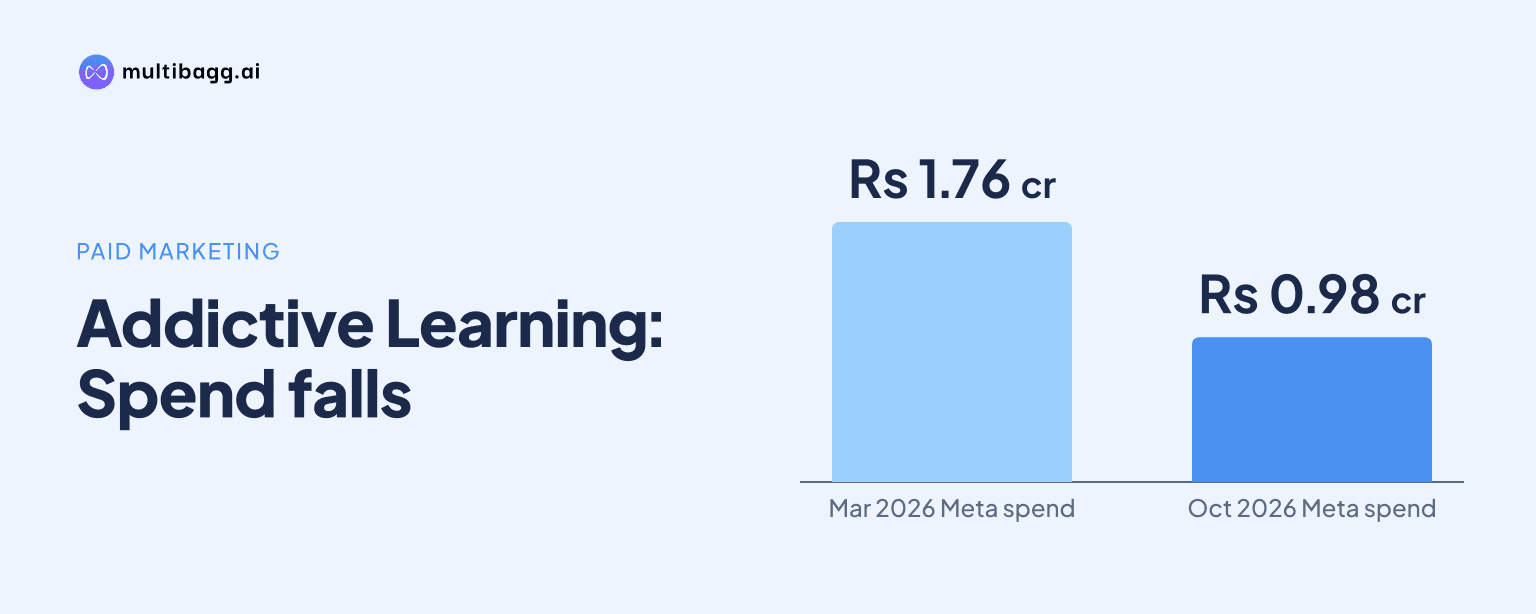
Addictive Learning cut monthly Meta advertising spend 45% to Rs 0.98 crore in October 2026 from Rs 1.76 crore in March, while paid registrations rose 4.4 times to 31,753. The company links the change to rebuilt entry funnels, automated launches and a larger volume of AI-produced video ads.
Know Addictive Learning Technology inside out
Results, valuation, peers and who's buying, in one view.
How did Addictive Learning’s paid-registration economics change?
Addictive Learning reduced blended cost per paid registration by 81%, to Rs 262 in October 2026 from Rs 1,357 in March 2026, while monthly paid registrations increased from 7,260 to 31,753. The metric covers registrations through both the Rs 10 entry funnel and the Rs 100–200 community funnels, rather than recognised revenue.
The increase came as monthly Meta spend declined by Rs 0.78 crore, from Rs 1.76 crore in March to Rs 0.98 crore in October. Addictive Learning said the blended result partly reflected a growing contribution from the Rs 10 funnel, which it tested in early 2026 and scaled from June. The company separately reported a Rs 560 cost for a Rs 100–200 community sign-up in October.
Free bootcamp sign-ups reached about 37,000 to 40,000 a month after July 2026, roughly twice the volume Addictive Learning cited before then. The company reported a Rs 37 free-sign-up cost in October, down from Rs 206 in October 2025, while the Rs 10 funnel generated about 26,000 registrations a month at about Rs 200 each.
What did Addictive Learning rebuild in its acquisition funnel?
Addictive Learning says it rebuilt acquisition in two stages during 2026: new paid-entry funnels and automatic funnel-launch software in Q1, followed by scaled AI advertising and AI video ads in Q2. The work followed higher Meta lead costs in late 2025, when the cost of a Rs 100–200 community sign-up rose from about Rs 1,000 to Rs 1,250 and peaked above Rs 2,000.
The Rs 10 entry funnel changed the product mix within the paid-registration measure. Its registration cost was Rs 196 in October 2026, compared with Rs 386 in October 2025, while the existing community sign-up cost was Rs 560 in October, versus Rs 1,323 in March. Addictive Learning cautioned that registrations are paid entry-funnel sign-ups, not revenue.
The company linked these operating changes to its Q2 FY27 results for July to September 2026. Consolidated revenue was Rs 25.3 crore, up 21% year on year, and profit after tax was Rs 2.29 crore, about seven times Q1. Meta spend per quarter fell 31%, from Rs 4.5 crore in Q4 FY26 to Rs 3.1 crore in Q2 FY27, while Meta spend as a share of revenue declined from 31% to 12%.
Got a follow-up? Ask IRIS
How much did AI video advertising contribute to Addictive Learning’s result?
Addictive Learning reported a Rs 61 cost per sign-up for video ads in November 2026, compared with Rs 174 for image ads. Video ads supplied half of November sign-ups, up from almost none in July, based on creative data across the company’s 13 active Meta accounts through 21 November 2026.
The volume of ads rose sharply as the company expanded testing. Ads running each month increased from 486 in June 2026 to 1,638 in October and 2,048 in November, more than four times the June level. Addictive Learning’s explanation is that a greater number of ads lets Meta identify lower-cost audiences for creative material that receives engagement.
AdHook, Addictive Learning’s machine-learning model, was trained on 6,037 ads to predict whether a video opening would retain viewers. The company said its top selections were correct 67% of the time, compared with 48% by chance. It also said Ad Maestro and Ad Monitor flagged expensive campaigns with 88% accuracy across 1,073 historical campaigns and were being rolled out.
Did festive-season competition raise Addictive Learning’s advertising costs?
Addictive Learning reported that Rs 100–200 community sign-up cost increased from Rs 438 in September 2026 to Rs 560 in October, a 28% rise. In the prior year, the comparable cost moved from Rs 1,016 in September 2025 to Rs 2,016 in October, and Addictive Learning said it remained 70% higher in November 2025.
The free bootcamp funnel showed a different pattern: its sign-up cost fell from Rs 48 in September 2026 to Rs 36 in November. Both paid funnels together rose 12% from September to October. November was a partial paid-funnel period, with the community cost at Rs 586 and the Rs 10 registration cost at Rs 198, so Addictive Learning used October for its complete comparison.
Addictive Learning attributed the comparatively smaller 2026 festive increase to better ads and more ads in market. The presentation does not isolate the effect of video creative from the effects of funnel pricing, audience selection or the changing mix of registrations. The Meta account figures include 18% goods and services tax.
What automation tools is Addictive Learning using beyond ad creation?
Addictive Learning uses Kit Importer to turn an ad kit into live funnels, links and tracking automatically. The company reported 2,997 funnels launched since August 2026, with 19,925 of October’s 38,773 funnel sign-ups coming through those launches. It estimated that the system saves about 1,070 hours a month.
Addictive Learning said it has not yet reached the same level of automation on Google as on Meta. Management is building Google campaign automation and expects similar results could widen the pool of low-cost leads, although it gave no timetable or quantified target. On annual Meta spend of about Rs 9 crore, the company estimated that every 1% saving would equal about Rs 9 lakh.
Conclusion
Addictive Learning’s presentation shows acquisition economics improving alongside lower Meta spending: monthly paid registrations rose 4.4 times between March and October 2026, while spend fell 45% and blended paid-registration cost fell 81%. Its Q2 FY27 revenue of Rs 25.3 crore, up 21% year on year, coincided with Meta’s share of revenue falling to 12% from 31%, although registrations themselves are not revenue.
The next point to watch is whether community sign-up costs remain near the October level of Rs 560 after the partial-November reading of Rs 586. Management is also rolling out Ad Maestro and Ad Monitor and building Google campaign automation, but the presentation does not disclose a launch date or performance target for the Google initiative.

