










Advance Agrolife Q2 EBITDA falls as COGS outpace sales
Key highlights
- Advance Agrolife's Q2 FY27 total income rose 35% to Rs 287.48 crore.
- Advance Agrolife's Q2 FY27 COGS increased 47% to Rs 240.37 crore.
- Advance Agrolife's Q2 FY27 EBITDA margin fell to 7.6% from 12.1% a year earlier.
- Advance Agrolife targets a 20% export revenue share by FY29, versus 2% currently.
powered by IRIS
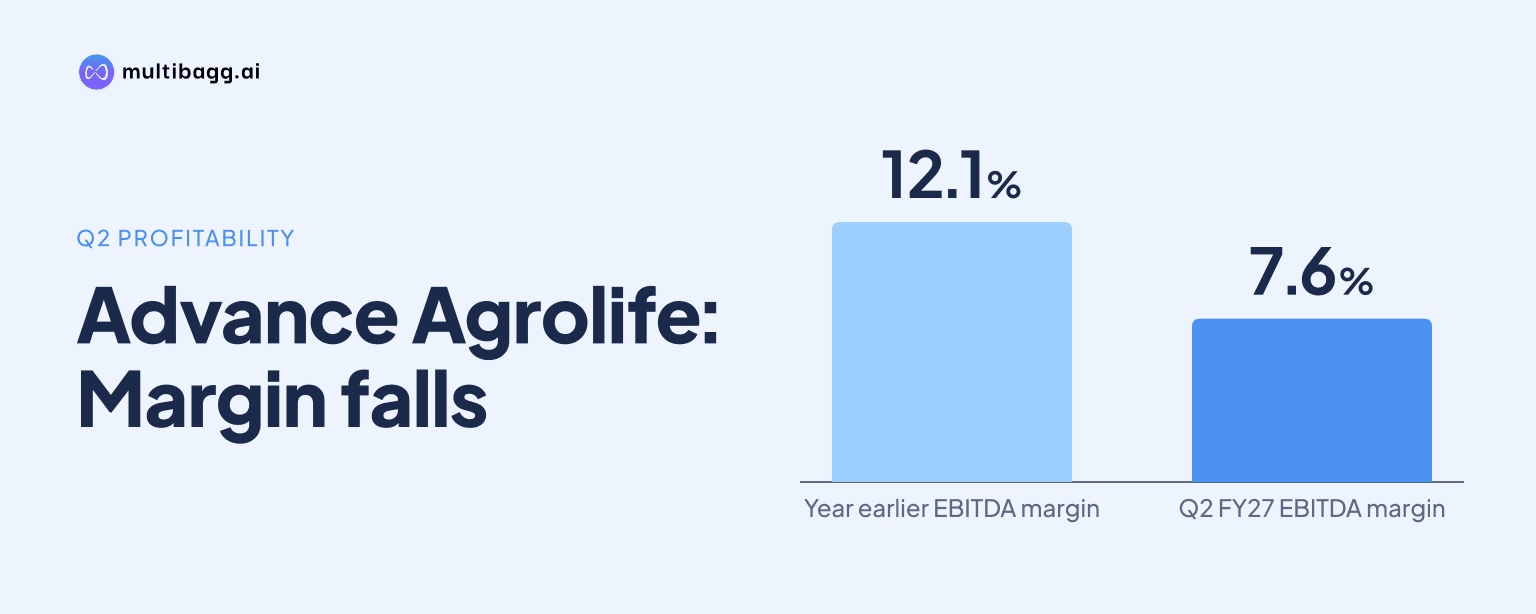
Advance Agrolife Limited reported Q2 FY27 total income of Rs 287.48 crore, up 35% year on year, but EBITDA fell 15% to Rs 21.83 crore as cost of goods sold rose 47% to Rs 240.37 crore and EBITDA margin declined to 7.6% from 12.1%.
Know Advance Agrolife inside out
Results, valuation, peers and who's buying, in one view.
Why did Advance Agrolife's Q2 FY27 profit decline despite revenue growth?
Advance Agrolife's Q2 FY27 profit declined because cost of goods sold, or COGS, rose faster than income. Revenue from operations increased 35% year on year to Rs 287.15 crore, while total income, including Rs 33 lakh of other income, reached Rs 287.48 crore. COGS rose 47% to Rs 240.37 crore from Rs 163.33 crore in Q2 FY26, outpacing total-income growth by 12 percentage points.
The cost increase was reflected in earnings before interest, tax, depreciation and amortisation, or EBITDA. EBITDA declined from Rs 25.78 crore in Q2 FY26 to Rs 21.83 crore in Q2 FY27. Profit before tax fell 25% to Rs 15.97 crore, while profit after tax, or PAT, declined 26% to Rs 11.79 crore. Earnings per share, or EPS, was Rs 1.84, down 48% from Rs 3.53.
The cost pattern was not the same across all expense lines in Q2 FY27. Manufacturing and operating expenses declined 5% year on year to Rs 12.05 crore, while employee benefits expense rose 34% to Rs 4.70 crore and other expenses increased 13% to Rs 8.20 crore. Those movements did not offset the Rs 77.04 crore increase in COGS from Q2 FY26.
How much did Advance Agrolife's EBITDA margin contract in Q2 FY27?
Advance Agrolife's EBITDA margin contracted by 4.5 percentage points to 7.6% in Q2 FY27 from 12.1% in Q2 FY26. Total income rose by Rs 74.62 crore over the year-earlier quarter, yet EBITDA declined by Rs 3.95 crore. The Q2 FY27 margin was also below the 10.6% reported in Q1 FY27.
The sequential figures show lower revenue as well as lower operating profit in Q2 FY27. Revenue from operations declined 13% from Rs 330.40 crore in Q1 FY27 to Rs 287.15 crore in Q2 FY27. EBITDA fell 38% from Rs 35.07 crore, and PAT dropped 48% from Rs 22.55 crore. COGS fell 10% sequentially to Rs 240.37 crore, a smaller decline than the 13% reduction in operating revenue.
Finance costs added to the movement below EBITDA. Q2 FY27 finance costs were Rs 3.03 crore, 41% above Rs 2.16 crore in Q2 FY26 and 49% above Rs 2.03 crore in Q1 FY27. Depreciation and amortisation rose 19% year on year to Rs 3.16 crore, resulting in earnings before interest and tax of Rs 19.01 crore, down 19% from Rs 23.35 crore.
Got a follow-up? Ask IRIS
What does the first-half FY27 result show for Advance Agrolife?
Advance Agrolife's H1 FY27 result shows income and profit growth over H1 FY26 despite the weaker Q2 performance. Revenue from operations increased 62% to Rs 617.56 crore, and total income rose 62% to Rs 618.11 crore. EBITDA increased 33% to Rs 56.90 crore and PAT rose 38% to Rs 34.34 crore.
Profitability on the larger first-half revenue base was lower than a year earlier. EBITDA margin was 9.2% in H1 FY27, compared with 11.3% in H1 FY26, a decline of 2.1 percentage points. COGS increased 71% to Rs 506.18 crore, faster than the 62% increase in total income, while manufacturing and operating expenses rose 19% to Rs 27.32 crore.
EPS did not increase alongside H1 FY27 PAT. Advance Agrolife reported H1 FY27 EPS of Rs 5.34, down 3% from Rs 5.51 in H1 FY26, although PAT rose from Rs 24.81 crore to Rs 34.34 crore. The presentation provides the profit and EPS figures but does not explain why EPS declined while PAT increased.
The H1 FY27 result was also close to the company’s full-year FY26 revenue base. Revenue from operations of Rs 617.56 crore in H1 FY27 was below FY26 sales of Rs 637.78 crore, while H1 FY27 EBITDA of Rs 56.90 crore was below FY26 EBITDA of Rs 63.69 crore. Historical EBITDA margin was 10% in FY26, compared with 9.2% in H1 FY27.
What is Advance Agrolife planning after the Q2 margin decline?
Advance Agrolife says the Gidhani plant is expected to be commissioned by the end of Q4 and to strengthen manufacturing capability, production capacity and product diversification. The presentation does not disclose the plant’s capital expenditure, capacity or an exact commissioning date within Q4. Management identifies manufacturing infrastructure as one of its strategic priorities.
The company also reported a wider pan-India distribution footprint and a deeper business-to-business presence during the period. Advance Agrolife entered Libya, Myanmar, Oman, Saudi Arabia, Somalia, Tanzania and Afghanistan as newer export geographies. It reported more than 500 product registrations, which management says support business continuity, market access and product diversification.
Management identifies backward integration as the mechanism intended to support margin expansion. Advance Agrolife says shifting from purchasing technical products to manufacturing them in-house would retain margins otherwise paid to suppliers and create operating leverage as utilisation improves. The presentation also outlines a fourfold scale-up in 2,4-D herbicides and targets export revenue share of 20% by FY29, from 2% currently.
Conclusion
Advance Agrolife’s Q2 FY27 figures show that revenue growth did not translate into higher operating profit as COGS grew faster than income. The quarterly margin contraction was also visible in the first half: H1 FY27 EBITDA rose 33% and PAT rose 38%, but EBITDA margin declined to 9.2% from 11.3% in H1 FY26.
The next disclosed operational milestone is the expected commissioning of the Gidhani plant by the end of Q4. The presentation also sets out management’s plans for backward integration, a fourfold 2,4-D herbicide scale-up and an increase in export revenue share from 2% to 20% by FY29; progress on these measures may provide context for future COGS and margin trends.